
Financial Wellness Apps for Women: 13 Tools That Support Your Life, Not Just Your Money
Last Updated April 2026
When we talk about financial wellness apps for women, it’s easy to assume we’re just talking about budgeting or tracking expenses. But if you’ve been here for a while, you already know—it goes so much deeper than that. The tools we use daily shape how we think, feel, and move through our lives. And the right apps don’t just help you manage money… they support your habits, your energy, your decisions, and ultimately, your relationship with wealth itself.
What’s The Deal With These Apps?
In a world overflowing with digital distractions, I’ve come to realize that what’s on your phone can deeply impact your health, happiness, and holistic wealth. Not just your social life or your productivity, but your mental clarity, financial stability, emotional regulation, and even your spiritual direction.
Over the years, I’ve experimented with countless apps, from budgeting tools to moon cycle trackers, and I can confidently say there are a handful I just couldn’t live without. These aren’t just about convenience. They’re about intentionality. They help me live in alignment with my values, energy, and goals—whether that means saving money, finding meaningful work, planning a healing trip, or simply syncing my cycle with the moon.
And something I’ve noticed—both in my own life and with clients—is that when you choose tools that actually support you, you create ease. You reduce decision fatigue. You stop overthinking every little move with your money or your time.
It’s similar to what I talk about in Conscious Spending: How to Spend Money Without Guilt — how your environment (digital or physical) quietly shapes your habits and, ultimately, your financial outcomes.
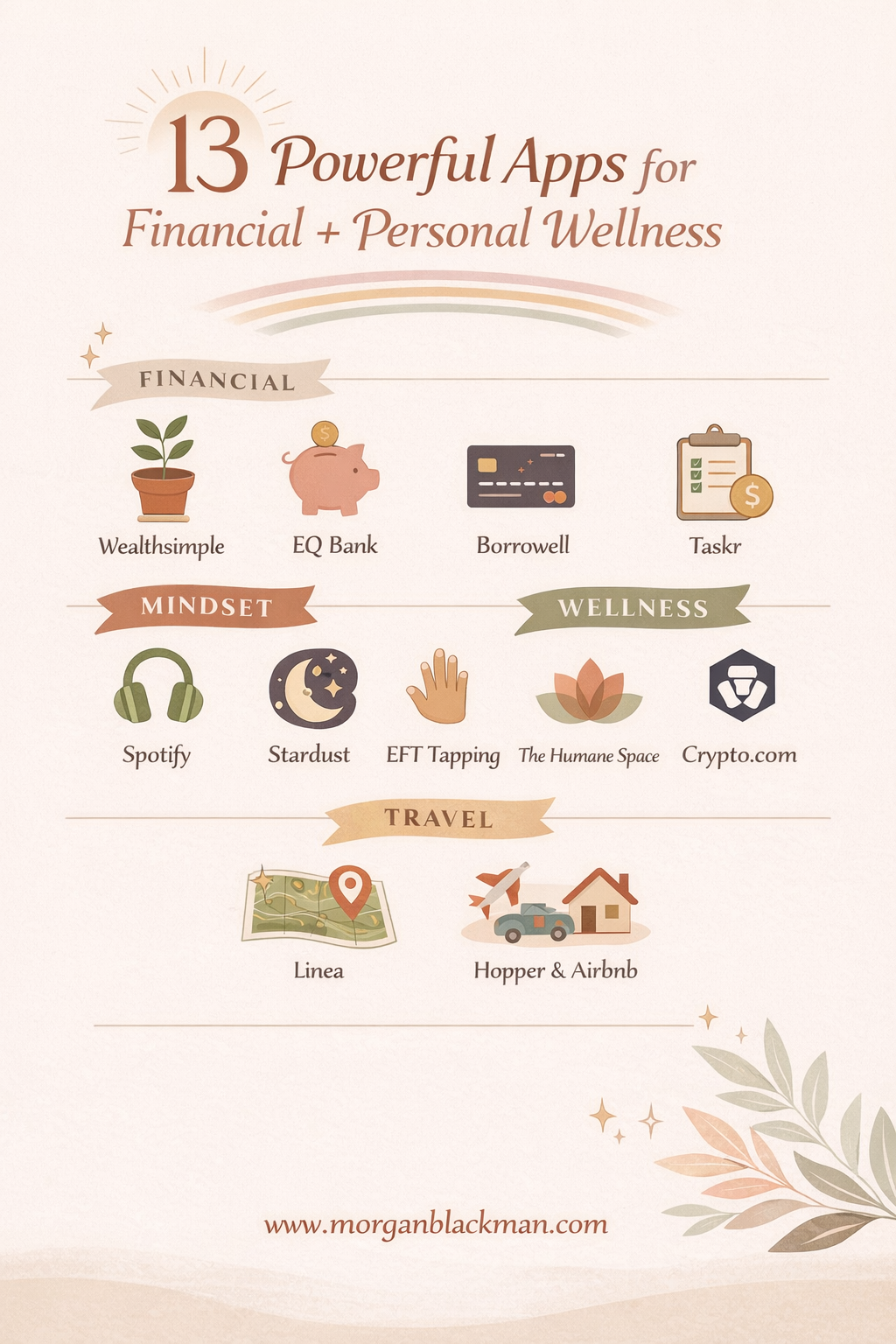
Here are the 13 essential financial wellness apps for women that have supported me through career pivots, financial glow-ups, emotional healing, and deep rest. Even if some of these aren’t available in your region, I encourage you to find apps that serve the same purpose.
1. Wealthsimple (Financial Literacy + Investing)
This is a must-have money management app for beginners and intermediate investors, especially if you're based in Canada. Wealthsimple has grown so much since I first started using it. Initially, it was just for investing in stocks—now it also supports crypto trading, has a built-in tax filing feature, and even offers managed portfolios for those who don't want to DIY.
If you’re not in Canada, look for an app that helps you:
Start investing simply
Offers educational resources or tutorials
Supports both self-directed and managed investing
And what I really appreciate about Wealthsimple is how it lowers the barrier to entry. Investing can feel intimidating—especially if you weren’t taught about it growing up—but tools like this make it feel approachable, almost like you’re learning as you go instead of needing to know everything upfront.
If you’ve been curious about getting started, join me and 3 million Canadians who trust Wealthsimple. Sign up now to get a $25 referral bonus, explore, and see how it feels.
Investing can feel intimidating—especially if you weren’t taught about it growing up—but tools like this make it feel approachable, almost like you’re learning as you go instead of needing to know everything upfront.
And if you’re still in that phase of figuring out where to even begin, I talk more about that transition in How to Improve Your Relationship With Money (Beginner Guide) — because that’s usually the real starting point.
2. EQ Bank (High-Interest Savings)
I use EQ Bank specifically to separate my savings from my everyday spending. This is crucial. Most traditional savings accounts offer next to nothing in interest (we're talking 0.05% or less), but EQ offers 2% to 4%, depending on market conditions. It also offers GICs (Guaranteed Investment Certificates), which are like investing in "safety mode."
It’s where I store sinking funds for taxes, travel, and emergencies—so that my money grows while I sleep.
And honestly, there’s something really calming about knowing your savings are not only safe, but quietly working for you in the background.
That separation alone can change your spending habits more than you think.
It’s something I’ve seen over and over again — when your money has a “place,” you naturally become more intentional with it, which I break down more deeply in Pay Yourself First: The Wealth Habit That Changes Everything.
Sign up today and earn a $20 referral bonus when you make the qualifying deposit, and add this wealth building app for saving money to your roster.

3. Borrowell (Credit Score Tracking)
I use Borrowell to track my credit score in real-time. It’s one of the best apps to improve financial habits, like checking your credit score. It's more for personal awareness than for official use (banks may pull from Equifax or TransUnion). But it helps me stay on top of changes, sends email alerts, and even includes a coaching feature that tells me how to improve my score based on my current profile.
They also offer blog posts and tips that support your financial literacy around credit and loans.
And I think that’s the biggest benefit here—awareness.
So many people avoid their credit score because it feels stressful or confusing. But when you can actually see what’s happening and understand it, you remove a lot of that fear.
And honestly, a lot of financial avoidance comes from that exact place — fear mixed with uncertainty — which I’ve unpacked more in How to Improve Your Relationship With Money (Beginner Guide).
Track your credit score here, and comment below if you’re feeling braggadocious about what it is.
4. Taskr (Side Hustle Finder)
When I needed flexible income, Taskr came through. It’s a freelance/gig platform for everything from pet walking and cleaning to admin work. I once worked as an administrative assistant through Taskr and brought in an extra $500/month for 2-3 months.
It’s a great option for:
Earning supplemental income
Offering niche skills like writing, organizing, and assembling furniture
Trying out different gigs during a career break
And sometimes, that extra income isn’t just about money—it’s about breathing room. It’s about feeling like you have options again.
I’ve talked about this before in How to Build Wealth: 7 Simple Strategies That Actually Work — because not all money is created equal, and how you earn matters just as much as how much you earn.
So if you’re looking for some extra side money now and then, give it a try, will ya?
5. Spotify (Education + Inspiration)
You probably know Spotify as a music app, but I see it as my audio university. I use it to:
Listen to audiobooks (saving tons of $$)
Catch up on wellness + financial podcasts
Create mood playlists that regulate my energy
It’s a one-stop shop for learning, grounding, and expansion.
And what you listen to daily matters more than we think. The conversations, ideas, and perspectives you’re exposed to slowly shape how you think—and that influences how you show up in your life and with your money.
Which is why I’m so intentional about what I consume — it’s the same principle behind what I share in Manifesting Money: How to Align Your Mindset With Wealth.
6. Airbnb (Travel with Cultural Intention)
I can’t live without Airbnb. Why? Because I travel to connect. I want to meet locals, eat real food, and live among the community. Hotels often isolate you from the culture of a place. But an Airbnb in a real neighborhood? That’s where you learn, heal, and grow.
That said, Airbnb’s prices have gone up lately. So I also recommend:
Hostels (budget-friendly and social)
Couchsurfing (for adventurous souls)
WWOOFing or work-trade stays (low-cost cultural immersion)
Travel, when done this way, becomes less about escaping your life and more about expanding it.
I also recently became a host on Airbnb! Actually, scratch that, I’m a SUPERhost. Yup. Big difference. And starting an Airbnb has already brought in between an extra $1,500 to $3,000 a month in gross income for me, just by deciding to renovate my parents’ basement and renting it out. It’s easily another form of revenue if you have any real estate assets sitting around…
And this is something I’ve been thinking about more lately — how wealth isn’t just about what you earn, but what you leverage, which I explore more in How to Invest in Yourself (The Most Powerful Wealth Strategy).
Airbnb has also widened its services to provide curated experiences and services for travellers in your local community, which you can also sign up for and make extra income if you are a service provider or just have a certain niche skill that travellers and locals alike would be willing to experience or engage with. Think a 3-course culinary experience in your backyard oasis, a private zen yoga session, or simply a walking tour of your edgy, beautiful, quaint or maybe diverse city.
7. Hopper (Flight Price Tracker)
I use Hopper to research flights and monitor prices over time. It lets you save your trip and sends alerts when prices drop or rise. I don’t always book through Hopper—my mom worked in travel and taught me to book directly through the airline for better refund and change policies—but it’s a powerful tool for planning.
Other alternatives: Skyscanner, Google Flights, Kayak.
It just takes away that constant second-guessing of “should I book now or wait?”—which honestly can be exhausting. It also doesn’t stop at searching for flights, but you can also shop around for accommodations and car travel, too. If interested, I’m giving you 7% off hotels with my special code.

8. Linea (Astrocartography Mapping)
This one is more spiritual. Linea lets you explore astrocartography—the study of how your birth chart maps onto the world. You can filter places for love, career, health, etc., and even check ideal timelines.
When I moved from Toronto to Calgary, I used Linea to confirm it was a great spot for grounding and new beginnings. It was. I felt at home instantly. I’m also sure I manifested my love when I decided to move back to Toronto last year because Venus, the planet of love, ease, and beauty, was presiding there.
And whether you fully believe in astrology or not, tools like this invite reflection—and sometimes that’s exactly what you need to make aligned decisions.
You definitely will want to check this one out.
9. Gmail & Outlook (Business + Communication)
These are my must-haves for communication, despite how boring a suggestion this one may be. Gmail is for my business; Outlook is for personal use. Without these apps, I would miss:
Client emails
Collaboration invitations
Newsletter replies
Media requests (podcasts, guest writing, affiliate offers)
It’s basic, but vital. And a big part of running any business or managing your life.

10. Stardust (Cycle Tracking + Moon Syncing)
This period tracker app is chef’s kiss. I used to use Eve, but Stardust goes beyond fertility. It integrates your menstrual cycle with moon phases and gives you a magical, intuitive interface that makes tracking your cycle feel sacred.
Why it matters: Women's energy levels, focus, and emotions shift throughout the month. I use my cycle to guide my eating habits, work schedule, fasting routine, and more.
This is a must if you’re:
Trying to understand your hormonal patterns
Aligning with your feminine energy
Looking to improve energy + emotional awareness
And once you start paying attention to these patterns… you realize how much easier life can feel when you’re working with your body instead of against it. Come sync with me inside of Stardust, to see for yourself.
It’s the same concept I apply to money — alignment first, strategy second — something I touch on in 10 Manifestation Laws That Can Help You Attract Wealth.
11. The Humane Space (Curiosity, Mindfulness + Mental Expansion)
This is the newest app I’ve downloaded, and I love it so much because it's like a learning and meditation tool in one.
The Humane Space is a woman-founded app that helps people build a daily practice of curiosity, wonder, and awe. We create experiences that feel meaningful, but that fit into a busy schedule.
A few minutes a day that can shift perspective, deepen learning, and support reflection.
What makes it different:
We offer 100% human-made, quality-crafted content experiences
No other app focuses on curiosity and wonder for greater wellbeing
Loved by people looking for a way to inject a little positivity into their day
We do not use psychologically harmful tactics like guilt or constant bombardment of notifications
Thoughtful, beautifully crafted content that people want to return to
Not only am I able to find relaxing activities to calm the mind and ground for the day, but I am also learning something new as I go and expanding my mind and curiosity which is fundamental to personal growth.
And I think that’s something we’re all craving right now—less noise, more meaning.
12. EFT Tapping (Emotional Regulation + Nervous System Support)
Another one is EFT Tapping which ive had for YEARS.
EFT tapping (Emotional Freedom Technique) is a practice where you tap on specific points on the body while working through emotions, fears, or limiting beliefs.
I like that they have guided tapping sessions for almost every situation or emotion you can think of.
EFT tapping came in very handy in the beginning stages of my business where I had to deal with intense fear of speaking, which as a coach you do a lot of. Speaking on stages, virtual workshops, showing up online.
I remember doing their public speaking tapping meditations a week before my first ever finance workshop as a coach (what turned out to be my best-selling savings masterclass you can still purchase here), and the usual symptoms I have when I go up in front of a group of people and present is nausea, gassiness (i seriously need to fart, dont laugh), and my heart is racing faster than you can say supercaligraliciousexpialadocious.
Thankfully, a week of intense tapping, I had ZERO of those symptoms.
I showed up and presented, so clear, so confident and ready to own the room.
I knew that tapping would be a no-brainer tool in my life, and one I eventually incorporated into my own coaching methodology and process.
And that experience really shifted how I approached not just speaking, but business, money, and visibility as a whole.
Because so much of what we struggle with financially isn’t strategy — it’s what’s happening in our nervous system, which connects deeply to what I share in How to Improve Your Relationship With Money (Beginner Guide).
13. Crypto.com (Digital Investing + Wealth Expansion)
Now, this one may seem intimidating if you haven't stepped into the world of digital trading or investing as yet, and it should.
Crypto is a relatively newer asset class in the world of trading, and hasn't had much leg in the game and proof of stability as other markets like stocks or real estate.
It's definitely something I've started putting money into at the beginning of COVID, and saw 100% increases in my wealth because of it.
Like any investing rule: don't put all your savings into one asset, diversify, and expect gains and losses, but long-term gains if you do it right.
Now obviously, this advice may seem very vague, but that's where my coaching expertise comes in through my Wealth Well course or private coaching offerings.
Crypto shouldn’t be the only market you’re investing your money in, but it can leverage the rest of your portfolio.
And this is where I always come back to balance — understanding risk, diversification, and your personal capacity — which I break down more in Saving vs Investing: Which Should You Focus on First?.
Not to mention, i’m not investing in crypto just because it can make me money, I truly believe in its vision to decentralize the financial system and put power back into the hands of the people as to how we choose to exchange money without middlemen, unnecessary fees, and with much more speed across borders.
If you feel ready and able, get started with this link today.
Final Thoughts
Half of the life upgrades I’ve experienced over the past few years would not have happened if I didn’t have these apps that directly had an impact on my life, all financial wellness.
Whether it was building credit, finding meaningful freelance work, saving for travel, or just understanding when I needed to rest—these tools supported my alignment. Some of these apps can be used regardless of gender, but as a woman, I really wanted to highlight the apps that helped me because of the limitations my gender places on me in society, and therefore affects the way I’m able to navigate and show up in life.
In the end, that’s what true alignment is really about.
Not doing more. Not downloading more.
And if you’ve been feeling like your finances are a bit all over the place lately, or like you’re doing “all the things” but still not feeling clear, that’s usually a sign it’s time to simplify and realign — not add more.
That’s really the foundation of everything I share in Financial Decision Making: How to Make Smarter Money Choices.
So you can choose what actually supports you.
Check This Out (Freebie)
If you’re feeling like you have all the tools but still feel unsure about your financial direction, I’d gently invite you to explore my Financial Confusion to Clarity Webinar.
It’s designed to help you simplify everything and create a clear, aligned plan with your money:
And if you love having curated tools and resources all in one place, you might enjoy The Well(th) List—it’s where I keep everything I personally use and recommend.

FAQs
1. What are the best financial wellness apps for women?
Apps like Wealthsimple, EQ Bank, and Borrowell help manage finances, while others support mindset and wellness.
2. Do financial apps really help build wealth?
Yes—especially when they automate saving, investing, and improve awareness.
3. Are these apps beginner-friendly?
Most of them are designed for beginners and include educational tools.
4. Can apps improve financial habits?
Yes, tracking and automation significantly improve consistency.
5. Is crypto safe for beginners?
It carries risk, so start small and diversify.
