
Savings Calculator
Chart Your Path to Savings Heaven
Plan your future with this free savings goal calculator. See how monthly contributions and interest can help you reach your target amount faster.
–
$0
Why Use This Savings Calculator?
A lot of people know they “should” save more, but they don’t always know what that actually looks like month to month.
Maybe you’ve thought:
“I want to save, but everything feels expensive.”
“I don’t even know how much I should be saving.”
“I start saving and then life happens.”
“I feel behind and don’t know where to begin.”
I know this feeling.
Saving can feel heavy when your money already feels stretched. But this is exactly why a savings calculator can help. It gives you a grounded number to work with instead of trying to save from anxiety or guesswork.
This calculator can help you estimate your future savings balance, compare different monthly contribution amounts, understand how compound interest works, and map out a realistic timeline for your goals.
And honestly, that matters.
Statistics Canada reported that Canada’s household saving rate fell to 4.4% in the fourth quarter of 2025, as spending grew faster than disposable income. So if saving feels harder right now, you’re not imagining it. The financial pressure is real. But having a clear plan can help you feel less powerless inside of it.
How To Use This Savings Calculator
This savings calculator is designed to make your goal feel more doable.
You can use it for:
Emergency savings
A vacation fund
A home down payment
A wedding
A baby fund
A freedom fund
A car
A business investment
A “just because I deserve peace” fund
Here’s what to enter.
Your Starting Balance
This is the amount you already have saved.
Maybe it’s $0.
Maybe it’s $500.
Maybe it’s a few thousand dollars sitting in an account that finally needs a purpose.
Whatever your starting point is, it counts.
We’re not shaming where we are.
We’re just getting honest so we can move forward.
Your Monthly Contribution
This is how much you plan to save each month.
And please hear me when I say this: it does not have to be perfect.
Even $25, $50, or $100 a month can build momentum when it’s done consistently.
This is where most people get it wrong. They think saving only matters if they can make some huge dramatic change. But small savings habits repeated over time can completely shift your relationship with money.
This is something I talk more about in Pay Yourself First: The Wealth Habit That Changes Everything
Your Savings Timeline
This is how long you want to save for.
You might be saving for something short-term, like a trip or emergency fund.
Or something longer-term, like a home, sabbatical, or career transition.
The timeline matters because it helps you understand how much you need to save monthly to reach your goal without feeling like you’re constantly restricting yourself.
Your Interest Rate
This is the annual interest rate your savings account earns.
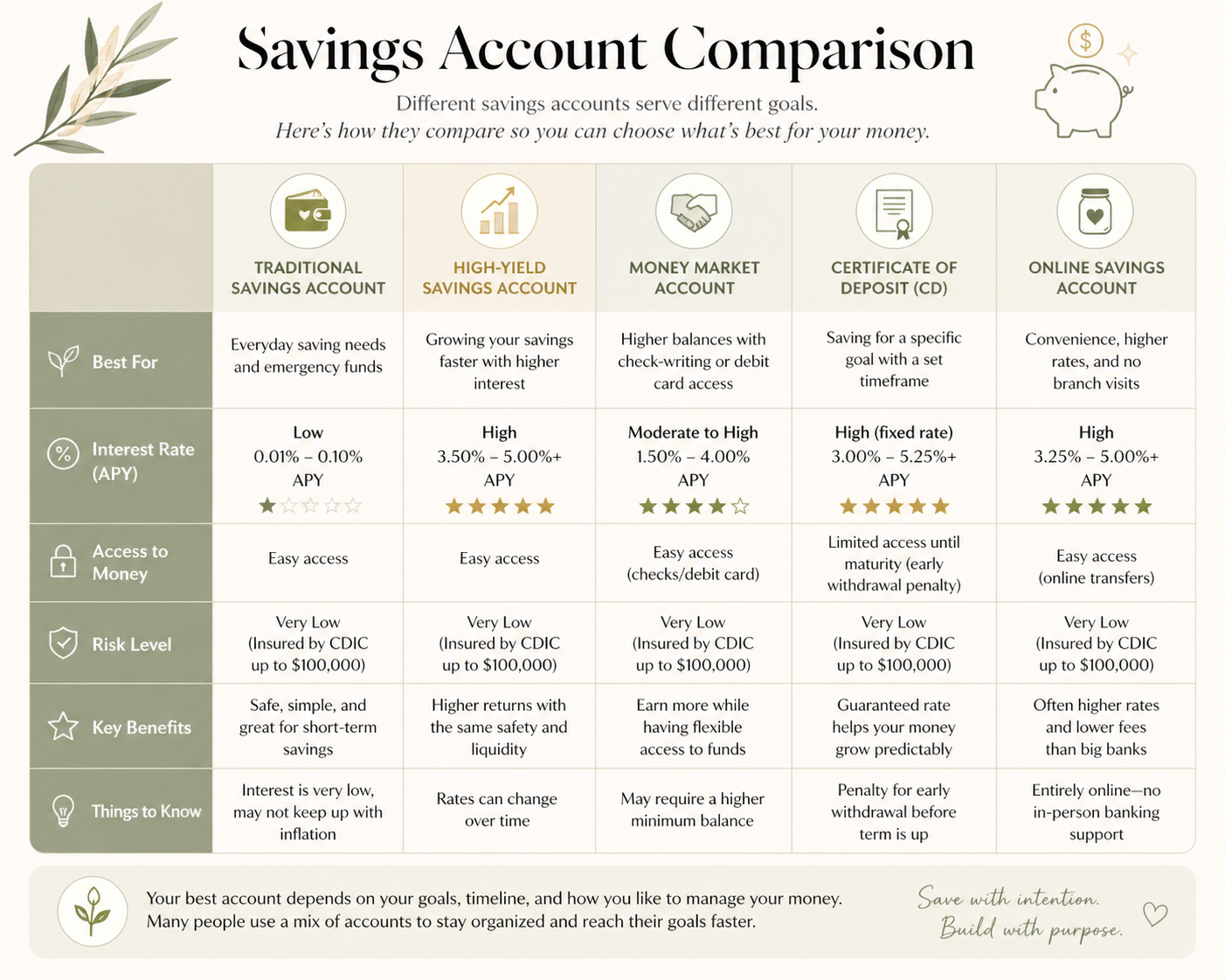
If you’re using a high-yield savings account, this number may be higher than a traditional savings account.
The Financial Consumer Agency of Canada explains that with compound interest, your initial deposit earns interest, then that interest gets added to your balance and can earn interest too. The more often interest compounds, the more your balance can grow.
This is why using a high yield savings account calculator or HYSA calculator can be helpful. It shows you how much more your money may grow when it’s sitting in the right place.
✨ Gentle reminder: You do not need to build wealth perfectly to build it successfully.
What Is A High-Yield Savings Account?
A high-yield savings account is basically a savings account that pays you more interest than a regular savings account.
It’s not meant to replace investing.
It’s not meant to make you rich overnight.
But it can be a really beautiful place to keep money you need safe and accessible.
Think:
Emergency fund
Short-term savings
Travel fund
Home down payment
Tax savings
Business savings
Money you don’t want exposed to stock market risk
APY, or annual percentage yield, shows how much interest you earn on a deposit account over one year. The higher the APY, the faster your savings can grow, while APR is usually the cost of borrowing money.
So when you’re comparing savings accounts, don’t just look at the bank name.
Look at the rate.
Look at fees.
Look at accessibility.
Look at whether the account actually supports the way you live.
Because the goal is not just to save money.
The goal is to build a system that feels peaceful enough to stick with.
How Compound Interest Helps Your Savings Grow
Compound interest is when your savings earns interest, and then that interest starts earning interest too.
It’s quiet.
It’s simple.
It’s honestly kind of magical when you first see it working.
For example, if you put $1,000 into a savings account earning 5% annual interest, you’d earn $50 in the first year. The next year, you’d earn interest on $1,050, not just the original $1,000. TD explains this as one of the core ways compound interest can help savings grow over time.
This is why a financial compounding calculator can be so helpful.
It lets you see how your money grows not just from what you add, but from the interest your money earns along the way.
And listen, savings growth may not feel as dramatic as investing.
But it creates something just as important:
Safety.
And safety is wealth too.
What Should I Save For First?
If your savings feel scattered, start with the thing that would give your nervous system the most peace.
For most people, that’s an emergency fund.
Not because emergencies are fun to think about.
They’re not lol.
But because having money set aside can stop one unexpected expense from turning into a full financial spiral.
After that, you can start creating sinking funds for things you know are coming.
Things like car repairs, holidays, travel, annual bills, gifts, wellness, home expenses, or business support.
This is where saving starts feeling less restrictive and more supportive.
You’re not depriving yourself.
You’re preparing for your life.
If this is something you’re working on, Emergency Fund: How Much Should You Actually Save? is a beautiful next step.
Saving Without Feeling Restricted
Can we talk about this for a second?
Saving money should not feel like punishment.
If your savings plan requires you to cut out every single thing that brings you joy, it probably won’t last.
We’re not doing that anymore.
A healthy savings plan should include both responsibility and pleasure.
Because you’re a whole human, not a spreadsheet.
This is why values-based spending matters so much. When you understand what actually matters to you, it becomes easier to save without feeling like you’re constantly denying yourself.
You can still have your coffee.
You can still buy the skincare.
You can still go out with your friends.
But you do it with intention instead of impulse.
I dive deeper into this in Conscious Spending: How to Spend Money Without Guilt and Mindful Spending: How to Align Your Spending With Your Values.
Simple Ways To Save More Consistently
You don’t need to overhaul your entire life to become better at saving.
Start here:
Automate your savings so the money moves before you have time to overthink it.
Rename your savings accounts so each dollar has a purpose.
Save on payday, not “whatever is left over.”
Create separate savings buckets for different goals.
Review your savings once a month without judgment.
Increase your contribution when your income increases.
This is the part where structure becomes self-care.
Because when your money has a system, you don’t have to carry every financial decision in your head all the time.
And honestly? That kind of mental peace is priceless.
Continue Learning About Saving Money
If you’re ready to build a more grounded relationship with saving, these articles will help you go deeper:
5 Easy Ways to Save Money and Build Wealth
2 Money Saving Strategies That Actually Work
Saving vs Investing: Which Should You Focus on First?
5 Budgeting Benefits That Will Transform Your Financial Life
How to Set SMART Financial Goals (With Real Examples)
How to Build Wealth: 7 Simple Strategies That Actually Work
Free Resources
If you’re ready to make saving feel less confusing and more organized, grab my free Wealth Well Tracker.
It’s a gentle way to start tracking your money, building better habits, and actually seeing where your money is going without making the whole process feel heavy.
Frequently Asked Questions
What is a savings calculator?
A savings calculator estimates how much money you could save over time based on your starting balance, monthly contributions, timeline, and interest rate.
How does a savings calculator work?
A savings calculator uses your current savings, future deposits, interest rate, and timeline to estimate your future savings balance.
What is a high-yield savings account calculator?
A high-yield savings account calculator estimates how much your money could grow in a savings account with a higher interest rate than a traditional account.
What is compound interest on savings?
Compound interest means your savings earns interest, and then that interest gets added to your balance and can earn more interest over time.
How much should I save each month?
The right amount depends on your income, expenses, goals, and timeline. Even small consistent contributions can help you build momentum.
Should I save or invest first?
If you don’t have emergency savings, it usually makes sense to build some savings first. Once you have a financial cushion, investing can help you grow long-term wealth.
Where should I keep my emergency fund?
Your emergency fund is usually best kept somewhere safe, liquid, and easy to access, like a high-yield savings account.
Book A Clarity Call 🤙🏾
So now you’ve seen the vision, thanks to my handy savings calculator… but do you have the plan? If you’re ready to turn projections into progress, let’s hash it out together. Book your complimentary clarity call now, and we’ll design toward roadmap to a solid savings fund of your dreams.