
Sustainable Investing: How to Build Wealth That Aligns With Your Values
Sustainable investing can feel a little confusing at first—especially when you’re trying to balance making money with doing good. But ethical investing options and socially conscious investing aren’t about choosing one or the other. When you understand how sustainable investing actually works, you start to realize it’s not about perfection, it’s about intention. It’s about building wealth in a way that still feels like you.
I had a huge wake-up call a few years ago when I really started investing.
At first, I was chasing profits like everyone else. I thought the goal was simple: find the stocks and funds that could give me the biggest returns and let my money grow. But then I had this moment where I looked closer at one of my ETFs — and realized my money was funding companies that I didn’t align with at all.
It hit me hard. Here I was, thinking I was making smart financial moves, when in reality, my dollars were supporting industries and practices I would never choose in my personal life. Things like fossil fuels, fast food giants, and companies with questionable labor practices.
That was the moment I realized:
If I’m only focused on returns, I lose myself in the process.
I lose my integrity, my values, and what I actually stand for.
From then on, I made a commitment to invest more intentionally. To find ways of building wealth that actually felt good, and to make sure that my money was doing something positive in the world — not just padding my bank account.
And honestly, this is where a lot of people are waking up right now. According to the Global Sustainable Investment Alliance, sustainable investing assets reached over $30 trillion globally in recent years, showing that more investors are actively choosing where their money goes—not just how much it earns.
The Myth About Ethical Investing
There’s this old myth in the investing world that if you invest ethically, you’ll make less money. That you have to choose between profits or principles.
That couldn’t be farther from the truth.
We now have years of evidence showing that sustainable investing and ethical investing options can perform just as well as, if not better than, traditional options.
In fact, Bloomberg Intelligence reported that ESG (Environmental, Social, and Governance) assets were on track to exceed $53 trillion by 2025.
And Morgan Stanley analyzed thousands of funds between 2004 and 2018, finding that sustainable funds delivered returns equal to or better than conventional options.
So not only is ethical investing possible — it’s profitable.
If anything, this shift toward socially conscious investing is becoming the new normal, not the exception.
Why Sustainable Investing Matters More Than You Think
The reality is this: no matter how you invest or consume, some level of harm is unavoidable.
Even walking outside and stepping on grass, you might unintentionally kill an insect. That’s just life.
But there’s a huge difference between creating harm intentionally versus ignorantly.
When you invest without awareness, you might be funding industries tied to war, child labor, discrimination, or environmental destruction. But when you choose intentionally, you get to redirect that flow of money toward companies trying to do better.
That’s where sustainable investing becomes powerful.
It’s not about being perfect. It’s about doing better with what you have.
And if this is something you’re just starting to explore, I go deeper into the mindset side of this in How to Improve Your Relationship With Money (Beginner Guide), because how you feel about money often shapes how you choose to grow it.
My Framework: The Three Ps
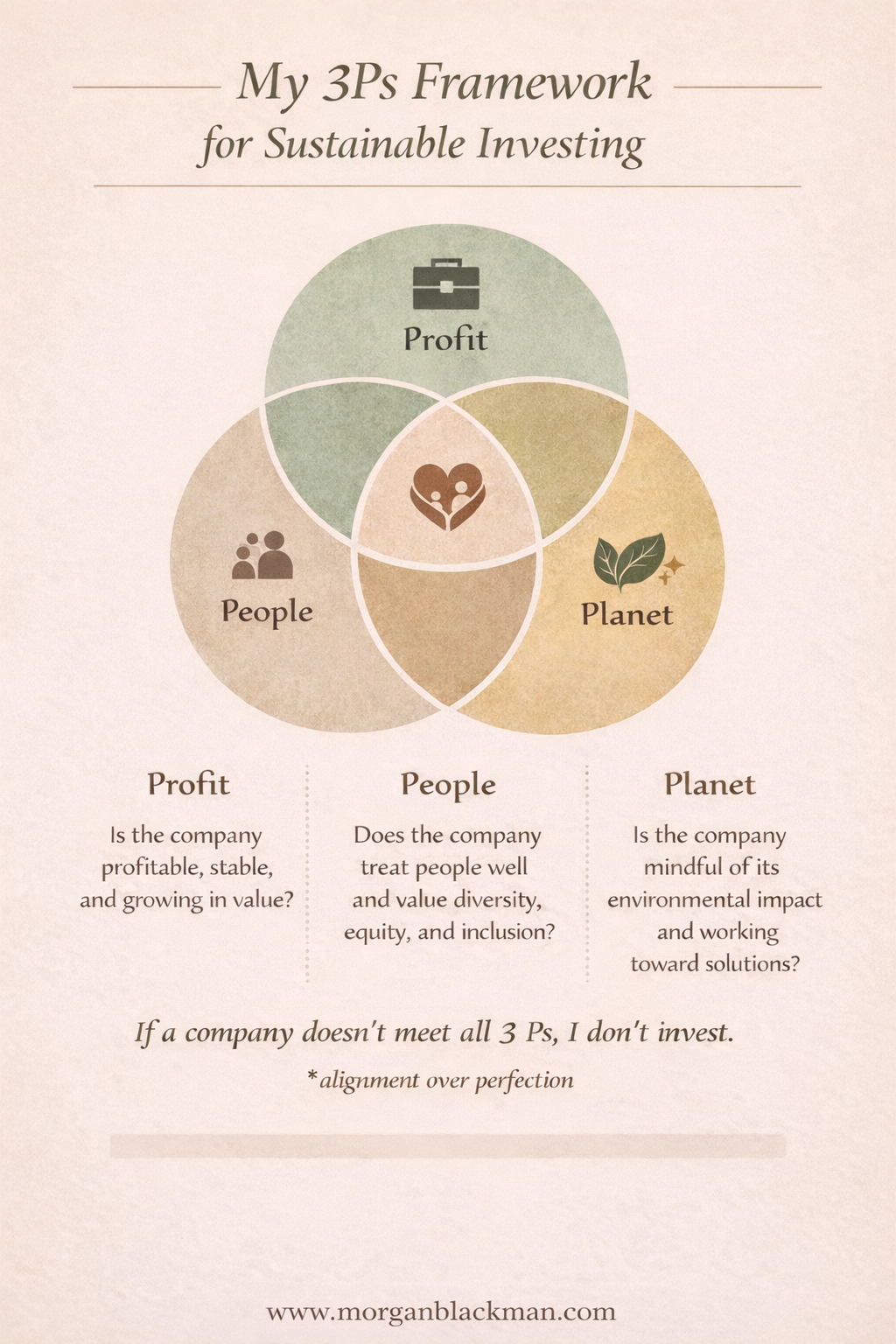
When I started investing through an ethical lens, I developed a simple framework that guides every decision I make. I call it the Three Ps Framework:
Profit
Let’s be real: we’re still investing to make money.
I want my investments to be profitable and to grow my wealth over time. That means looking at financial statements, KPIs, and whether a company has long-term stability.
People
How does this company treat people?
Do they support diversity, equity, and inclusion? Do they care about worker rights and fair wages? Are they minimizing harm to communities instead of exploiting them?
Planet
We only have one Earth.
Companies I invest in need to be mindful of their impact on the environment, from carbon emissions to resource use. I want to know they’re at least working toward solutions instead of creating bigger problems.
If a company doesn’t align with all three — profit, people, and planet — I don’t put my money there.
This is something I break down further in Holistic Finances: How to Align Money, Wellness, and Purpose, because your investments are an extension of your values whether you realize it or not.
What Ethical Investing Actually Looks Like in Real Life
When people hear “ethical investing,” they sometimes imagine it’s complicated or only for experts.
But in reality, socially conscious investing can be simple and layered over time.
It can look like:
Choosing ESG-focused ETFs or funds
Avoiding industries that don’t align with your values
Supporting companies with strong environmental or social practices
Researching where your money is actually going
It doesn’t have to happen all at once. You can shift gradually.
And if you’ve ever felt overwhelmed by investing in general, you’re not alone. A 2023 study by FINRA found that a large portion of individuals still lack confidence in understanding investment products, which is exactly why starting simple matters.
If you’re in that phase, I walk through the foundations in The Wealth Wellness Framework: 3 Principles for Building Abundance, because clarity always comes before confidence.
Examples From My Own Portfolio
To give you a sense of how I use this framework in real life, let me share some examples.
Airbnb (Profit + People)
I’ve used Airbnb countless times while traveling. Because I’ve been a direct consumer of their service, I felt comfortable investing when they went public. I could see their value and long-term growth. Plus, their platform creates economic opportunities for everyday people, not just big corporations.
Bumble (People)
I haven’t invested in Bumble, but it’s a company I respect because of how it centers women’s safety and agency. Bumble was created to give women the first move in dating, which flips the script and reduces harassment. That’s a people-centered mission worth paying attention to.
Tesla (Planet + Profit)
Tesla is controversial, but when it first launched, it represented a big shift toward sustainable transportation. Electric cars aren’t perfect, but they’ve pushed the industry forward in important ways. For me, Tesla fit both profit and planet criteria.

Why It’s Not About Perfection
Listen — you’re not going to get it perfect every time.
Some companies will claim sustainability and still fall short. Others might do well for years and then get caught in scandals.
The point isn’t to never make mistakes. The point is to invest with awareness.
When you know better, you can do better.
And ethical investing gives you the tools to make choices that align with your values, your money goals, and your vision for the future.
Ethical Investing Is The Future
Here’s what excites me: the more people care about where their money is going, the more the market shifts.
If we, collectively, start funneling money into companies that treat people well, protect the planet, and still deliver profit, the harmful companies will eventually lose power.
They won’t get the same level of funding, and over time they’ll fade out.
That’s the power of sustainable investing.
We get to use our dollars as votes for the kind of world we want to live in.
And if you’ve been feeling that pull—that desire to make your money feel more aligned—this is something I guide you through inside the Ethical Investor Starter Kit, because you don’t have to figure it all out on your own.

Take the First Step
If you’re ready to learn more about ethical investing, I created a free resource just for you:
👉The Ethical Investor Starter Kit
It’s a 5-day email series filled with guides, reflection prompts, checklists, and resources to help you start building your own values-based investment strategy.
Whether you’re brand new to investing or you’ve been in the game for a while but want to be more intentional, this kit will give you the clarity you need.
Affiliate Recommendation
If you’re starting to explore sustainable investing, one of the most helpful things you can do is actually see where your money is currently going.
That’s where Wealthsimple can be a really supportive tool. It’s an investing platform that offers socially responsible portfolios, making it easier to start aligning your investments with your values without needing to build everything from scratch.
It’s especially helpful if you’re new to investing or want a more hands-off approach while still prioritizing ethical investing options.
FAQs
What is sustainable investing?
Sustainable investing is an investment approach that considers environmental, social, and governance (ESG) factors alongside financial returns to align money with personal values.
What are ethical investing options?
Ethical investing options include ESG funds, socially responsible ETFs, impact investing, and choosing individual companies that align with your values.
Is socially conscious investing profitable?
Yes. Research shows that sustainable funds can perform similarly or even outperform traditional investments over time.
How do I start sustainable investing?
Start by researching ESG funds, defining your values, and gradually shifting your portfolio toward investments that align with those values.
What is ESG investing?
ESG investing evaluates companies based on environmental impact, social responsibility, and governance practices alongside financial performance.
Can beginners do ethical investing?
Absolutely. Many platforms offer beginner-friendly socially responsible portfolios, making it easy to start without deep expertise.
If you’d like to keep journeying together…
→ Start Here: free tools and reflections to help you feel grounded, clear, and more confident with your money.
→Work With Me: private coaching, strategy sessions, and programs designed to help you build wealth that feels aligned, stable, and sustainable.
→ Subscribe to the Channel: If this resonated, come hang out with me on YouTube where I break this down in real life — the habits, the mindset shifts, and what this actually looks like day-to-day.
→ Or Join My Email List: This is where I share deeper insights, behind-the-scenes thoughts, and the kind of conversations we don’t always have publicly.
