
How to Do a Life Audit to Transform Your Life
Doing a life audit can feel a little confronting at first, but honestly, that’s usually a sign that it’s needed. A personal life audit gives you the space to slow down, look at the full picture, and get honest about what’s actually supporting your well-being and what’s quietly draining it. When you know how to do a life audit in a way that includes your health, relationships, time, career, environment, and finances, you stop making random changes and start making aligned ones.
When most people hear the word “wealth,” their minds immediately go to money. Numbers in a bank account. Income. Investments.
But here’s the truth I’ve learned: wealth is not just financial. True wealth is an ecosystem, a set of interconnected areas in your life that all work together to sustain your well-being, your energy, and your ability to grow.
If even one area of that ecosystem is neglected, your financial life will eventually reflect the imbalance.
That’s why I created what I call the Wealth Ecosystem Framework, a holistic way to look at your life and money beyond the numbers. Today, I’m going to guide you through how to do your own life audit using this framework so you can see where you’re thriving, where you’re neglecting yourself, and what adjustments could directly impact your wealth-building journey.
And truly, this matters more than ever. Research from the APA found that 72% of Americans said they felt stressed about money at least some time in the previous month, which tells me what many of us already feel in our bodies: when life feels shaky, money stress rarely stays in just one lane. It touches our sleep, our choices, our relationships, and our sense of safety.
A life audit helps bring that whole picture into view. Not to shame you. Not to make you feel behind. Just to help you tell the truth about what season you’re in and what needs your care right now.

Step 1: Create Your Wealth Ecosystem Chart
Grab a piece of paper and something to write with. You can draw this in different ways:
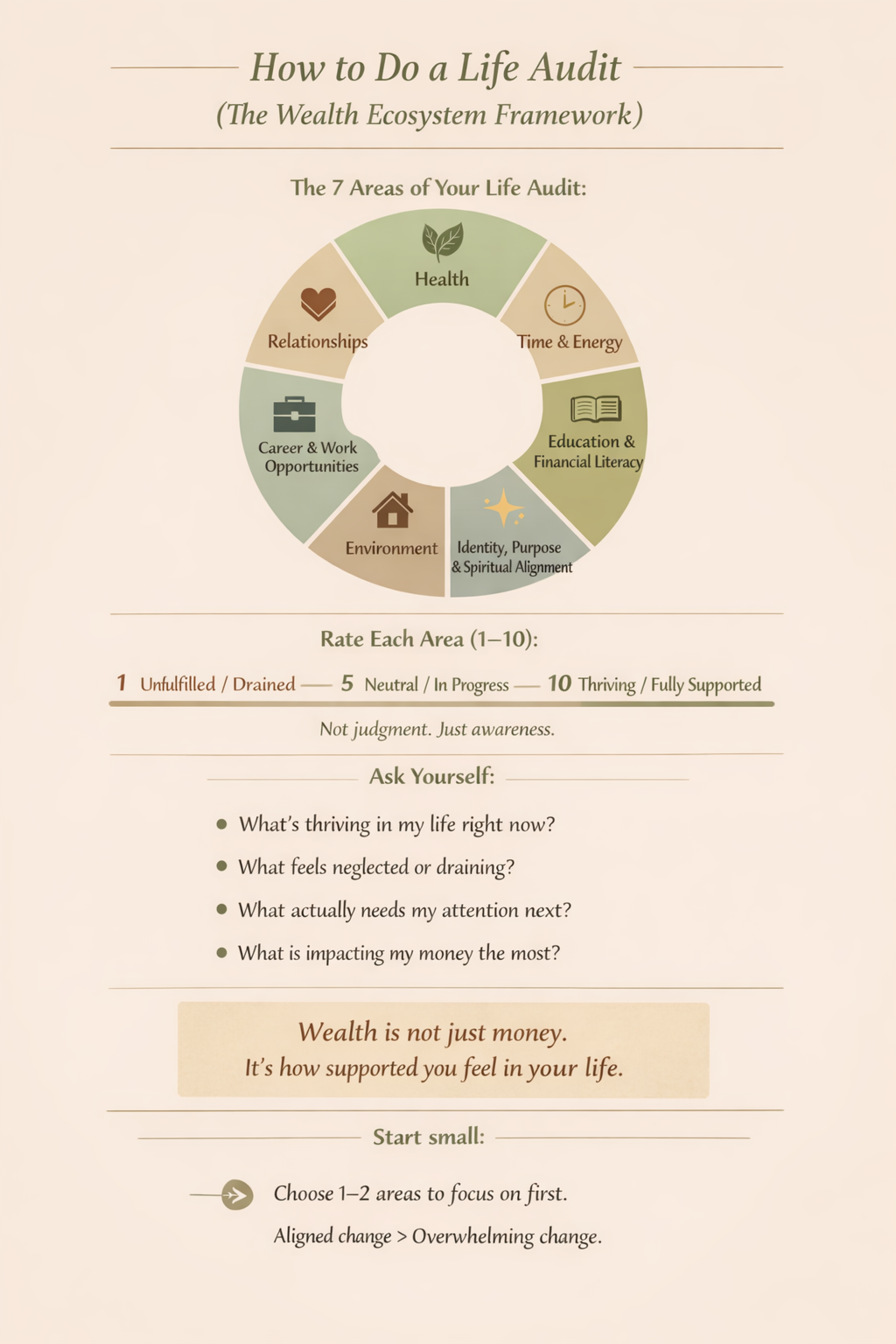
A large circle divided into 7 slices
A grid of 7 squares
A simple list with 7 categories
Choose whichever feels good to you. Sometimes it’s fun to make it visual with a circle or wheel, but even a list works.
Once you have your chart ready, label each section with these 7 Wealth Ecosystem categories:
Health
Relationships
Time & Energy
Education & Financial Literacy
Career & Work Opportunities
Environment
Identity, Purpose & Spiritual Alignment
You can also add an 8th category, Finances, if you want to reflect directly on your money, although the original point of this exercise is to look beyond the numbers.
What I love about doing a life audit this way is that it gets you out of tunnel vision. Sometimes we think the problem is money, when really the issue is burnout. Or a lack of clarity. Or an environment that makes it hard to think. Or relationships that keep pulling us out of alignment.
That’s why this kind of personal life audit can be so revealing. It shows you where the root actually is.
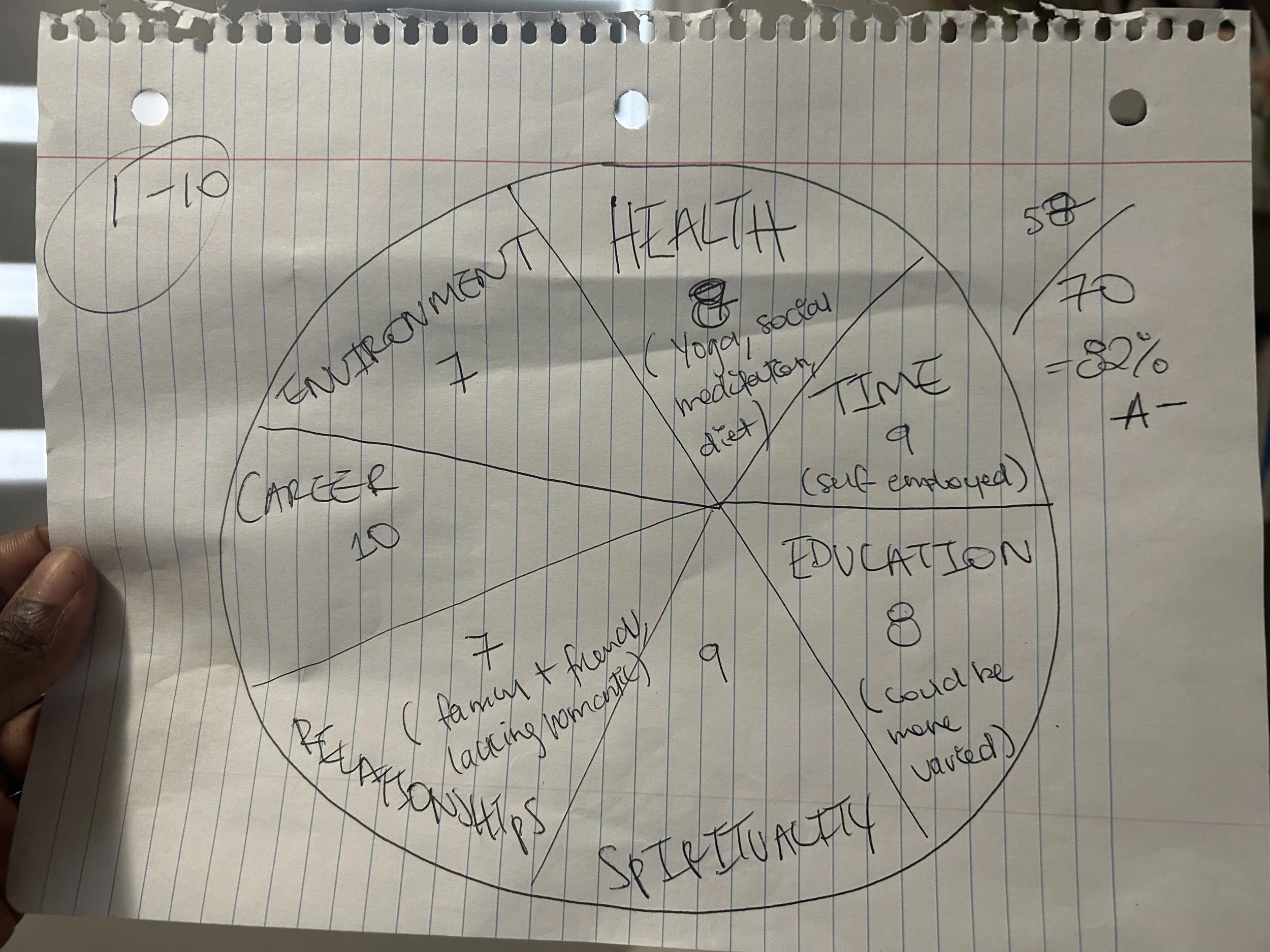
my very scrappy wealth ecosystem audit
Step 2: Define the 7 Pillars of Your Wealth Ecosystem
Let’s briefly go through each of these categories so you know how to evaluate them in your own life.
1. Health
This includes your mental, emotional, physical, and spiritual health. Health is often the most layered category because you might feel strong in one area but lacking in another. For example, you may feel mentally sharp but physically depleted, or emotionally balanced but spiritually disconnected.
The saying “health is wealth” exists for a reason. Without a strong baseline of health, it’s hard to summon the energy and clarity needed to build wealth.
And this is not just a nice idea. The WHO says poor working environments, excessive workloads, inequality, and job insecurity all pose risks to mental health, and depression and anxiety lead to an estimated 12 billion lost workdays globally each year. That’s huge. It reminds us that when your body and mind are asking for support, it is not a weakness to listen. It’s wisdom.
When you audit your health, ask yourself: am I actually well, or am I just functioning? Those are not the same thing.
This is something I break down further in Self Care for Entrepreneurs: Protecting Your Energy While Building Wealth, because protecting your nervous system and protecting your capacity are deeply connected.
2. Relationships
This category includes romantic, family, friendships, colleagues, and social circles. The people around you shape how you view money, how you manage it, and even your beliefs about what’s possible.
Ask yourself: are my relationships supportive, loving, and empowering? Or are they draining, chaotic, or full of unhealthy patterns?
This pillar matters more than many people realize. The U.S. Surgeon General has warned that lacking social connection can increase the risk for premature death to a level comparable to smoking up to 15 cigarettes a day. So if your relationships feel isolating, one-sided, or chronically unsafe, that isn’t a small thing. It affects your whole ecosystem.
And yes, this shows up financially too. Who you date, live with, trust, lean on, or constantly rescue can absolutely affect your spending, your stability, and your future plans.
3. Time & Energy
You cannot buy back time. And if your days are stretched thin or your energy is constantly depleted, you won’t have the capacity to make or manage money in sustainable ways.
This pillar is about time management, energy levels, and balance. Do you feel spaciousness in your life? Or do you feel like you’re constantly running on empty?
A lot of women are trying to fix their finances while also being deeply exhausted. That usually does not work long-term, because tired people do not always make spacious decisions. They make urgent ones. Reactive ones. Survival-based ones.
If this is something you’re working through, I dive deeper into The Wealth Wellness Framework: 3 Principles for Building Abundance, because wealth built from depletion rarely feels good to hold.
4. Education & Financial Literacy
Wealth building isn’t just about what you earn, it’s about what you know and what you do with it.
Ask yourself: am I learning about financial literacy, money systems, and how wealth works? Do I understand credit, debt, investing, assets versus liabilities? Do I seek out new knowledge that can help me build, sustain, and grow my wealth?
When you know better, you do better.
And right now, financial resilience is feeling shaky for a lot of people. The 2024 FINRA National Financial Capability Study found that 26% of respondents said they spend more than their income, up from 19% in 2021, and 35% said they probably or certainly could not come up with $2,000 for an unexpected expense. That doesn’t mean people are careless. It often means they need more support, more margin, and better tools.
This is also why healing your emotional relationship with money matters alongside the practical side. I talk more about this in How to Improve Your Relationship With Money (Beginner Guide), because financial literacy lands differently when shame is not running the show.
5. Career & Work Opportunities
This is about the alignment, fulfillment, and opportunities in your work. Do you feel inspired and resourced in your current career? Do you have access to opportunities? Or are you struggling with barriers such as discrimination, lack of access, or a job that drains you without fueling your long-term goals?
Career equity is about both what you do and the systemic realities that impact your options.
This part of a life audit can be uncomfortable because it asks very direct questions. Am I underpaid? Am I outgrowing this role? Am I choosing security over alignment? Am I staying because I’m scared to want more?
Sometimes the issue isn’t that you’re unmotivated. Sometimes you are simply no longer meant for the version of work you’re forcing yourself to keep tolerating.
This is something I explore more in How to Choose a Career That Aligns With Your Life Goals and Right Livelihood: How to Align Your Career With Your Values, especially if your work life looks fine on paper but doesn’t feel right in your body anymore.
6. Environment
Your environment shapes your energy. This includes both your physical space (your home, neighborhood, living conditions) and your ecological impact (how you engage with the planet).
Ask yourself: does my environment feel safe, nurturing, and supportive? Or does it feel toxic, unstable, or draining?
This pillar can be easy to overlook, but clutter, disorganization, and constant visual overstimulation can quietly wear on your focus. Research highlighted by Princeton notes that visual clutter competes for your attention and tires out your cognitive functions over time. Even your space can affect how clear you feel.
And honestly, sometimes support here can be practical. If your space is stressing you out and you need help resetting it, a service like Taskrabbit can be genuinely helpful for things like cleaning, organization, furniture assembly, and small home projects, especially when your environment is one of the areas dragging on your energy. Taskrabbit says its platform connects people with local help for cleaning, home repairs, organizing, moving, and more.
That kind of support is not laziness. Sometimes it’s exactly what helps you create a home that finally feels like it’s working with you instead of against you.
7. Identity, Purpose & Spiritual Alignment
Wealth is harder to hold if you’re out of alignment with your purpose.
This pillar is about your sense of self, values, and connection to something greater. Are you doing work that fulfills you? Do you feel clear about why you’re here? Do your financial decisions align with your deeper values and integrity?
When you feel disconnected from your purpose, it often shows up in money decisions that don’t feel good long-term.
This is where the life audit becomes more than a productivity exercise. It becomes a truth-telling exercise.
Because what’s the point of building a beautiful financial life if it doesn’t actually feel like your life?
I talk more about this in Holistic Finances: How to Align Money, Wellness, and Purpose, because purpose and prosperity do not need to live in separate rooms.
Step 3: Rank Yourself
For each of the 7 categories, rate yourself on a scale of 1 to 10:
1 = completely unfulfilled
10 = thriving and fulfilled
Be honest. This is not about judgment or shame. It’s simply data, a snapshot of where you are right now.
For example, when I did my own audit recently, my scores looked like this:
Health: 8
Time: 9
Education: 8
Spirituality: 9
Relationships: 7
Career: 10
Environment: 7
Finances (added as an extra slice): 5
When I tallied it up, I scored 58 out of 70, which is about an A- grade.
One thing I want to add here: don’t obsess over the grade. The point is not to perform well on your own life audit. The point is to notice patterns.
Maybe you’re mostly doing okay, but one category is chronically low and quietly affecting all the others. That matters.
Maybe your score in career is high, but your health is low. Maybe your relationships are beautiful, but your environment feels chaotic. Maybe your finances are struggling, but your purpose is crystal clear. That matters too.
This exercise is not here to flatten your life into numbers. It’s here to help the numbers tell a story.
Step 4: Reflect on the Results
Once you’ve rated yourself, pause and reflect. Ask yourself:
What’s thriving? Which areas are 7 or above? Celebrate what’s going well.
What’s neglected? Which areas are under 7? Where are you leaking energy or neglecting yourself?
What’s required? What actions, boundaries, or shifts would improve the neglected areas?
What’s connected to money? Which categories directly impact your ability to earn, manage, or grow wealth?
For me, the categories where I scored lower, such as environment, relationships, and finances, were directly affecting my money. My nomadic lifestyle was impacting stability. My relationships were fulfilling but lacked a long-term partner. And financially, I was still bouncing back after inconsistent business income.
This is the part where the audit gets real. Reflection is where you begin to connect dots.
Maybe your overspending is actually tied to loneliness.
Maybe your procrastination is actually exhaustion.
Maybe your financial inconsistency is tied to a lack of structure, support, or clarity in your work.
Maybe you don’t need more discipline. Maybe you need a different environment, better boundaries, or a more honest plan.
That’s why a personal life audit can be so powerful. It lets you stop misdiagnosing the problem.
Why the Wealth Ecosystem Matters
When you look at your life this way, you start to realize something powerful:
👉 Wealth is not just money.
You could have six figures in your bank account and still feel empty, anxious, or burnt out. On the other hand, you could be in a rebuilding phase financially but feel deeply fulfilled, supported, and aligned in every other area of your life.
The Wealth Ecosystem Framework helps you see the full picture so you can build wealth that feels good and sustains you.
And that’s really the deeper invitation here. To stop asking only, “How do I make more money?” and start asking, “What kind of life am I building, and does it actually support me?”
Because more money inside a life that feels misaligned will not magically create peace.
Colorful wheel divided into 8 sections with different categories for a wealth ecosystem
Make the Wealth Audit a Regular Practice
Your Wealth Ecosystem will change with time. Some seasons you’ll score higher. Others you’ll score lower. That’s normal.
The key is to treat this as a regular practice. Check in every few months, or at least once a year. Compare your new results with past audits. Notice where you’ve grown, where you’ve regressed, and what patterns keep repeating.
There’s no shame if your scores dip. Life happens. The point is to notice, reflect, and adjust.
Wealth is not just a paycheck, a budget, or an investment portfolio. Wealth is how you feel, how you live, and how supported you are in all areas of your life. When you nurture your health, relationships, time, education, career, environment, and purpose, you create a foundation where financial wealth can actually grow and last.
So try this: complete your own Wealth Ecosystem Audit this week. See what comes up. Notice where you’re thriving and where you can show yourself more love and attention.
And remember, this is not about perfection. It’s about progress, reflection, and building a life that feels abundant from the inside out.
If your audit leaves you realizing you’re not actually lacking ambition, but clarity, that’s exactly why I’d point you toward the Financial Clarity Webinar. It’s a supportive next step when you want help making sense of what your money, goals, and next moves are really asking of you.

Affiliate Recommendation
If your life audit brought up anything around emotional burnout, stress, or feeling mentally overwhelmed, it might be worth having a little extra support while you sort through it.
This is where something like Talkspace can be really helpful. It’s an online therapy platform that gives you access to licensed therapists from the comfort of your own home, which can feel a lot more approachable than trying to navigate traditional therapy settings. You can message, schedule sessions, and in many cases even use insurance, which makes it more accessible than people often expect.
Because sometimes what comes up in a life audit isn’t just about habits or strategy. Sometimes it’s deeper. And having a space to process that, especially with someone trained to hold it with you, can make all the difference as you start making changes.

FAQs
What is a life audit?
A life audit is a personal check-in where you evaluate the key areas of your life, like health, relationships, work, finances, time, and purpose, so you can see what’s working and what needs attention.
What are the key steps to performing a personal life audit?
Start by choosing the categories you want to assess, define what each area means for your life, rate each one honestly, and then reflect on patterns, gaps, and the changes that would support you most.
How often should I do a life audit?
A good rhythm is every few months or at least once a year. You can also do one anytime you’re feeling stuck, burnt out, financially off-track, or out of alignment.
How can I assess my current financial well-being during a life audit?
Look at both the numbers and the emotions. Review your income, spending, savings, debt, and financial habits, but also notice whether money feels calm, confusing, restrictive, or draining.
What should I do after completing a life audit?
Choose one or two areas to focus on first. You do not need to overhaul your whole life at once. The best next step is usually the one that creates the most relief, clarity, or stability.
Are there tools or apps that can help with a life audit?
Yes. Journals, digital planners, habit trackers, budgeting apps, and calendar tools can all help. But honestly, a notebook and a quiet hour can still be enough to begin.
How do I set realistic goals after a life audit?
Use what your scores revealed. Focus on specific, measurable shifts that match your actual capacity. Small aligned actions tend to create more lasting change than dramatic plans you can’t sustain.
ten shows up in money decisions that don’t feel good long-term.
If you’d like to keep journeying together…
→ Start Here: free tools and reflections to help you feel grounded, clear, and more confident with your money. →Work With Me: private coaching, strategy sessions, and programs designed to help you build wealth that feels aligned, stable, and sustainable.
→ Subscribe to the Channel: If this resonated, come hang out with me on YouTube where I break this down in real life — the habits, the mindset shifts, and what this actually looks like day-to-day.
→ Or Join My Email List: This is where I share deeper insights, behind-the-scenes thoughts, and the kind of conversations we don’t always have publicly.
