
Why Hyper Independence Is Making You Broke and Burnt Out
Hyper independence trauma is one of those things many of us learned to wear like a badge of honor before we ever understood the weight of it. We learned to say “I got it” even when we were exhausted. We learned to figure it out because help was inconsistent, unsafe, unavailable, or came with conditions. And while that self-reliance may have protected us at one point, it can also become the very thing keeping us broke, burnt out, emotionally unavailable, and disconnected from the support we actually need to build holistic wealth.
The Origin of Hyper-Independence
Let’s talk about the badge of honor so many of us were handed before we even knew its weight: hyper independence.
For many Black women and folks from marginalized communities, hyper independence is not just a personality trait. It is not simply being “strong,” “capable,” or “good at handling things.” A lot of the time, it is a survival strategy. It is a trauma response. It is a learned way of moving through a world that has not always made support feel safe, consistent, or accessible.
And I want to be really gentle when I say this, because I know so many of us became hyper independent for very real reasons.
Maybe you grew up in a home where asking for help meant being dismissed, shamed, or punished. Maybe you watched your mother, aunties, grandmothers, or caregivers carry entire households on their backs with very little acknowledgment. Maybe you learned early that vulnerability was dangerous. Maybe people who were supposed to protect you disappointed you so many times that eventually your nervous system decided, “Okay, I’ll just do everything myself.”
And at one point, that may have helped you survive.
But what helps us survive is not always what helps us thrive.
What Is Hyper Independence Trauma?
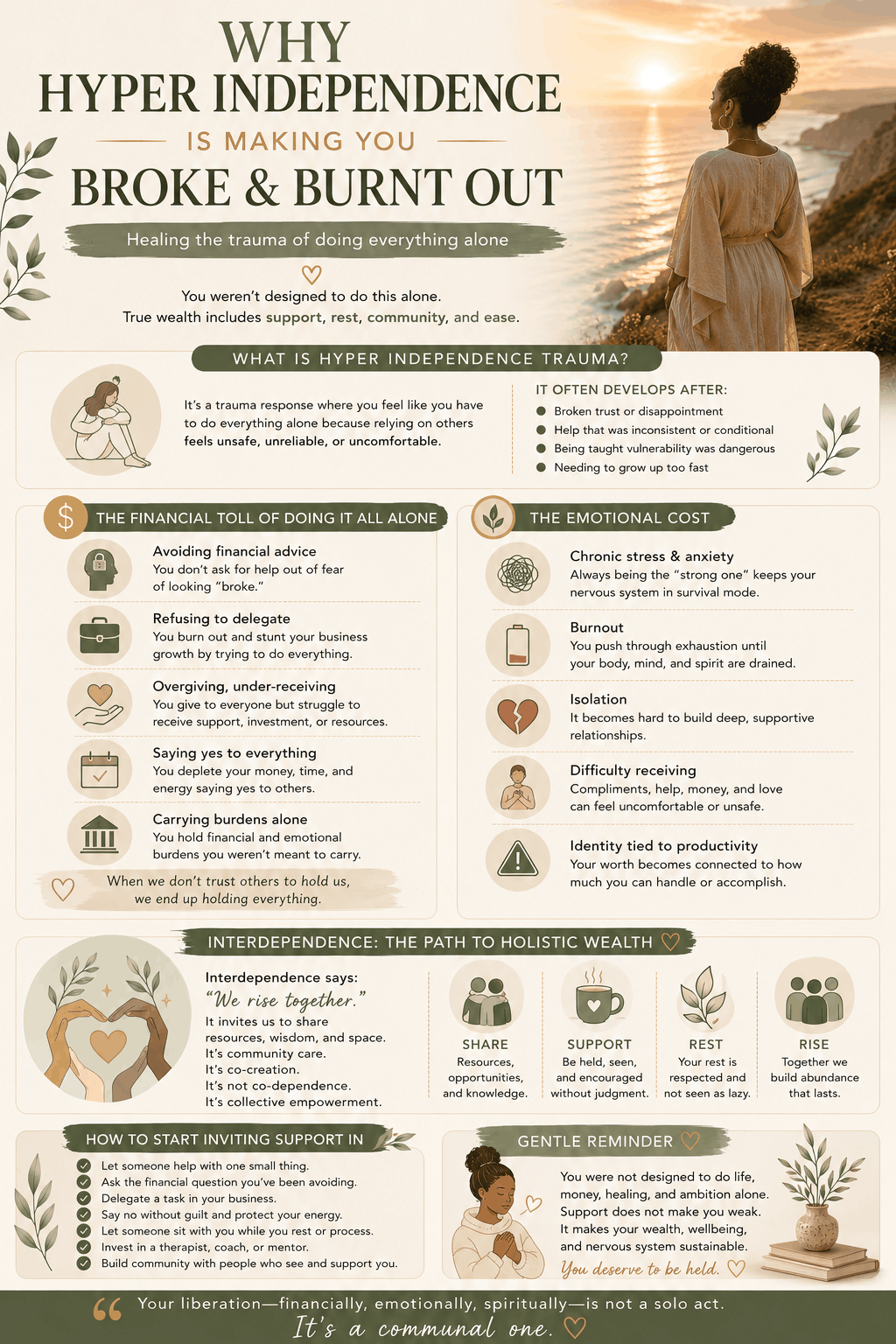
Hyper independence trauma is the pattern of relying only on yourself because trusting others feels unsafe, unfamiliar, or emotionally risky. It often develops after experiences where support was unavailable, inconsistent, conditional, or harmful. Over time, “I can do it myself” stops being a choice and starts becoming armor.
This is different from healthy independence.
Healthy independence says, “I trust myself, and I can also receive support.”
Hyper independence says, “I have to do everything alone because no one else will come through for me.”
And that distinction matters deeply.
Psychologists often describe hyper independence as a trauma-linked pattern where people avoid depending on others because relying on someone else can bring up stress, shame, fear, or the expectation of disappointment. Over time, this can affect relationships, emotional well-being, and quality of life.
I think so many of us confuse hyper independence with strength because society rewards people who can keep going without needing anything. We praise the woman who never asks for help. The entrepreneur who does it all. The eldest daughter who carries the whole family. The friend who shows up for everyone but never needs anyone herself.
But sometimes what we call strength is actually exhaustion dressed up nicely.

The Origin of Hyper Independence
Hyper independence often begins in environments where trust was broken.
Maybe help was promised, but never came. Maybe adults around you were emotionally unavailable. Maybe you were parentified and had to grow up too fast. Maybe vulnerability was met with criticism instead of care. Maybe being “low maintenance” became your way of staying safe.
Especially in many Black and Brown households, there can be this deep cultural inheritance around strength. We watched generations before us survive impossible things, often with limited resources, limited rest, and very little room to fall apart. So naturally, we learned that being strong meant being self-reliant. We learned that needing support made us weak. We learned that our worth was tied to how much we could carry without complaining.
And I want to honor that survival.
Because our mothers, grandmothers, aunties, and ancestors did what they had to do with what they had.
But I also want us to tell the truth.
We are allowed to build something softer now.
We are allowed to ask whether the strength we inherited is still serving us, or whether it has quietly become a cage.
How Hyper Independence Keeps You Broke
From a holistic wealth perspective, hyper-independence trauma can be incredibly expensive.
Not always in obvious ways at first, but slowly.
It shows up when you refuse to ask for financial advice because you don’t want anyone to think you’re struggling. It shows up when you avoid looking at your numbers because you feel like you should already know better. It shows up when you try to build a business alone, doing your own branding, marketing, bookkeeping, admin, sales, content, client work, and emotional labor until you are completely drained.
It shows up when you overgive financially because being needed feels safer than being supported.
It shows up when you say yes to everyone else’s needs and then wonder why your own savings account keeps getting neglected.
Hyper independence can make you believe that receiving help means you failed. So instead of asking for support, you overwork. Instead of delegating, you burn out. Instead of building community, you isolate. Instead of letting someone pour into you, you keep proving you can survive on crumbs.
And eventually, that pattern starts affecting your money.
Because when you are exhausted, unsupported, and emotionally depleted, it becomes harder to make grounded financial decisions. It becomes harder to build wealth. It becomes harder to create from overflow. It becomes harder to see opportunities clearly.
Social support is strongly connected to stress resilience, and the American Psychological Association notes that support systems can help people manage stress more effectively. Research also links high-quality social support with greater resilience and protection against trauma-related distress.
That matters financially, too, because your nervous system is part of your wealth-building capacity.
How Hyper Independence Leads to Burnout
Hyper-independence trauma often creates the belief that rest must be earned, help must be avoided, and everything depends on you.
So you keep going.
Even when your body is tired.
Even when your bank account is stressed.
Even when your spirit feels heavy.
Even when your creativity is gone.
Even when your relationships are suffering.
Even when you secretly wish someone would notice how much you’re carrying.
And because you are so used to being “the strong one,” people may not even realize you need support.
This is where burnout enters.
Burnout is not just being tired after a long week. It is what happens when your body, mind, and emotions have been running on survival for too long. Studies on burnout and stress have found links between chronic work stress, physiological strain, and health impacts, while social support can help reduce some of burnout’s negative effects on health.
And honestly, that makes so much sense.
Because we were never meant to carry everything alone indefinitely.
There is a difference between being capable and being chronically unsupported.
The Relationship Between Hyper Independence and Receiving
One of the sneakiest ways hyper independence trauma shows up is through difficulty receiving.
Receiving compliments.
Receiving help.
Receiving money.
Receiving rest.
Receiving care.
Receiving love.
Receiving opportunities.
Receiving support without feeling guilty.
For many of us, receiving feels vulnerable because it requires trust. And if trust has been broken before, receiving can feel like danger.
So instead, we stay in the role of the giver.
The fixer.
The provider.
The problem-solver.
The one who has it handled.
But constantly giving without receiving creates imbalance. And that imbalance can show up financially, emotionally, physically, and spiritually.
You may find yourself investing in everyone else’s dreams while delaying your own. You may pay for family needs before funding your emergency savings. You may offer free emotional labor while undercharging for your actual work. You may pour into your community but feel resentful because no one pours back into you.
And here’s the tender truth:
You are allowed to receive without proving you are struggling enough first.
You are allowed to be supported before you collapse.

Interdependence Is the Real Wealth
I think part of healing hyper-independence trauma is learning the difference between dependence, codependence, independence, and interdependence.
Interdependence is not helplessness.
It is not giving your power away.
It is not losing yourself in other people.
It is not depending on someone else to save you.
Interdependence is the understanding that we are human beings who need each other.
It says, “I trust myself, and I can also allow safe people to support me.”
It says, “I do not have to build wealth, healing, business, family, or freedom completely alone.”
It says, “Community care is not weakness. It is wisdom.”
From a holistic wealth lens, interdependence is deeply powerful because wealth has never truly been built in isolation. People build wealth through relationships, networks, shared knowledge, mentorship, emotional support, childcare, referrals, collaboration, access, and community care.
This is why I talk so much about wealth being more than money.
Because true wealth includes the people who help hold you when life gets heavy.
What Healing Hyper Independence Can Look Like
Healing hyper-independence trauma does not mean suddenly trusting everyone or abandoning your discernment.
It means learning how to soften safely.
It may start with letting someone help you with one small thing instead of immediately saying, “No, I’m good.” It may mean asking a friend to sit with you while you organize your finances. It may mean hiring support in your business before you completely burn out. It may mean going to therapy or coaching and allowing someone to witness the parts of you that are tired of performing strength.
It may mean letting your partner, friend, family member, or community show up for you in ways that feel unfamiliar but nourishing.
And yes, it may feel uncomfortable at first.
Because if your nervous system learned that support is unsafe, receiving help can feel like exposure. It can bring up guilt, fear, suspicion, or even grief.
But discomfort does not always mean danger.
Sometimes discomfort is just what healing feels like when your body is learning a new pattern.
Gentle Reminder
You were not designed to do life, money, healing, and ambition alone.
If hyper independence helped you survive, honor that version of yourself. But you are allowed to choose something softer now. Support does not make you weak. It makes your wealth, wellbeing, and nervous system more sustainable.
How to Start Inviting Support In
A soft place to begin is asking yourself where you are gripping the tightest.
Where are you refusing help even though you secretly need it?
Where are you over-functioning because you don’t trust anyone else to show up?
Where are you undercharging, overgiving, or overworking because being needed feels safer than being supported?
You do not need to change everything at once. In fact, healing hyper independence usually happens slowly, through small moments where you practice receiving and realize the world does not fall apart when you are not carrying all of it.
Maybe this week you let someone help you with one task. Maybe you ask a financial question you’ve been too embarrassed to ask. Maybe you delegate something in your business. Maybe you say no to a request that would drain you. Maybe you let someone emotionally support you without immediately minimizing what you feel.
These small moments matter.
They teach your body that support can be safe.
Hyper Independence Trauma and Holistic Wealth
The path to holistic wealth is not just about saving more, earning more, investing more, or building more.
It is also about unlearning the patterns that drain your capacity to receive, rest, collaborate, and be supported.
Because what is the point of building wealth if your nervous system is constantly in survival mode?
What is the point of financial freedom if you are too burnt out to enjoy it?
What is the point of success if you had to abandon yourself to get there?
For many of us, healing hyper independence trauma is part of building a new relationship with wealth. One where we are not proving our worth through exhaustion. One where we are not confusing isolation with strength. One where we are not measuring success by how much pain we can quietly carry.
Your liberation — financially, emotionally, spiritually — is not a solo act.
It was never meant to be.
Further Reading
Continue Exploring Healing, Support & Holistic Wealth
If you're learning how to soften survival patterns, receive support, and build wealth in a way that feels emotionally sustainable, these articles may support you further.
Free Resource To Share
If hyper-independence trauma has shaped the way you relate to money, support, receiving, or asking for help, my free Money Mindset Ebook may be a beautiful place to begin. Sometimes the financial patterns we judge ourselves for are actually connected to deeper emotional beliefs around safety, worth, trust, and survival.
This resource is here to help you gently explore scarcity mindset, limiting beliefs, and the emotional layers behind your money story so you can start building a relationship with wealth that feels safer, softer, and more supportive.
Product Recommendation
Because hyper independence often lives in the body, not just the mind, nervous system support can be such an important part of healing. Othership offers guided breathwork practices that can help you slow down, regulate stress, and reconnect with your body when you feel like you have to hold everything alone.
I love this kind of support because sometimes we do not need another productivity hack. Sometimes we need a safe moment to exhale, soften, and remind our bodies that rest is allowed, too.
FAQs
What is hyper-independence trauma?
Hyper independence trauma is a trauma response where someone feels like they have to do everything alone because relying on others feels unsafe, uncomfortable, or unreliable. It often develops after experiences where support was inconsistent, harmful, conditional, or unavailable.
How does hyper-independence affect money?
Hyper independence can affect money by making it harder to ask for help, receive support, delegate, seek financial advice, or build community. Over time, this can lead to burnout, overworking, undercharging, emotional spending, and carrying financial burdens alone.
Is hyper independence a trauma response?
Yes, hyper independence can be a trauma response. It often forms when someone learns that depending on others leads to disappointment, danger, shame, or emotional pain, so they begin relying only on themselves as protection.
Why do Black women struggle with hyper-independence?
Many Black women are culturally and socially conditioned to be strong, self-sacrificing, and endlessly resilient. This can be connected to family patterns, systemic inequality, survival, caregiving roles, and the pressure to carry everything without complaint.
How do you heal hyper-independence trauma?
Healing hyper-independence trauma often starts with building emotional safety, practicing small acts of receiving, asking for support, setting boundaries, resting without guilt, and working with safe people such as therapists, coaches, mentors, friends, or community.
What is the difference between independence and hyper-independence?
Healthy independence means you trust yourself while still being open to receiving support. Hyper independence means you feel like you cannot rely on anyone else, even when you are overwhelmed, exhausted, or in need.
How does interdependence support holistic wealth?
Interdependence supports holistic wealth because it reminds us that success, healing, money, and wellbeing are not meant to be built in isolation. Community, collaboration, support, shared wisdom, and safe relationships all help create more sustainable wealth.
