
Lifestyle Inflation: More Money Doesn’t Always Equal Wealth
Lifestyle inflation doesn’t always look flashy. Sometimes it looks like healing retreats, spontaneous flights, expensive self-care, or constantly chasing experiences that promise peace, transformation, or escape. The more money I started making, the more I realized that lifestyle inflation can quietly disguise itself as “growth” while still pulling us further away from financial alignment, nervous system regulation, and true wealth.
There was a time I genuinely thought Bali or a trip to Mexico could save me.
Not literally, but emotionally. Spiritually. Energetically.
I thought the ocean air, morning meditations, wellness cafés, and rice paddies would somehow stitch something back together inside of me. And honestly, in some ways, they did. Travel expanded me. Certain experiences softened me. Some moments genuinely helped me reconnect with myself.
But underneath all of it, there was still this quiet undercurrent whispering:
“You’re not healed enough yet.”
“You’re not doing enough.”
“You still need something else to finally feel whole.”
And that’s when I realized I had fallen into a different kind of spending spiral.
Not necessarily on material things.
Not on designer bags or luxury cars.
But on experiences.
Flights.
Retreats.
Concerts.
Luxury wellness spaces.
Expensive weekends away.
“Transformational” workshops.
Healing intensives.
Spiritual escapes.
And the hardest part was that from the outside, it all looked incredibly intentional.
It looked like self-growth.
Like self-care.
Like alignment.
But internally?
My finances were stretched.
My nervous system was overwhelmed.
And I was still chasing a feeling I couldn’t quite name.
That’s the thing about lifestyle inflation that nobody really talks about.
Sometimes it doesn’t arrive dressed as luxury.
Sometimes it arrives disguised as healing.
What Is Lifestyle Inflation?
Most people think lifestyle inflation only refers to spending more money as your income increases.
And technically, yes — that’s true.
Lifestyle inflation happens when your expenses rise alongside your earnings, leaving you financially stuck despite making more money.
But emotionally, I think it runs deeper than that.
Because lifestyle inflation isn’t always about wanting “more.”
Sometimes it’s about trying to feel enough.
It’s about unconsciously using spending to soothe discomfort, regulate emotions, escape burnout, or create identity.
And in today’s world, experiential spending is one of the easiest ways this shows up.
The Experience Trap
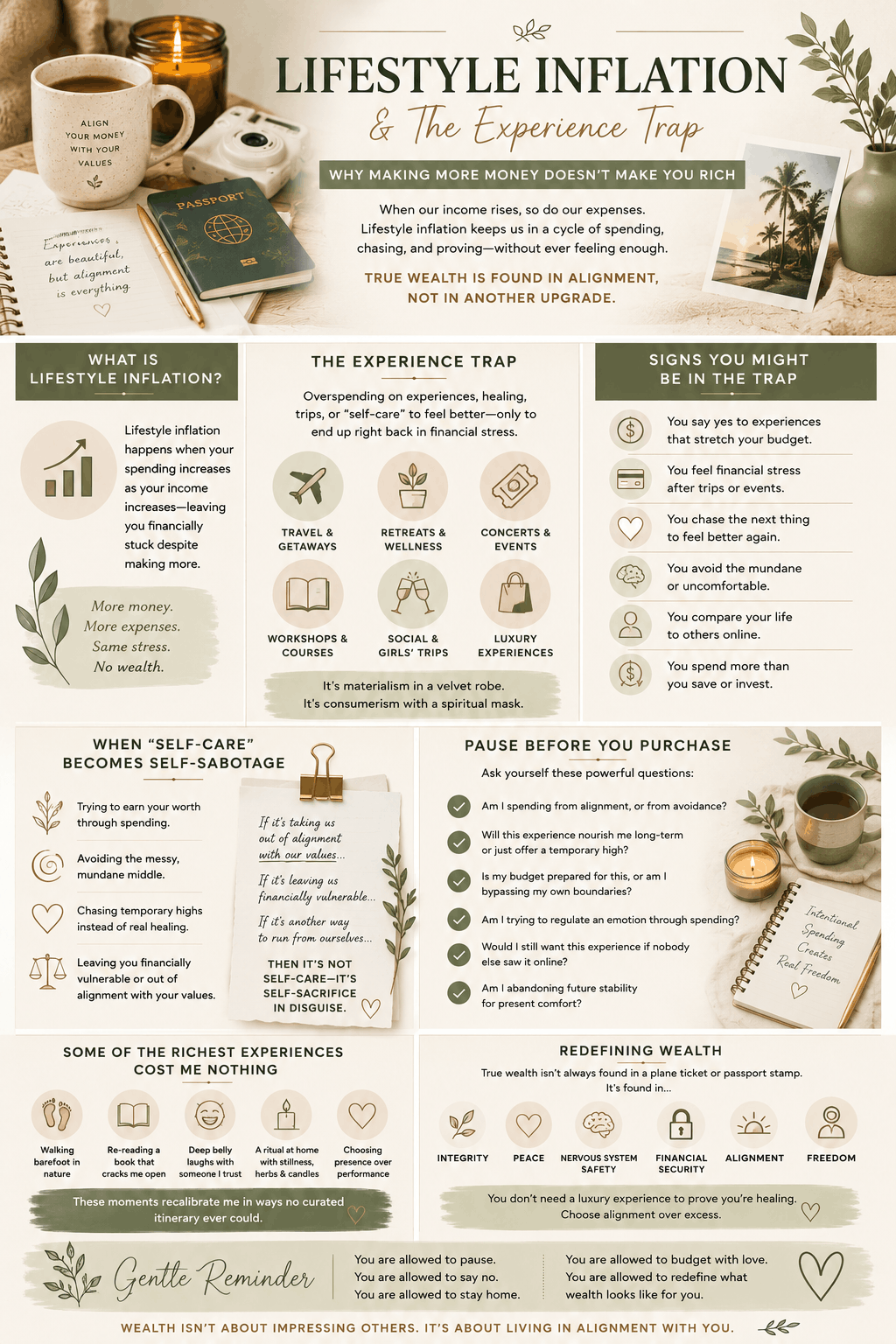
The experience trap happens when we overspend on healing, social events, luxury experiences, retreats, travel, concerts, or self-development in the name of self-care — only to end up right back in the financial stress we were trying to escape.
And honestly?
This form of spending can feel incredibly justified.
Because unlike material purchases, experiences often feel meaningful.
Intentional.
Soulful.
Even “healthy.”
You’re not buying another purse.
You’re investing in yourself, right?
But this is where lifestyle inflation gets emotionally slippery.
You book a wellness retreat to reconnect with yourself… but the cost quietly creates anxiety for the next three months.
You say yes to another girls’ trip because you want memories and connection… but deep down you know your savings account is struggling.
You buy another healing course because you believe this one will finally “fix” you.
And the hardest part?
You often can’t even talk about it openly because healing is supposed to be “worth the investment.”

Consumerism in a Softer Outfit
One of the biggest realizations I’ve had over the last few years is that consumerism adapts.
It evolves with us.
If we no longer crave status through designer goods, capitalism simply learns how to market identity, healing, spirituality, wellness, and self-optimization instead.
Lifestyle inflation today often looks less like flashy consumption and more like curated self-improvement.
Expensive wellness memberships.
Luxury morning routines.
Biohacking.
Healing retreats.
Self-development addiction.
Constant optimization.
And listen — I’m not against any of these things.
I love beautiful experiences.
I love travel.
I love intentional spending.
I love investing in growth.
But I think we need more honest conversations about the emotional motivations underneath our spending.
Because sometimes what we call “alignment” is actually avoidance.
Research in behavioral psychology shows that emotional spending is often tied to dopamine-seeking behaviors, stress regulation, identity formation, and emotional escape. Which honestly makes so much sense.
Experiences can absolutely bring joy.
But they can also temporarily distract us from discomfort we haven’t fully processed yet.
And temporary relief is not the same thing as long-term peace.
When Self-Care Becomes Self-Sabotage
This isn’t about shaming rest, pleasure, beauty, or joy.
I think women especially deserve softness, experiences, celebration, and spaciousness.
But I also think there’s an important distinction between supportive spending and self-abandonment disguised as self-care.
Sometimes we’re still trying to earn our worth.
Sometimes we’re emotionally exhausted and desperate for relief.
Sometimes we feel behind in life and experiences become a way to feel “caught up.”
Sometimes we simply want to feel alive again.
And honestly, I deeply understand that.
But if our spending is:
creating chronic financial stress
disconnecting us from our values
draining our savings
increasing emotional instability
reinforcing avoidance patterns
making us financially dependent or vulnerable
…then it may not actually be self-care.
It may be emotional spending in softer packaging.
That realization was incredibly uncomfortable for me personally because I had to admit that some of my “healing” spending was actually coming from dysregulation, escapism, and emotional avoidance.
Not all of it.
But enough of it.
And awareness changed everything.
Pause Before You Purchase
One of the healthiest things I started doing was pausing before emotional or experiential spending.
Not to shame myself.
Not to deprive myself.
But to reconnect with intentionality.
Now before I spend money on certain experiences, I ask myself:
Am I spending from alignment or avoidance?
Is this nourishing me long-term or offering temporary relief?
Does my budget genuinely support this right now?
Am I trying to regulate an emotion through spending?
Would I still want this experience if nobody else saw it online?
Am I abandoning future stability for present comfort?
And honestly, those questions have saved me thousands of dollars.
Because sometimes what I actually needed wasn’t another escape.
It was rest.
Stillness.
Routine.
Therapy.
Connection.
Sleep.
Boundaries.
Time offline.
Some of the most healing experiences I’ve had lately cost almost nothing.
Walking barefoot outside.
Cooking slowly at home.
Reading old journal entries.
Laughing deeply with people I trust.
Lighting candles and sitting in silence.
Listening to music without multitasking.
Spending an entire weekend not trying to “optimize” myself.
Those moments recalibrated my nervous system in ways no luxury itinerary ever could.
Lifestyle Inflation & Social Media Pressure
I also think social media has quietly intensified lifestyle inflation in ways we don’t fully acknowledge yet.
We are constantly exposed to curated versions of wealth, healing, freedom, beauty, and luxury.
And because so much of wellness culture is now aestheticized online, it becomes easy to associate spending with self-worth.
You start believing:
healing should look luxurious
success should look expensive
freedom should look photogenic
self-care should cost money
But true wealth often looks much quieter than social media teaches us.
Research consistently shows that people tend to adapt quickly to lifestyle upgrades — a psychological concept known as hedonic adaptation. Which means the “high” we get from new experiences or purchases usually fades faster than we expect.
And if we’re constantly chasing the next emotional high through spending, lifestyle inflation becomes endless.
There will always be another retreat.
Another destination.
Another luxury experience.
Another thing promising transformation.
But eventually, we have to ask ourselves:
What are we actually searching for underneath all of it?
Choose Presence Over Performance
You do not need a luxury experience to prove you’re healing.
You don’t have to earn rest through spending.
You don’t have to perform abundance online.
You don’t have to financially overextend yourself to feel worthy, successful, spiritual, or evolved.
And honestly, one of the most financially healing things I’ve learned is how to stay home without feeling like I’m missing my life.
That used to feel impossible for me.
Now it feels grounding.
Because true wealth isn’t always found in plane tickets, passport stamps, expensive dinners, or curated experiences.
Sometimes true wealth looks like:
peace
enoughness
nervous system safety
boundaries
financial stability
slow mornings
emotional regulation
savings
integrity
freedom from constant chasing
Lifestyle inflation teaches us to constantly upgrade our lives externally.
But real wealth often asks us to slow down long enough to reconnect internally.
And honestly?
That version of abundance feels so much fuller to me now.
Further Reading
Continue Exploring Money, Healing & Alignment
If you're navigating emotional spending, money mindset, financial wellness, or redefining what wealth truly means, these posts may support you further.
Free Resource To Share
If lifestyle inflation or emotional spending has been creating stress for you lately, I’d really recommend starting with the Financial Clarity Webinar.
It gently walks through some of the biggest money habits and mindset patterns that keep people financially stuck while helping you build a healthier, more grounded relationship with money.
Product Recommendation
One book I genuinely think supports this conversation beautifully is The Year of Less.
It explores emotional spending, consumption, identity, and what happens when we stop using purchases to emotionally fill ourselves. It’s thoughtful, grounding, and deeply reflective without feeling judgmental.
FAQs
What is lifestyle inflation?
Lifestyle inflation happens when your spending increases alongside your income, making it difficult to build long-term wealth even while earning more money.
Why does lifestyle inflation happen?
Lifestyle inflation often happens because people unconsciously adjust their spending habits as their income grows. Emotional spending, social comparison, stress, and identity-based spending can also contribute.
Can experiences contribute to lifestyle inflation?
Yes. Lifestyle inflation is not only about material purchases. Expensive travel, wellness retreats, luxury self-care, social events, and constant experiential spending can also create financial strain over time.
What is emotional spending?
Emotional spending is using money to cope with emotions such as stress, loneliness, burnout, boredom, insecurity, or anxiety instead of addressing the root emotional need directly.
How can I avoid lifestyle inflation?
You can avoid lifestyle inflation by creating intentional spending habits, maintaining financial boundaries, increasing savings as income grows, and checking in emotionally before making purchases.
Is self-care spending always bad?
No. Rest, pleasure, healing, and experiences can absolutely be supportive. The key is understanding whether the spending is aligned and sustainable or being used to avoid emotional discomfort or financial reality.
〰️ LISTEN TO THE PODCAST OR WATCH THE VIDEO
↳ Listen to the full podcast version of this post and many others on The Greenest Tea Podcast
↳ Watch the YouTube Video for this blog post HERE
〰️ WORK WITH ME
↳ my coaching services https://bit.ly/3ZAs0NZ
↴ additional resources and perks:
→ Watch my FREE Webinar 'From Financial Confusion to Clarity' - https://bit.ly/4h7dXqq 📺
→ Download my free ebook on mastering your money mindset https://bit.ly/3fAfj33 💵
→ Download my free Wealth Tracker - https://bit.ly/48H8Rxj 🧮
→ Invest in stocks with Wealthsimple https://bit.ly/3PJYscp 📈
→ Invest in crypto and receive $25 USD https://bit.ly/3TxD4dr 🪙
→ Invest like the rich in art and receive a $200 bonus (USD only) https://bit.ly/3Popuqh 🖼️
→ Sign up for my bi-weekly newsletters https://bit.ly/466g09H 📨
〰️ CONTACT ME
✉️ hello@morganblackman.com
