
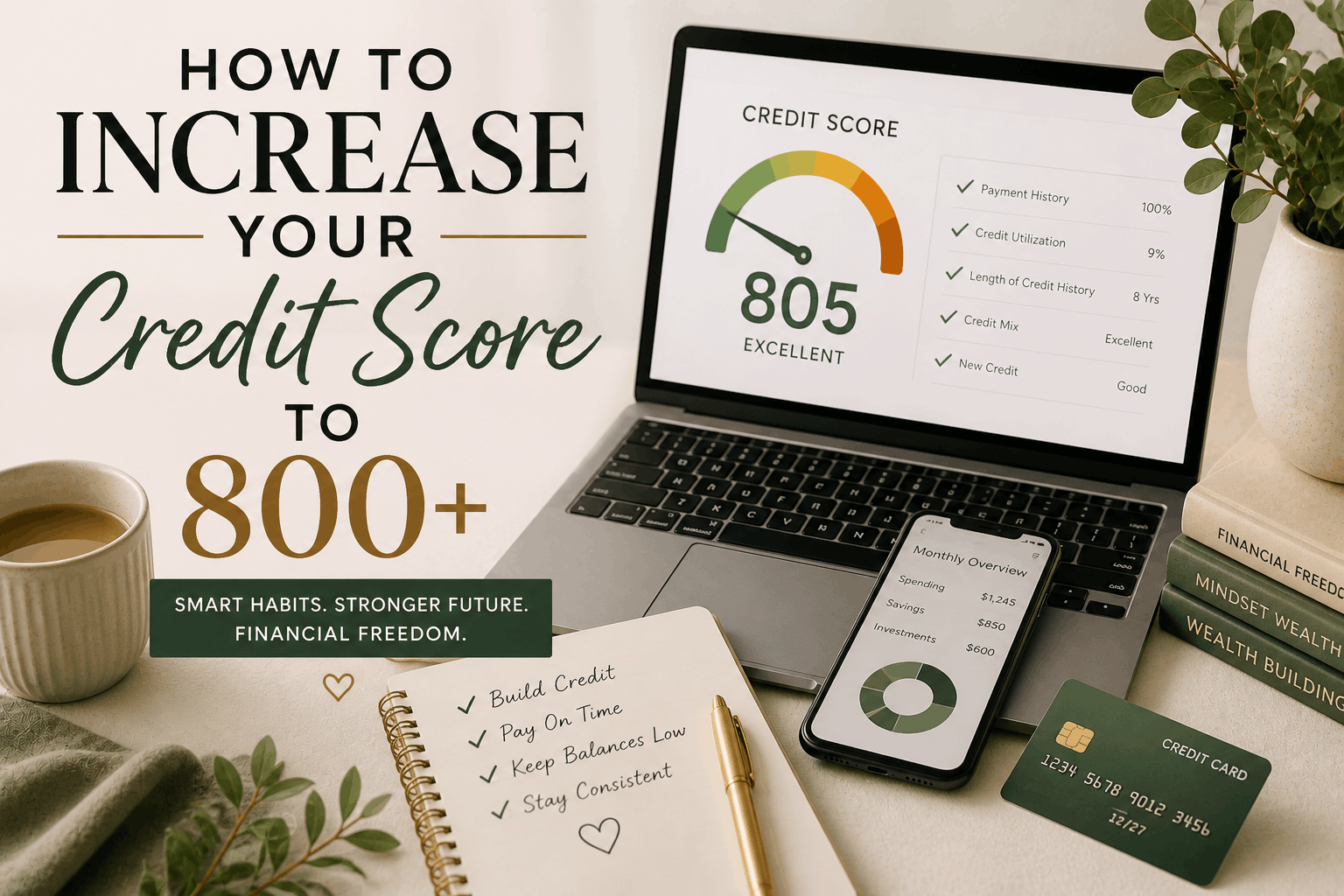
How to Increase Your Credit Score to 800+
Learning how to improve your credit score isn’t about being perfect with money — it’s about building healthier financial habits consistently over time. From managing your credit utilization to understanding responsible credit card use and long-term credit history, small changes can significantly impact your score. In this guide, we’re breaking down practical credit building strategies that can help you move closer to an excellent credit score while creating healthier financial habits overall.
The Credit Habits That Helped Me Reach 800+
Improving your credit score requires a combination of smart habits and consistent financial management. Learning how to improve your credit score involves strategies like increasing your credit limit, managing credit cards responsibly, and building strong credit history. With the right credit building strategies, reaching an excellent score is possible.
A big financial goal for many people is paying off debt completely.
And honestly, one of the hardest parts about becoming more financially conscious is realizing how much past financial decisions can continue affecting your future opportunities for years afterward.
Sometimes it’s credit card debt.
Sometimes it’s student loans.
Sometimes it’s missed payments or simply never learning how credit actually works in the first place.
Because the truth is, many of us were never properly taught financial literacy growing up.
We were handed credit cards before we fully understood:
interest rates
utilization
payment history
credit history
how scores are calculated
how long financial decisions follow you
And honestly? I think a lot of people carry shame around credit scores when really they were never given the education they needed in the first place.
Over the past several years, I’ve been fortunate enough to maintain a credit score above 800. And while nobody needs an 800+ score to build wealth or become financially successful, it can absolutely create more financial flexibility, lower interest rates, and stronger borrowing opportunities long-term.
More importantly though, improving your credit score often reflects healthier financial habits overall.
1. Keep Your Credit Utilization Low
The biggest factor that helped me maintain my credit score in the 800s was consistently managing my credit utilization rate.
Credit utilization refers to how much of your available credit you’re actively using at any given time.
For example:
if your credit limit is $1,000
and your balance is $800
…your utilization rate is 80%, which is considered very high.
Most financial experts recommend keeping utilization below 30%, but personally, I try to stay closer to 10% whenever possible.
This was one of the biggest lessons I learned the hard way.
Years ago, I maxed out a credit card and watched my score drop over 100 points incredibly quickly. That experience completely changed how I viewed credit.
Because credit cards are not free money.
They’re financial tools.
And honestly, one of the healthiest habits you can build is only using your credit card for purchases you could realistically pay off relatively quickly.
Research from Experian consistently shows that lower credit utilization is one of the strongest factors associated with higher credit scores.

A laptop with a man’s right hand shown holding a rainbow Mastercard.
2. Increasing Your Credit Limit Can Help
One strategy that helped improve my credit score significantly was increasing my available credit limit over time.
Because when your total available credit increases, your utilization percentage automatically decreases — even if your spending stays the same.
For example:
someone with a $1,000 limit using $500 has 50% utilization
someone with a $10,000 limit using $500 has only 5% utilization
That’s a huge difference.
However, I do think this strategy requires honesty and self-awareness.
Because if increasing your limit simply leads to overspending or accumulating more debt, it can quickly backfire.
Personally, having a higher available limit gave me more flexibility while still allowing me to maintain low utilization rates consistently.
This is why I always say financial wellness is less about restriction and more about responsible management.
3. Never Miss a Payment
This advice sounds repetitive because it truly matters that much.
Payment history is one of the largest factors affecting your credit score.
Late payments can:
lower your score significantly
remain on your report for years
affect future borrowing opportunities
increase interest rates
And honestly, automating payments has been one of the simplest ways I’ve protected my score long-term.
Even if you can’t pay the full balance immediately, making at least the minimum payment on time still matters enormously.
Behavioral finance research continues to show that automation significantly improves financial consistency and reduces missed payments over time.
Sometimes the best financial systems are the simplest ones.

4. Be Careful With Reward Credit Cards
This opinion may surprise some people.
But honestly? I think many reward cards psychologically encourage overspending.
Travel points.
Luxury perks.
Cashback bonuses.
Exclusive rewards.
And while there’s nothing inherently wrong with rewards cards, many people end up spending far more money chasing perks than the rewards themselves are actually worth.
I’ve personally experienced this too.
At one point, I opened a rewards card specifically for travel perks and realized I needed to spend thousands just to receive relatively modest rewards back.
That perspective shifted how I viewed “free” perks entirely.
This is something I talk more about in “Conscious Spending: How to Spend Without Guilt” because intentional spending matters far more than chasing rewards impulsively.
5. Keep Your Oldest Credit Card Open
One of the biggest mistakes I made financially was closing one of my oldest credit cards.
At the time, I thought I was simplifying my finances.
But what I didn’t fully realize was how heavily credit history impacts your score.
The longer your accounts stay open and active responsibly, the stronger your overall credit history appears.
Closing older cards can:
shorten your average credit age
reduce available credit
increase utilization percentages
And honestly, I wish more people understood this before canceling long-standing cards impulsively.
If possible, it’s often better to keep older accounts open and use them occasionally for small purchases instead.

6. Multiple Credit Cards Can Sometimes Help
This may sound counterintuitive, but responsibly managing multiple credit cards can actually improve your score.
Why?
Because multiple cards can:
increase total available credit
lower utilization percentages
diversify your credit profile
Personally, I maintain multiple cards across personal and business spending categories, which helps me distribute expenses without heavily utilizing any one account.
But again, this strategy only works if spending stays intentional and manageable.
More available credit is only helpful if it’s being managed responsibly.
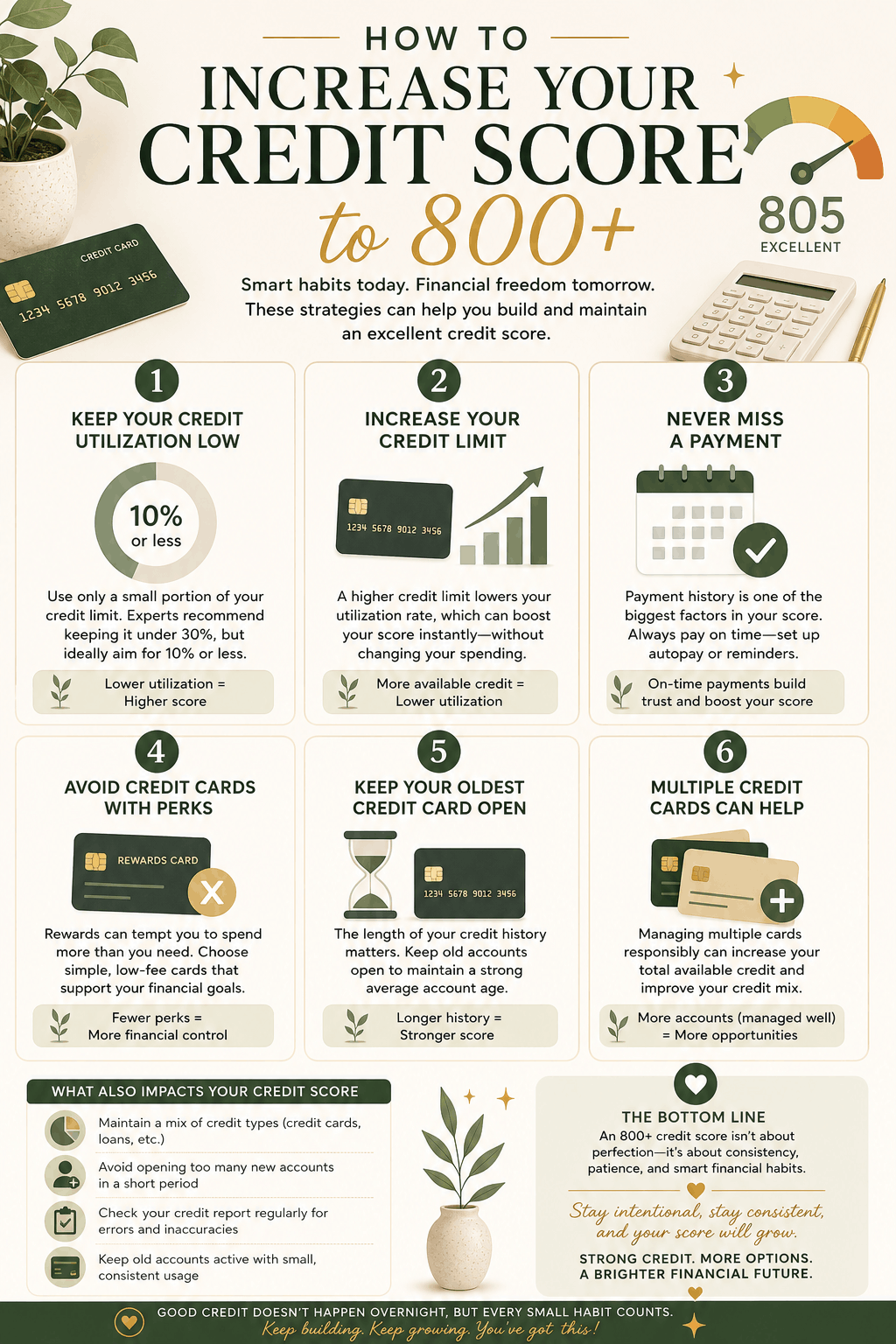
Improving Your Credit Score Is Really About Consistency
An 800+ credit score isn’t built overnight.
And honestly, it’s not really about perfection either.
It’s usually the result of:
consistent payments
lower utilization
intentional spending
financial awareness
patience
long-term habits
That’s what credit building strategies really come down to.
Not becoming obsessed with numbers — but learning how to manage money more consciously over time.
Because improving your credit score isn’t just about qualifying for loans or impressing lenders.
For many people, it’s also about rebuilding trust with themselves financially.
And honestly? That confidence matters too.
Further Reading
Strengthen Your Financial Foundation
If you're currently working on improving your finances, paying off debt, or building healthier money habits, these posts may support you further.
Free Resource to Start With
If you’re currently working on improving your financial habits, paying down debt, or creating more structure around your money, my Wealth Well Tracker can help you stay organized and intentional with your financial goals in a supportive, realistic way.
Product Recommendation
One financial tool I genuinely recommend for improving spending awareness and managing money more intentionally is KOHO because it helps track spending, build healthier financial habits, and reduce the temptation to overspend on traditional credit cards. Download KOHO and receive for 3 free months get access to the KOHO Everything Plan. A premium, all-inclusive prepaid Mastercard subscription ($22/month or $177/year) offering maximum rewards and high-interest savings. It features 3.5% interest on the entire balance, 2% cash back on groceries, transportation, and dining, and 0.5% on other purchases, plus no foreign exchange fees.
FAQs
What is considered a good credit score?
Generally, a credit score above 700 is considered good, while scores above 800 are considered excellent.
How can I improve my credit score quickly?
Lowering your credit utilization, making on-time payments, and avoiding missed payments are some of the fastest ways to improve your score over time.
What is credit utilization?
Credit utilization is the percentage of available credit you’re currently using compared to your total credit limit.
Does increasing your credit limit improve your credit score?
It can help lower your credit utilization ratio, which may positively impact your score if spending stays manageable.
Should I close old credit cards?
Usually no. Keeping older accounts open can strengthen your credit history and improve your overall credit profile.
Do multiple credit cards hurt your credit score?
Not necessarily. Multiple credit cards can actually help your score if they’re managed responsibly and utilization remains low.
This article is for informational purposes only, it should not be considered Financial or Legal Advice. Consult a financial professional before making any major financial decisions.
〰️ WORK WITH ME
↳ my coaching services https://bit.ly/3ZAs0NZ
↴ additional resources and perks:
→ Download my free ebook on mastering your money mindset https://bit.ly/3fAfj33 💵
→ Download my free Wealth Tracker - https://bit.ly/48H8Rxj 🧮
→ Invest in stocks with Wealthsimple https://bit.ly/3PJYscp 📈
→ Invest in crypto and receive $25 USD https://bit.ly/3TxD4dr 🪙
→ Invest like the rich in art and receive a $200 bonus (USD only) https://bit.ly/3Popuqh 🖼️
→ Sign up for my bi-weekly newsletters https://bit.ly/466g09H 📨
〰️ CONTACT ME
✉️ hello@morganblackman.com
