
How to Set SMART Financial Goals (With Real Examples)
Setting SMART financial goals helps turn vague money intentions into clear, actionable plans. By using the SMART framework—specific, measurable, achievable, relevant, and time-bound—you can create realistic financial goals that support long-term wealth and consistency.

Setting SMART financial goals is one of the most effective ways to turn your financial dreams into actionable plans. But if we’re being honest, most people don’t struggle with dreaming big—they struggle with following through.
If you’ve ever felt stuck in your financial journey, despite knowing what you want, you’re not alone. A lot of people have goals, but they don’t have a structure to support those goals. And without that structure, it’s easy for things to stay in the “idea phase” instead of actually becoming part of your life.
That’s really what this comes down to—closing the gap between intention and action.
Why Most Financial Goals Fall Apart
Here’s the truth most people don’t talk about: goals without a plan are just dreams in disguise.
And that’s where a lot of financial goals fall apart.
You might say things like, “I want to save more money” or “I want to get out of debt,” and while those are great intentions, they’re not clear enough to act on. What does “more” actually mean? What does “better” look like?
Without clarity, it becomes really hard to stay consistent. And when consistency drops, so does momentum. This is usually the point where people start feeling frustrated or discouraged, even though the issue isn’t effort—it’s structure.
This is also why having clear direction is such a big part of how to build wealth, because your goals are what guide your decisions day-to-day.
Why SMART Goals Make Such a Difference
The difference between people who follow through on their financial goals and those who don’t often comes down to clarity.
SMART goals give you that clarity.
They take something vague and turn it into something you can actually work toward. Instead of guessing what progress looks like, you can see it. Instead of relying on motivation, you create a system.
And over time, that system becomes one of your strongest financial habits for wealth building, because it keeps you consistent even when you don’t feel motivated.
What SMART Financial Goals Actually Mean
The SMART framework is simple, but when you actually apply it, it changes everything.
SMART stands for:
Specific
Measurable
Achievable
Relevant
Time-bound
It’s not complicated, but it forces you to get clear—and clarity is what most people are missing when it comes to their finances.
Breaking Down SMART Goals (In a Real-Life Way)
Instead of overcomplicating this, let’s walk through what this actually looks like in practice.
Specific
Your goal needs to clearly define what you’re working toward. Not in a general way, but in a way that actually gives you direction.
For example, instead of saying, “I want to save money,” you might say, “I want to save $10,000 for a home down payment by December 2024.”
Now you’re not just hoping—you’re working toward something concrete.
Measurable
Once your goal is specific, it needs to be measurable. This is what allows you to track your progress and stay accountable.
If your goal is $10,000, then the next question becomes: how are you going to get there?
How much do you need to save each month?
What does that look like weekly?
How will you know you’re on track?
When you break it down, it becomes much easier to follow through. For example, saving $10,000 over 18 months comes out to about $556 per month.
Achievable
This is where honesty comes in.
Your goal should challenge you, but it also needs to be realistic based on your current situation. If it feels completely out of reach, it’s going to be hard to stay consistent with it.
Instead of setting a goal that overwhelms you, adjust it to something that feels doable. Because consistency will always get you further than intensity.
Relevant
Your goal should actually matter to you—not just sound good on paper.
It should align with what you’re trying to build in your life right now. If you’re focused on stability, your goal might be building an emergency fund. If you’re focused on growth, it might be investing.
And a lot of this comes back to your relationship with money, which I talk more about in how to build a healthy relationship with money.
Time-Bound
Every goal needs a timeline.
Without a deadline, there’s no urgency. And without urgency, it’s easy to keep pushing things off.
A time-bound goal creates structure and gives you something to work toward. For example:
“I will save $10,000 by December 2024 by contributing $556 each month.”
Now your goal has direction, structure, and accountability built into it.
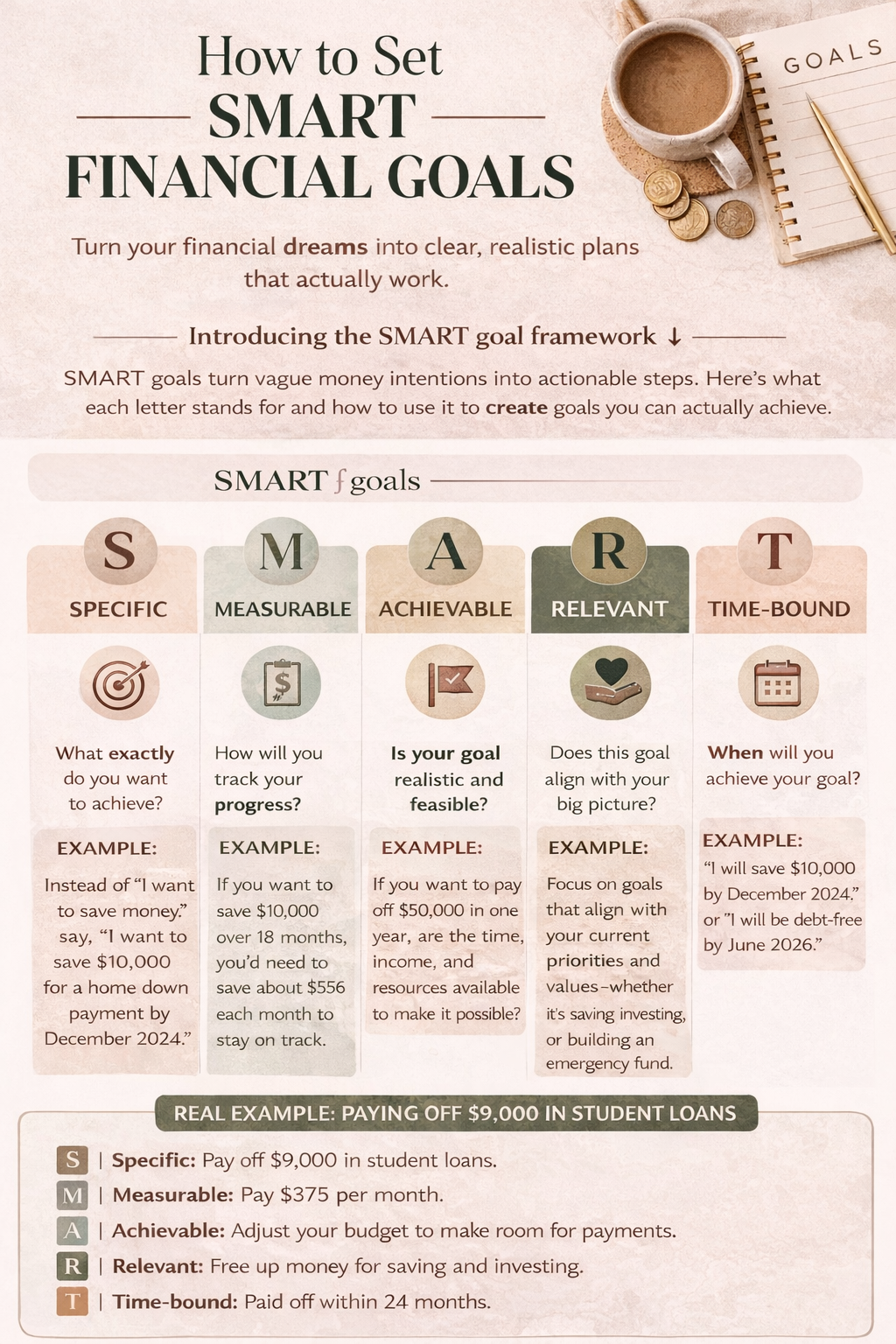
A Real Example: Paying Off $9,000 in Student Loans
Let’s bring this all together in a way that actually feels real.
If you’re a recent graduate with $9,000 in student loan debt, your SMART goal might look like this:
Specific: Pay off $9,000 in student loans
Measurable: Pay $375 per month
Achievable: Adjust your budget to make room for payments
Relevant: Free up money for saving and investing
Time-bound: Paid off within 24 months
What this does is take something that feels overwhelming and break it into something manageable. Instead of focusing on the full amount, you’re focusing on the next step—and that’s what builds momentum.
Common Mistakes to Watch For
Even with a framework like this, there are a few patterns that come up again and again.
A lot of people:
set goals that are too vague
don’t write them down
try to do too much too quickly
stop tracking their progress
None of this means you’re bad with money. It just means you don’t have the right system in place yet.

Staying Consistent With Your Financial Goals
Setting the goal is one thing, but staying consistent is where the real work happens.
And what I’ve found is that consistency doesn’t come from being perfect—it comes from staying connected to what you’re working toward.
That might look like:
creating accountability (whether that’s a coach, a friend, or even writing it down)
celebrating small wins instead of waiting for the end result
adjusting your plan when life happens instead of abandoning it
Because life will happen.
And the goal isn’t to get everything right—it’s to keep moving forward.
Turning Your Goals Into Action
At the end of the day, financial goals only work if you act on them.
Not perfectly.
Not all at once.
But consistently.
So if you take anything from this, let it be this: start with one goal, write it down using the SMART framework, and take the first step. If you're ready to create a S.M.A.R.T goal, here's my customized S.M.A.R.T. Goal worksheet.
Because the longer you wait for the “perfect time,” the longer your goals stay where they are—ideas instead of reality.

FAQ: SMART Financial Goals Questions You Might Be Asking
What are SMART financial goals?
SMART financial goals are structured goals that are specific, measurable, achievable, relevant, and time-bound, making them easier to follow and achieve. If you're ready to create a S.M.A.R.T goal, here's my customized S.M.A.R.T. Goal worksheet.
Why are SMART goals important for financial success?
They provide clarity, structure, and accountability, which helps you stay consistent and track progress over time.
How do I set realistic financial goals?
Start by defining a clear goal, breaking it into measurable steps, and setting a timeline that feels achievable based on your current situation.
Can SMART goals help with saving money?
Yes, SMART goals make saving more intentional by giving you a clear target and plan instead of relying on vague intentions.
If you’d like to keep journeying together…
→ Start Here: free tools and reflections to help you feel grounded, clear, and more confident with your money.
→Work With Me: private coaching, strategy sessions, and programs designed to help you build wealth that feels aligned, stable, and sustainable.
→ Subscribe to the Channel: If this resonated, come hang out with me on YouTube where I break this down in real life — the habits, the mindset shifts, and what this actually looks like day-to-day.
→ Or Join My Email List: This is where I share deeper insights, behind-the-scenes thoughts, and the kind of conversations we don’t always have publicly.
