
5 Budgeting Benefits That Will Transform Your Financial Life
Budgeting isn’t about restriction. It’s about clarity and control over your finances. Understanding the real budgeting benefits can help you build better financial habits, reduce stress, and create a simple system for managing your money. These budgeting tips for beginners will show you how effective budgeting methods can transform your financial life.

The 5 Real Benefits of Budgeting (That Actually Change Your Life)
When people talk about budgeting, they usually focus on what you have to give up. But in reality, budgeting gives you more than it takes.
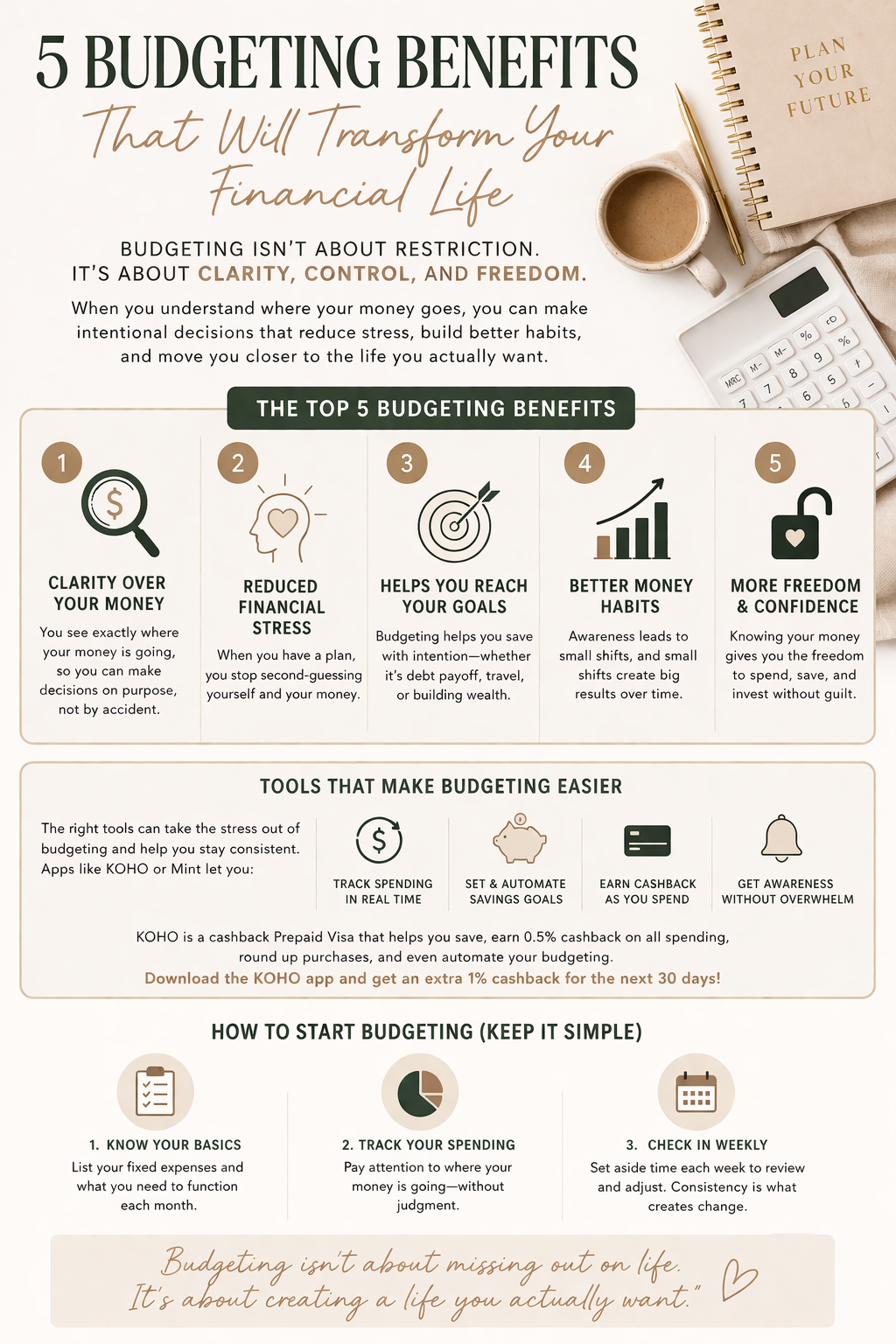
At its core, budgeting creates five key shifts:
clarity over where your money is going
less financial stress and second-guessing
stronger, more intentional spending habits
a clear path toward your goals
more freedom and confidence with your money
Everything else in this post really comes back to these.
Why Budgeting Feels So Frustrating (At First)
Let’s face it: hearing “budgeting” is enough to make your eyes roll. It feels tedious, like it’s taking your freedom away and forcing you to confront uncomfortable truths about where your money actually goes. Most people don’t avoid budgeting because they’re bad with money—they avoid it because it feels restrictive, overwhelming, and honestly a little confronting.
But what I’ve learned over time is that budgeting only feels that way when you’re approaching it from the wrong angle. When you see budgeting as control, it feels heavy. When you see it as clarity, it starts to feel like relief. With the right approach, budgeting becomes less about restriction and more about awareness, helping you develop mindful money habits and spend without stress. This is also why budgeting is one of the first steps in learning how to build wealth, because without understanding your money, it’s almost impossible to grow it intentionally.
This is why one of the biggest benefits of budgeting is clarity—because once you can see what’s happening, everything starts to feel more manageable.
Budgeting Is Less About Restriction and More About Freedom
Budgeting isn’t about cutting everything out or saying no to your life. If anything, it gives you more freedom—just a different kind of freedom than people expect. It’s the freedom of knowing where your money is going, the freedom of not second-guessing every purchase, and the freedom of not feeling that constant low-level stress about whether you’re doing “enough.”
A lot of people approach budgeting like it’s a punishment, when really it’s just a tool. And like any tool, it works best when it’s used in a way that fits you. There isn’t one perfect system that works for everyone. The goal isn’t to follow a rigid structure—it’s to create something that supports your lifestyle and helps you feel more in control over time.
And this is where another major benefit of budgeting comes in—it reduces that constant financial stress and uncertainty.
My Experience: What Budgeting Actually Did for Me
Let me give you a real example from my own life. When I bought my car in 2017 for $13,000, I made the decision pretty early on that I didn’t want to be paying it off for years longer than necessary. So I created a plan.
That plan wasn’t fancy—it was just consistent.
I picked up a second job, became more aware of my spending, and made intentional choices about where my money was going. Budgeting wasn’t about restricting myself—it was about redirecting my money toward something I actually cared about. And over time, that consistency added up. I paid the car off two years early.
What budgeting gave me wasn’t just results—it gave me direction. It showed me what was possible when I was actually paying attention. That’s when I started to see how budgeting helps you actually move toward your goals instead of just thinking about them. A lot of this also ties into your relationship with money and how you’ve been taught to think about it, which I go deeper into in your money story: how your past shapes your financial future.
Why Most Budgeting Advice Doesn’t Stick
One of the biggest problems with budgeting advice is that it’s often too rigid. People are taught one method and expected to make it work, even if it doesn’t match their personality or lifestyle. And when it doesn’t stick, they assume they’re the problem.
But budgeting isn’t supposed to feel like punishment—it’s supposed to feel like support.
This is where I always think about what James Clear talks about in Atomic Habits. Habits stick when they’re obvious, easy, and satisfying. Budgeting should follow the same logic. If your system feels complicated or draining, you’re not going to stay consistent with it—and consistency is what actually builds results.
Finding a Budgeting Style That Actually Works for You
Not everyone is going to approach budgeting the same way, and that’s a good thing. Some people love spreadsheets and structure, while others prefer something more visual or automated.
The method matters less than your ability to stay consistent with it.
Once you find something that fits your personality, budgeting starts to feel less like something you have to do and more like something that naturally fits into your life. And this is often where people begin to shift their financial habits for wealth building, because awareness always comes before change.
Over time, this is what builds better spending habits—ones that actually align with your life instead of working against it.
Using Tools to Make Budgeting Easier
One thing that has made a big difference for me is using tools that remove friction from the process. Budgeting becomes a lot easier when you don’t have to think about it constantly.
Apps like KOHO or Buddy allow you to track your spending, set savings goals, and get real-time insights into your finances without having to manually track everything. Since I started using KOHO, I’ve been able to:
earn cashback on purchases
set automatic savings goals
stay aware of how my spending connects to my bigger goals
And what I’ve noticed is that it makes the process feel lighter. It becomes something that’s integrated into your life instead of something extra you have to manage.
KOHO is a cashback Prepaid Visa card, that you can use to pay off your bills and other expenses while also using it to earn 0.5% cashback on all spending. Additional features include savings accounts for multiple life goals, dollar round-ups and wait for it — automatic budgeting. Download the KOHO app and get an extra 1% cashback for the next 30 days.
How to Start Budgeting Without Overcomplicating It
If you’re just starting out, the most important thing you can do is keep it simple. You don’t need a perfect system—you just need a starting point.
Focus on a few key things first:
understanding your fixed expenses
tracking where your money is currently going
setting aside time each week to check in
From there, you can start making small adjustments. Budgeting isn’t something you master overnight—it’s something you build over time. And if your budget ever feels like it’s not working, it usually means it needs to be adjusted—not abandoned. I talk more about that in how to fix your budget when it isn’t working.
What Budgeting Actually Changes
One of the most overlooked benefits of budgeting is the sense of freedom it creates.
And that awareness is what reduces financial stress over time. It’s also one of the most effective ways to manage financial anxiety, which I go deeper into in financial anxiety: how to stop money stress from controlling your life.
Budgeting doesn’t just change your numbers. It changes how you feel about your money—and that’s where the real transformation happens.
If there’s one thing to take away from this, it’s that budgeting isn’t here to limit you. It’s here to support you. It’s what allows you to spend with intention, save with purpose, and build a financial life that actually feels aligned with who you are.
Because at the end of the day, budgeting isn’t about missing out on life.
It’s about creating a life you actually want.

FAQ: Budgeting Questions You Might Be Asking Right Now
What are the benefits of budgeting?
Budgeting helps you gain clarity on your finances, reduce stress, and build better spending and saving habits over time.
How does budgeting help with financial stress?
Budgeting reduces stress by giving you visibility and control over your money, helping you feel more prepared and less reactive.
What is the best way to start budgeting?
The best way to start budgeting is by tracking your current spending and choosing a system that feels simple and sustainable.
Why is budgeting important for building wealth?
Budgeting creates awareness, which allows you to save and invest more intentionally over time.
*Author: Clear, James, Published: New York : Avery, an imprint of Penguin Random House, [2018].
** KOHO is a free pre-paid visa chequing account that makes it easy to feel good about saving and spending.
***Check out this incredible podcast with James Clear on the Rich Roll Show.
If you’d like to keep journeying together…
→ Start Here: free tools and reflections to help you feel grounded, clear, and more confident with your money.
→Work With Me: private coaching, strategy sessions, and programs designed to help you build wealth that feels aligned, stable, and sustainable.
→ Subscribe to the Channel: If this resonated, come hang out with me on YouTube where I break this down in real life — the habits, the mindset shifts, and what this actually looks like day-to-day.
→ Or Join My Email List: This is where I share deeper insights, behind-the-scenes thoughts, and the kind of conversations we don’t always have publicly.
