
How to Start a Coaching Business (And Why It Can Change Your Life)
Learning how to start a coaching business is about far more than creating an Instagram page or offering coaching calls online. Building a sustainable coaching business requires clarity, emotional resilience, intentional branding, client trust, and a willingness to grow both personally and professionally along the way. Whether you’re interested in life coaching, business coaching, wellness coaching, or mindset work, these coaching business tips can help you build a business that creates real impact while supporting the lifestyle and freedom you genuinely want.
When I first started my coaching business, I honestly had no idea how much it would change my life.
At the time, I wasn’t just looking for another career path. I was looking for something that felt meaningful. I wanted to create work that felt aligned with who I was becoming, not just something that paid the bills.
And honestly, I think that’s what draws many people toward coaching in the first place.
It’s rarely just about money.
It’s usually about impact.
Freedom.
Purpose.
Connection.
Helping people through things you’ve personally navigated yourself.
But I also want to be honest from the beginning: coaching is not always easy.
Social media sometimes glamorizes coaching businesses as this effortless “work from your laptop on the beach” lifestyle. And while coaching absolutely can create incredible flexibility and financial opportunity, building a sustainable coaching business still requires emotional resilience, consistency, self-awareness, and a willingness to continuously evolve.
For me personally, coaching became one of the most transformational experiences of my life because it pushed me to grow in every possible direction — emotionally, professionally, financially, spiritually, and creatively.
And honestly, I’m still growing through it now.
Research from the International Coaching Federation continues showing that the coaching industry has grown significantly over the past decade, particularly in areas like wellness, business, mindset, leadership, and career development. At the same time, demand for personalized support, accountability, and transformation-based services continues increasing globally.
But despite the industry growth, I think many people still misunderstand what actually makes a coaching business successful long term.
Because coaching is not just about having knowledge.
It’s about building trust.
Coaching Is About Transformation
At its core, coaching is about helping people move from where they are to where they want to be.
That transformation may involve:
finances
business
health
relationships
mindset
confidence
emotional healing
career growth
life transitions
And honestly, one of the most rewarding parts of coaching is witnessing people reconnect with their own potential in ways they may have forgotten existed.
When I first started coaching, much of it came from my own personal experiences around financial wellness, mindset work, emotional growth, and rebuilding my relationship with money. I realized there were so many things I had learned through lived experience that other people were also struggling with quietly.
And I think that’s important to remember:
Your lived experience matters.
Your story matters.
Your perspective matters.
Many successful coaches build businesses around the intersection of:
personal experience
professional knowledge
emotional intelligence
communication skills
genuine passion for helping others
This is also why niche clarity matters so much in coaching. Research around coaching businesses consistently shows that coaches with clearer positioning and more specific niches often attract stronger clients and build trust faster.

You Don’t Need to Have Everything Figured Out
I think one of the biggest fears people have around starting a coaching business is feeling like they need to be “fully healed” or have their entire life perfectly together first.
And honestly, that mindset keeps a lot of people stuck.
Because coaching is not about perfection.
It’s about guidance.
Support.
Perspective.
Accountability.
Transformation.
You do not need to know everything in order to help someone through something you’ve already navigated yourself.
Now of course, ethical coaching matters deeply. Continuing education, certifications, mentorship, and professional development are all incredibly valuable. But I also think people underestimate how impactful lived experience can be when paired with integrity and emotional awareness.
Some of the best coaches I know are not people pretending to have perfect lives.
They’re people who are honest, self-aware, compassionate, skilled communicators, and deeply committed to helping others grow.
Finding Your Coaching Niche
One of the biggest coaching business tips I can give is this:
Do not try to help everyone.
I know that sounds counterintuitive initially because when you start a business, it feels tempting to cast a very wide net. But honestly, clarity creates trust.
When people clearly understand:
who you help
what problem you solve
what transformation you provide
…it becomes much easier for them to connect with your work.
For example, instead of simply saying:
“I’m a life coach.”
You could position yourself more specifically:
money mindset coach
wellness coach for entrepreneurs
burnout recovery coach
relationship coach
business mindset coach
financial wellness coach
career transition coach
Specificity helps people feel seen.
And honestly, the strongest coaching businesses are usually built around solving clear emotional or practical problems.
This is something I also talk more deeply about in “How to Improve Your Relationship With Money (Beginner Guide),” especially around understanding emotional transformation and long-term behavioral change.
✨ Gentle Reminder
You Don’t Need to Start Perfectly
Many coaching businesses grow slowly and quietly at first. You do not need a massive audience, perfect branding, or years of experience to begin helping people meaningfully. What matters most is your willingness to keep learning, refining your skills, and showing up consistently over time.
Most successful coaches did not start with everything figured out. They started by helping one person well, then another, and slowly built trust from there.
Building Trust Matters More Than Going Viral
One thing I’ve learned through coaching is that trust will always matter more than visibility alone.
You do not need millions of followers to build a successful coaching business.
What you do need is:
credibility
consistency
emotional connection
clear communication
integrity
client results
authenticity
And honestly, I think many people underestimate how powerful genuine connection still is online.
Some of my best coaching opportunities came from:
conversations
referrals
community building
newsletters
workshops
long-form content
honest storytelling
Not viral content.
Research around coaching business growth consistently emphasizes the importance of relationship-building, niche clarity, and authority-building through valuable content and trust over time.
Create an Offer That Solves a Problem
One thing that completely shifted my business was learning how to create coaching offers around actual client problems instead of vague inspiration alone.
People are usually searching for support because they want help with something specific.
For example:
reducing money stress
leaving burnout
improving confidence
building healthier habits
growing a business
navigating life transitions
improving relationships
healing emotionally
The clearer the problem and transformation, the easier your marketing becomes.
And honestly, simplicity usually converts better than complexity.
When people understand:
“This coach helps me solve this specific problem.”
…they’re far more likely to trust your offer.

Coaching Businesses Require Emotional Resilience
I don’t think enough people talk honestly about the emotional side of entrepreneurship.
Building a coaching business can bring up:
self-doubt
fear of visibility
imposter syndrome
rejection
inconsistency
comparison
financial stress
burnout
And honestly, there were moments in my own business journey where I questioned myself deeply.
But one thing coaching has taught me is that entrepreneurship often becomes personal growth work too.
Because your business will frequently mirror your:
beliefs
confidence
boundaries
nervous system
communication patterns
emotional capacity
And honestly, that growth can become incredibly healing if you allow it to.
Multiple Income Streams Matter
One thing I genuinely love about coaching businesses is how flexible they can become over time.
You are not limited to only one-on-one coaching forever.
As your business grows, you can expand into:
group coaching
workshops
memberships
digital products
courses
ebooks
speaking
retreats
affiliate income
brand partnerships
This flexibility creates both creative freedom and financial scalability.
And honestly, creating multiple income streams reduced so much pressure in my own business journey because it allowed me to support clients in different ways while also protecting my energy more sustainably long term.
Marketing Your Coaching Business Without Burning Out
I think one of the biggest misconceptions online is that you need to constantly post content every single day in order to grow.
And honestly, that’s simply not sustainable for many people.
One of the biggest coaching business tips I can offer is this:
Choose marketing strategies that actually align with your personality and energy.
Some people thrive on:
Instagram
TikTok
YouTube
podcasting
networking
email newsletters
blogging
speaking events
Others prefer quieter forms of marketing.
And honestly, both are valid.
The goal is not performing online constantly.
The goal is building trust consistently.
Starting Before You Feel Ready
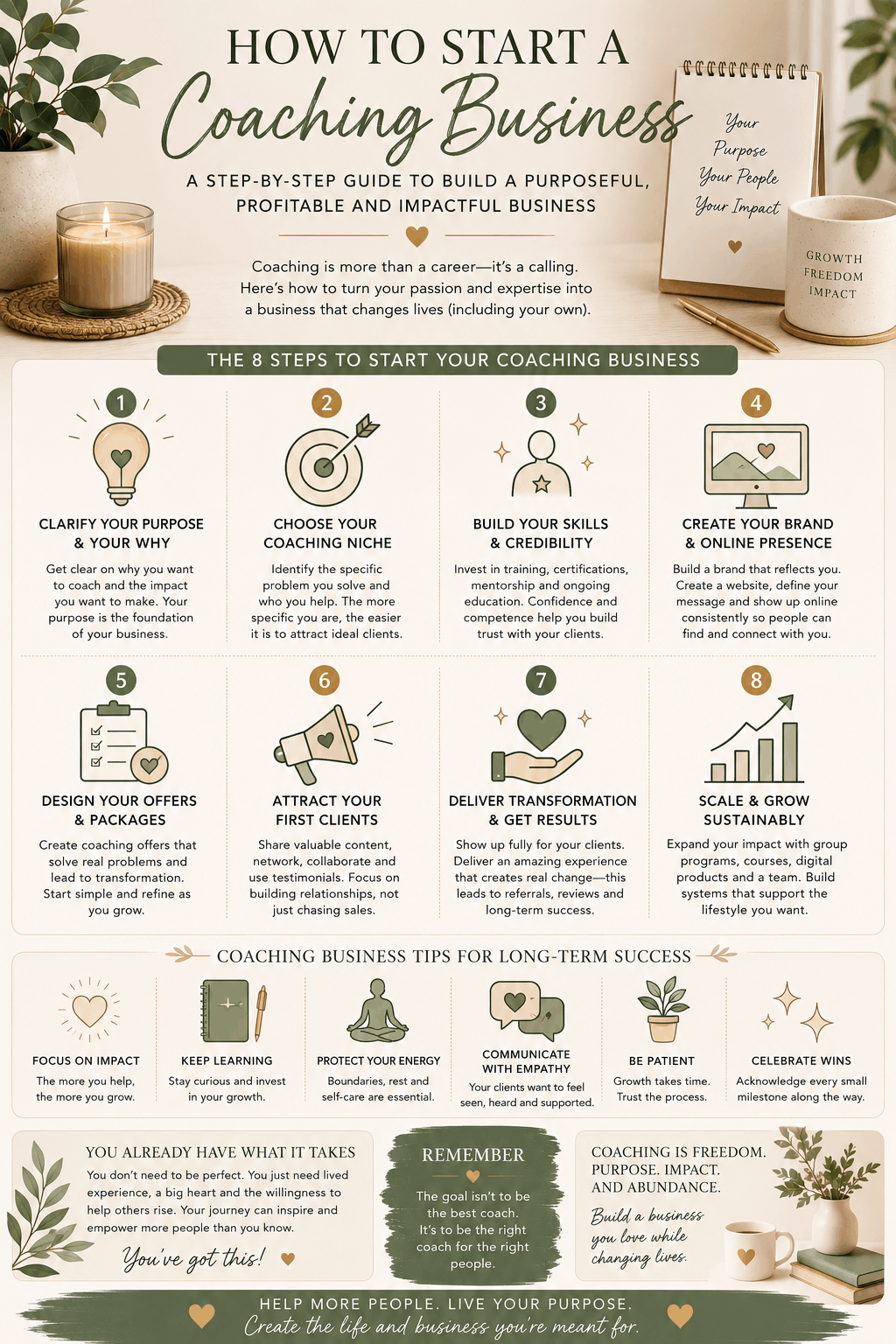
At the end of the day, learning how to start a coaching business is really about deciding whether you’re willing to trust yourself enough to begin.
Not perfectly.
Not fearlessly.
But intentionally.
Because honestly, most coaches do not start fully confident. Most people start scared, uncertain, and still figuring things out as they go. I definitely did.
But over time, confidence grows through action.
Through helping people.
Through refining your voice.
Through learning what works.
Through making mistakes.
Through continuing anyway.
And honestly, coaching has changed my life because it allowed me to build work that feels deeply aligned with who I am while also creating meaningful impact for other people. It gave me flexibility, freedom, creativity, purpose, and opportunities for growth I never would have experienced otherwise.
But none of that happened overnight.
It happened through consistency, learning, emotional resilience, and continuing to show up even when things felt uncertain.
And if you feel genuinely called toward coaching, that curiosity may be worth listening to.
Because sometimes the businesses that transform our lives begin with the simple decision to finally start.
Further Reading
Continue Building Your Business & Abundance
If you’re working toward building a purpose-driven business, improving your mindset, and creating long-term financial freedom, these posts may support you further.
Resource to Start With
If you’re currently working on building confidence, improving your mindset, and creating a more intentional relationship with money and business, I’d start with the Intuitive Wealth Blueprint. It’s designed to help you align your goals, mindset, and financial growth in a way that feels supportive and sustainable long term.
Product Recommendation
One platform I genuinely recommend for new coaches is Thrivecart. What I appreciate most is that it allows you to host coaching programs, digital products, affiliate partner systems, landing pages, and courses all in one place, which can simplify the early stages of building a coaching business significantly.
When you’re first learning how to start coaching, having systems that reduce overwhelm can make a huge difference. Simplicity creates consistency, and consistency is often what helps businesses grow sustainably over time.
Get Started Today
FAQs
How do I start a coaching business?
Start by identifying your coaching niche, understanding the problem you help solve, building trust through content or community, and creating a clear coaching offer.
Do I need certification to become a coach?
Certification is not always legally required, but coaching education and ongoing professional development can improve credibility, confidence, and client trust.
What coaching niche should I choose?
Choose a niche that aligns with your lived experience, skills, passions, and the specific transformation you genuinely enjoy helping people achieve.
How do coaching businesses get clients?
Many coaching businesses attract clients through referrals, social media, workshops, blogging, newsletters, networking, and trust-building content.
Can coaching become a full-time business?
Yes. Many coaches eventually scale through one-on-one coaching, group programs, digital products, memberships, and courses.
How long does it take to grow a coaching business?
Building a sustainable coaching business often takes time, consistency, relationship-building, and ongoing refinement of your offers and messaging.
〰️ WORK WITH ME
↳ my coaching services https://bit.ly/3ZAs0NZ
↴ additional resources and perks: ↴ additional resources:
→ Download my free ebook on mastering your money mindset https://bit.ly/3fAfj33 💵
→ Download my free Wealth Tracker - https://bit.ly/48H8Rxj 🧮
→ Invest in stocks with Wealthsimple https://bit.ly/3PJYscp 📈
→ Invest in crypto and receive $25 USD https://bit.ly/3TxD4dr 🪙
→ Invest like the rich in art and receive a $200 bonus (USD only) https://bit.ly/3Popuqh 🖼️
→ Sign up for my bi-weekly newsletters https://bit.ly/466g09H 📨
〰️ CONTACT ME
✉️ hello@morganblackman.com
