
Common Money Lies That Keep People From Getting Rich
From “get rich fast” schemes to toxic money myths around success, many people grow up believing financial advice that quietly keeps them stuck. The truth is, building wealth usually has far more to do with consistency, emotional awareness, financial habits, and long-term strategy than flashy overnight success. Understanding these common money lies can completely change the way you approach wealth, investing, and financial freedom moving forward.
I honestly think one of the biggest reasons so many people struggle financially is because most of us were never actually taught how money works.
We were taught how to earn money.
How to spend money.
How to survive.
But not necessarily how to build wealth.
And because of that, a lot of us grow up carrying financial beliefs that quietly shape our entire lives without us even realizing it.
I know that was true for me.
My friends and I used to joke all the time about being broke. We’d spend money, live our best lives, laugh about student loans, and tell ourselves we’d figure everything out later. And honestly, when you’re younger, later feels so far away that it almost doesn’t feel real.
Until eventually later actually comes.
I graduated with around $30,000 in student debt while also paying off my car loan. And suddenly, money stopped feeling theoretical. I realized I couldn’t continue joking about being broke forever while secretly feeling anxious every time I checked my bank account.
I wanted stability.
Freedom.
Options.
Security.
I wanted to stop constantly feeling behind financially.
And honestly, one of the biggest things that changed my life was realizing how many money lies I had unconsciously accepted as truth.
Because so many of the things we’re taught about wealth are either incomplete, outdated, emotionally driven, or designed to keep people consuming instead of building.
And once I started questioning those beliefs, everything slowly started changing.
Lie #1: Getting Rich Will Automatically Make You Happy
I think this is one of the biggest money lies society constantly sells us.
That once we finally “make it,” everything in life will suddenly feel better.
And honestly, I understand why people believe that.
Money absolutely can relieve stress in many ways. Financial stability can create safety, flexibility, opportunities, healthcare access, housing security, travel experiences, and a level of peace that financial instability often makes difficult to access.
But money does not magically heal insecurity, loneliness, burnout, self-worth issues, or emotional pain.
And I think social media sometimes makes this even worse because we constantly see curated versions of wealth online that make it seem like rich people are automatically happier, more fulfilled, more successful, and more confident.
But honestly, wealth and happiness are not always the same thing.
I’ve seen people chase money obsessively while neglecting their health, relationships, nervous systems, and emotional wellbeing in the process. And then once they finally reach certain income levels, they realize they still feel disconnected from themselves.
That doesn’t mean money is bad.
It means money is a tool — not a personality transformation.
And I think true financial wellbeing happens when wealth supports your life instead of becoming your entire identity.
This is also something I explore more deeply in “How to Improve Your Relationship With Money (Beginner Guide),” especially around emotional security and money mindset work.

Lie #2: You Need to Make a Lot of Money to Build Wealth
This is probably one of the most damaging money myths that keeps people stuck for years.
There’s this belief that wealth only belongs to:
doctors
celebrities
entrepreneurs making millions
people born into money
people with six-figure salaries
And honestly, I used to believe that too.
I thought building wealth was something you did after you became successful financially, not something you could begin while still trying to get your life together.
But over time, I realized wealth and income are not the same thing.
I’ve seen people making very high incomes still living paycheck to paycheck because their spending increased alongside their salary. And I’ve seen people with average incomes slowly build strong investment portfolios, emergency savings, and financial stability simply because they learned consistency.
That realization shifted everything for me.
When I graduated university, I definitely wasn’t rich. I was paying off debt, trying to stabilize financially, and working hard just to create breathing room. I picked up side hustles, worked in restaurants, budgeted aggressively, and started investing where I could — even if the amounts initially felt small.
And honestly, those smaller consistent habits mattered far more than waiting for some imaginary future version of myself that “made enough money” to start caring about wealth.
Research from Ramsey Solutions found that many millionaires did not build wealth through massive salaries, but instead through long-term investing, consistency, disciplined spending, and financial planning over time.
And honestly, I think that’s incredibly empowering because it means wealth building is often far more accessible than people think.
Lie #3: Get Rich Fast Is Realistic
We really need to talk about the “get rich fast” obsession online.
Because honestly, it’s everywhere now.
Social media constantly pushes:
overnight success stories
luxury lifestyles
trading screenshots
crypto hype
passive income fantasies
“make $10,000 this month” content
quick business promises
And when people are financially stressed, emotionally overwhelmed, or feeling behind in life, those promises become incredibly tempting.
I get it.
When you’re struggling financially, slow wealth can feel frustrating.
You want relief now.
You want security now.
You want your life to change now.
But honestly, sustainable wealth is usually much slower and much less glamorous than social media makes it look.
Real wealth is often built through:
consistency
patience
investing
emotional discipline
long-term thinking
learning
systems
repeated habits
Not shortcuts.
And honestly, I think one of the biggest financial mistakes people make is constantly chasing quick wins instead of building long-term foundations.
This is something I learned personally through investing too. One of the best financial decisions I made years ago was investing money I had saved during university into the stock market instead of spending it all. It wasn’t flashy. It wasn’t instant. But over time, those investments compounded while I continued learning how wealth actually works.
And honestly, that’s the part social media rarely shows:
wealth is often built quietly.
✨ Gentle Reminder
Real Wealth Usually Looks Boring
Long-term wealth is often built through consistency, patience, emotional discipline, investing, financial education, and repeated habits over time — not flashy overnight success stories online.
Sometimes the people quietly building the most wealth are not the people trying hardest to appear rich publicly.
Lie #4: All Debt Is Bad
Debt is one of the most emotionally charged topics in personal finance.
And honestly, I used to think all debt was automatically bad too.
But over time, I realized there’s a massive difference between:
consumer debt
strategic debt
High-interest consumer debt that continuously funds impulsive spending can absolutely become financially destructive.
But strategic debt can sometimes create opportunities that build future wealth.
For example:
education
business investments
real estate
certain forms of leverage
…can potentially increase your earning potential long term when used intentionally.
I’ve personally invested in coaching programs, education, and business support that helped me grow my business significantly. At the time, spending that money felt scary. But those investments eventually helped me create income opportunities that far exceeded the original cost.
That’s why I think financial literacy matters so much.
Because money is nuanced.
And honestly, blanket statements around money rarely tell the full story.
Lie #5: Some People Are Just “Good With Money”
I hear this constantly.
“I’m just bad with money.”
And honestly, I think this belief keeps people trapped in shame.
Because being “good with money” is not some magical personality trait people are born with.
Money management is a skill.
And like any skill:
it can be learned.
Nobody naturally comes into the world understanding:
budgeting
investing
taxes
wealth building
retirement accounts
financial systems
emotional spending
debt management
Those are learned behaviors.
And honestly, many people were never taught them properly in the first place.
That’s why I think financial education can feel so empowering once people stop attaching shame to not already knowing everything.
Because once you stop identifying as “bad with money,” you become much more open to learning.

Lie #6: Wealth Has to Look Expensive
Social media has completely distorted what people think wealth looks like.
We’ve been taught that wealth means:
luxury cars
designer brands
expensive dinners
giant homes
flashy vacations
constant consumption
And honestly, I think a lot of people are quietly going broke trying to look rich online.
Real wealth often looks much quieter than that.
It looks like:
investments
low debt
emergency savings
ownership
options
flexibility
peace
freedom
time
Some of the wealthiest people I know don’t “look rich” at all.
And honestly, I think financial peace is far more impressive than financial performance.
Because true wealth is not about impressing strangers online.
It’s about creating a life that feels secure, sustainable, and aligned with your values.

Lie #7: Investing Is Too Risky
I think fear keeps many people from investing at all.
And honestly, I understand why.
Investing can feel intimidating initially, especially if nobody taught you how it works growing up.
But avoiding investing entirely also comes with risk.
Inflation quietly reduces the value of money over time. And historically, long-term investing through diversified portfolios has significantly outperformed simply leaving money sitting in cash accounts forever.
That doesn’t mean investing is risk-free.
It means learning matters.
Education matters.
Starting small matters.
And honestly, I think people underestimate how life-changing long-term investing can become simply because it doesn’t feel exciting immediately.
But wealth often compounds slowly before it compounds significantly.
Lie #8: Hard Work Automatically Creates Wealth
This one hits deeply because so many people are genuinely working incredibly hard.
Multiple jobs.
Long hours.
Burnout.
Exhaustion.
And still struggling financially.
And honestly, that’s because hard work alone is not always enough.
Wealth also involves:
strategy
systems
opportunities
financial education
emotional regulation
investing
leverage
decision making
Hard work matters.
Absolutely.
But working harder without financial knowledge can sometimes just lead to exhaustion instead of freedom.
And honestly, I think many people deserve far more compassion around this conversation because the financial system itself is not always built equally for everyone.
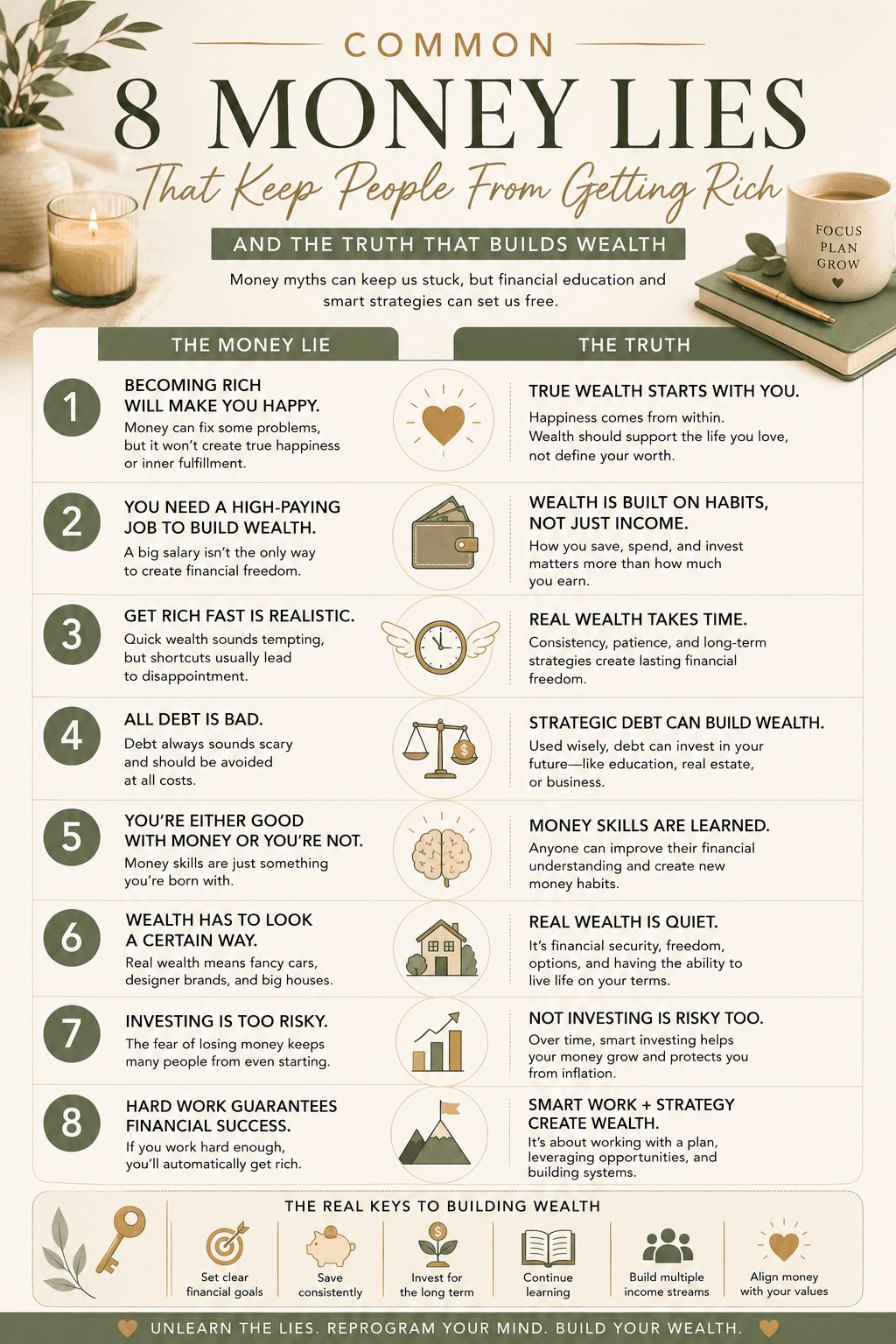
The Real Keys to Building Wealth
Honestly, I think the real keys to building wealth are much less glamorous than people expect.
Building wealth usually looks like:
learning continuously
spending intentionally
investing consistently
managing emotions around money
avoiding lifestyle inflation
creating systems
building multiple income streams
thinking long term
staying patient
And honestly, none of that is particularly viral online.
But it works.
That’s the part people don’t always want to hear because slow wealth requires emotional discipline.
It requires trusting that small consistent actions matter even before you see dramatic results.
And honestly, I think that’s why mindset matters so much around money.
Because if you constantly believe you’re behind, incapable, or doomed financially, your behaviors often start reflecting those beliefs too.

Rewriting Your Relationship With Money
At the end of the day, I honestly don’t think most people are bad with money.
I think most people were simply never taught how wealth actually works.
We were taught how to consume.
How to spend.
How to survive.
How to chase status.
How to look successful.
But many of us were never taught how to:
invest consistently
manage money emotionally
build long-term wealth
create financial systems
understand financial literacy
separate self-worth from income
And honestly, that realization changed everything for me.
For a long time, I genuinely believed wealth belonged to other people. People with different opportunities, different families, different backgrounds, different lives. I thought financial freedom was reserved for people who were naturally smarter with money or simply luckier than I was.
Meanwhile, I was carrying student debt, trying to stabilize financially, working side jobs, and quietly feeling overwhelmed every time I looked at my bank account.
But over time, I slowly realized that wealth is often built through much quieter and more ordinary decisions than social media makes it seem.
It’s built through:
learning consistently,
saving intentionally,
investing early,
questioning old beliefs,
creating healthier habits,
and continuing to make better decisions over time.
And honestly, none of that happened overnight for me.
There wasn’t one magical moment where suddenly everything changed financially. It was gradual. It was uncomfortable at times. It required me to completely unlearn so many money lies I had absorbed growing up and online.
I had to stop romanticizing the appearance of wealth and start focusing on actual financial wellbeing instead.
Because real wealth is not always flashy.
Sometimes real wealth looks like:
finally paying off debt
building an emergency fund
investing consistently
having peace around money
creating options for yourself
no longer living in constant financial anxiety
buying back your freedom and time slowly over the years
And honestly, I think that’s a much healthier definition of wealth than what we’re constantly sold online.
The truth is, sustainable wealth is usually built slowly. Not through constant urgency, comparison, or “get rich fast” thinking, but through consistency, emotional awareness, financial education, and long-term decision making.
That’s why I think healing your relationship with money matters just as much as learning financial strategy.
Because money is emotional too.
It’s tied to fear.
Safety.
Identity.
Confidence.
Scarcity.
Security.
Self-worth.
And once you start becoming aware of the money lies you’ve inherited, you finally give yourself permission to build a different financial future.
One that feels more intentional.
More grounded.
More sustainable.
More aligned with the actual life you want to create.
And honestly, I think that’s where real financial freedom begins.
Further Reading
Continue Rebuilding Your Relationship With Money
If you’re currently unlearning limiting beliefs around money, wealth, and financial freedom, these posts may support you further.
Resource to Start With
If you’re currently working on shifting your money mindset and unlearning limiting beliefs around wealth, I’d start with the Money Mindset Ebook. It’s designed to help you rebuild your relationship with money in a way that feels supportive, empowering, and sustainable.
Product Recommendation
One platform I genuinely recommend for beginners looking to start investing and building wealth is Wealthsimple. What I appreciate most is how simple and accessible it makes investing, especially if you’re just starting to learn about building long-term wealth.
Having tools that simplify investing can make the process feel far less overwhelming and help you take action sooner instead of waiting until everything feels “perfect.”
FAQs
What are common money lies?
Common money lies include beliefs like “you need a high income to build wealth,” “get rich fast is realistic,” and “you’re either good with money or you’re not.”
Is getting rich fast possible?
While quick financial gains can happen, sustainable wealth is usually built through long-term strategies, consistency, and smart financial decisions.
What are the real keys to building wealth?
The real keys to building wealth include consistent saving, investing, financial education, long-term thinking, and building multiple income streams.
Why do people struggle with money?
Many people struggle with money due to lack of financial education, emotional spending habits, limiting beliefs, and inconsistent financial systems.
Can anyone learn to be good with money?
Yes. Money management is a skill that can be learned and improved over time with education, practice, and consistency.
How do I stop believing money myths?
Start by educating yourself, questioning your beliefs, learning new financial strategies, and surrounding yourself with more accurate and supportive financial information.
↳ my coaching services https://bit.ly/3ZAs0NZ
↴ additional resources and perks:
→ Download my free ebook on mastering your money mindset https://bit.ly/3fAfj33 💵
→ Download my free Wealth Tracker - https://bit.ly/48H8Rxj 🧮
→ Invest in stocks with Wealthsimple https://bit.ly/3PJYscp 📈
→ Invest in crypto and receive $25 USD https://bit.ly/3TxD4dr 🪙
→ Invest like the rich in art and receive a $200 bonus (USD only) https://bit.ly/3Popuqh 🖼️
→ Sign up for my bi-weekly newsletters https://bit.ly/466g09H 📨
〰️ CONTACT ME
✉️ hello@morganblackman.com
