
Financial Anxiety: How to Stop Money Stress
Financial anxiety can feel incredibly overwhelming, especially when money stress begins affecting your sleep, emotional wellbeing, relationships, or daily decision-making. Whether you’re experiencing constant worry about finances, money spending anxiety, or feeling emotionally exhausted by financial pressure, you’re not alone. Learning how to manage financial anxiety starts with understanding that your emotional relationship with money matters just as much as the numbers themselves.
Navigating financial anxiety is something so many people silently experience, yet rarely talk about openly. And honestly, money stress can affect almost every area of your life. It can impact your sleep, your nervous system, your confidence, your relationships, your spending habits, and even your sense of safety in the world.
For some people, financial anxiety feels constant and consuming. For others, it shows up more subtly through avoidance, emotional spending, scarcity thinking, or feeling overwhelmed every time they look at their bank account.
And the truth is, financial anxiety is about so much more than money.
Often, it’s deeply emotional.
I know for me personally, a lot of my own anxiety around money was connected to deeper fears around safety, stability, self-worth, and uncertainty. Growing up around financial stress or emotional instability can shape the way we relate to money as adults in ways we don’t always recognize immediately.
That’s why healing financial anxiety often requires both practical financial support and emotional healing at the same time.
Research from the American Psychological Association consistently shows that money remains one of the leading causes of stress for adults. Financial stress can contribute to anxiety, burnout, sleep disruption, emotional exhaustion, and even physical health symptoms over time.
But the good news is that financial anxiety can be managed.
And honestly, small shifts can make a much bigger difference than we sometimes realize.
Understanding Financial Anxiety
Financial anxiety refers to persistent stress, fear, or emotional overwhelm related to money or financial situations.
This can include:
fear of not having enough money
anxiety around spending money
constant worry about debt or bills
fear of financial failure
avoiding finances completely
obsessive money checking
emotional spending habits
scarcity mindset patterns
For some people, money anxiety develops after financial hardship or instability. For others, it can stem from childhood experiences, trauma, societal pressure, comparison culture, or simply never feeling financially “safe” enough emotionally.
And honestly, even people who appear financially successful externally can still struggle deeply with financial anxiety internally.
Because financial wellbeing isn’t just about income.
It’s also about emotional safety.
This is something I explore more deeply in “How to Improve Your Relationship With Money (Beginner Guide),” especially around how our emotional patterns and beliefs shape financial behaviors over time.
Signs You May Be Experiencing Money Anxiety
Sometimes financial anxiety becomes so normalized that we don’t even realize how much it’s affecting us emotionally.
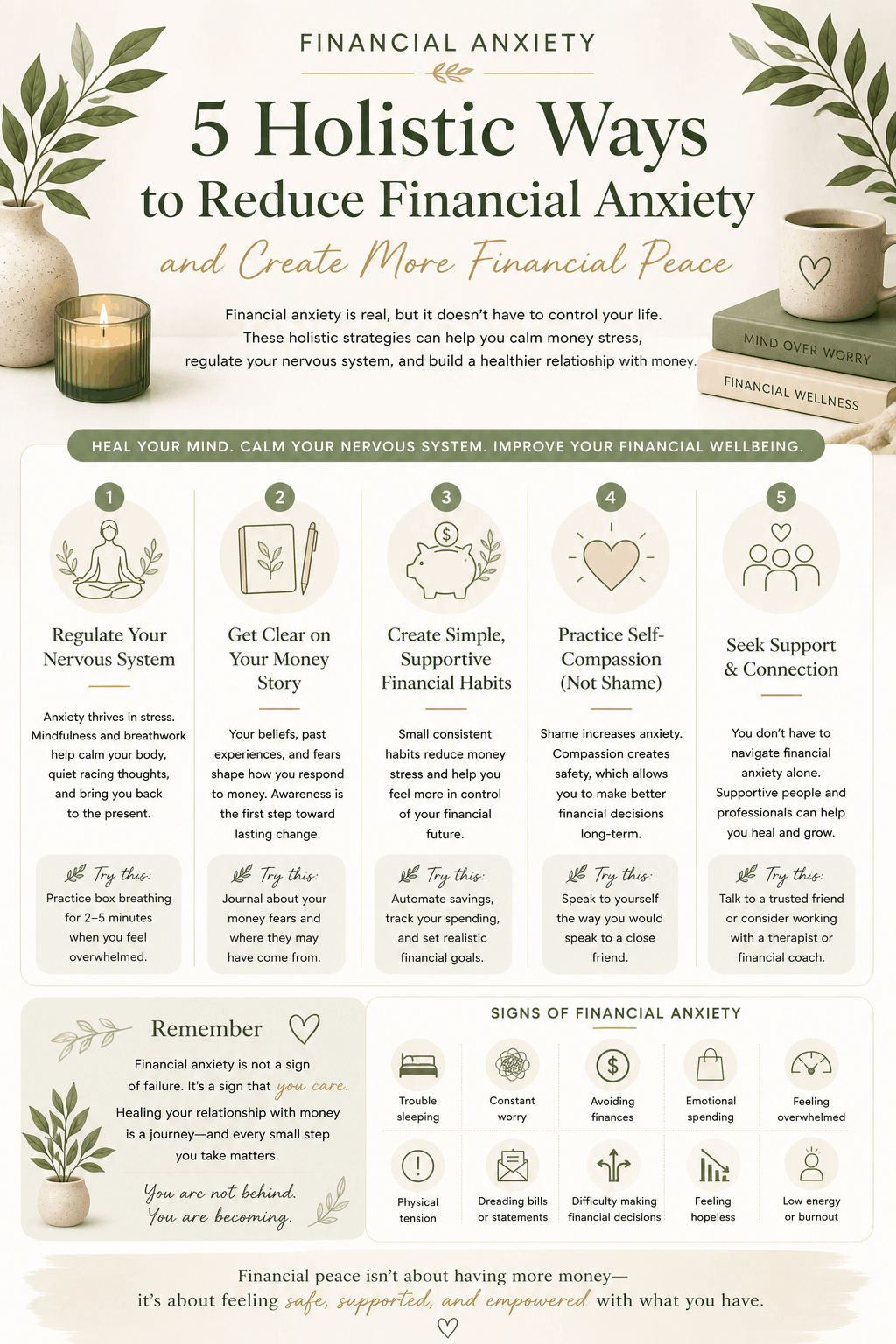
Money anxiety can show up through:
trouble sleeping because of financial stress
panic or overwhelm when checking accounts
avoiding budgeting or financial planning
guilt after spending money
compulsive overspending or emotional shopping
feeling constantly behind financially
obsessive worrying about future finances
difficulty making financial decisions
physical symptoms like tension, headaches, or fatigue
And honestly, avoidance often increases financial anxiety long term.
The more disconnected we become from our finances emotionally, the more overwhelming they tend to feel.
Gentle Reminder
Your Financial Anxiety Does Not Define Your Worth
Living with financial anxiety can feel incredibly isolating, especially when social media constantly makes it seem like everyone else has money figured out. But struggling with money stress does not make you irresponsible, behind, or incapable of building wealth.
Healing your relationship with money is a process. And honestly, awareness, compassion, and small intentional changes often create more lasting transformation than shame or perfection ever will.
Financial Anxiety Treatment Starts With Awareness
One of the first steps in financial anxiety treatment is becoming aware of how money stress is showing up emotionally and physically in your life.
That awareness matters so much.
Because many people stay stuck in cycles of:
avoidance
shame
emotional spending
fear-based decision-making
financial self-sabotage
…without realizing their nervous system is deeply dysregulated around money.
For me personally, mindfulness and nervous system regulation became huge parts of healing my relationship with money.
Not because they magically solved every financial problem overnight, but because they helped me respond to stress more intentionally instead of reactively.

Mindfulness and Nervous System Support
Mindfulness can be incredibly supportive for managing financial anxiety because it helps create space between your thoughts, emotions, and reactions.
And honestly, anxiety thrives in constant future-focused fear.
Mindfulness practices can help bring your nervous system back into the present moment.
Some supportive practices include:
meditation
breathwork
journaling
mindful movement
yoga
walking
nervous system regulation exercises
reducing overstimulation online
Research continues to show that mindfulness-based practices can significantly reduce anxiety symptoms and improve emotional regulation over time.
This is also why intentional living and minimalism can sometimes feel emotionally healing for people experiencing money anxiety. Slowing down consumption and comparison often reduces mental overwhelm significantly.
Therapy and Emotional Healing
Therapy can also be an incredibly powerful tool for financial anxiety treatment.
Especially when money anxiety is connected to:
childhood experiences
trauma
self-worth
chronic stress
scarcity mindset patterns
emotional instability
Different therapeutic approaches may help depending on your situation, including:
Cognitive Behavioral Therapy (CBT)
EMDR
somatic therapy
nervous system-focused healing
trauma-informed therapy
Through therapy, I personally began understanding how deeply emotions, beliefs, and nervous system responses were connected to my relationship with money.
And honestly, that awareness changed everything.
Lifestyle Shifts That Support Financial Wellness
Your daily habits can also play a major role in reducing financial anxiety and improving emotional wellbeing overall.
Small lifestyle shifts often create emotional stability that supports healthier financial decisions.
Some supportive habits include:
improving sleep quality
reducing overstimulation
creating routines
moving your body regularly
eating nourishing foods
limiting comparison online
spending time with supportive people
creating healthier financial habits gradually
This is something I also explore further in “Financial Wellbeing: Money Mindset & Wellness,” especially around how emotional wellness and financial wellness are deeply interconnected.

Money Spending Anxiety and Emotional Spending
One of the most common experiences connected to financial anxiety is money spending anxiety.
Some people cope with anxiety by avoiding spending completely out of fear.
Others cope through emotional spending and impulsive purchases as a temporary emotional escape.
And honestly, both patterns are usually rooted in emotional overwhelm rather than lack of discipline.
That’s why healing money spending anxiety often requires:
emotional awareness
nervous system support
healthier coping mechanisms
intentional financial habits
self-compassion
Not shame.
Because shame rarely creates sustainable financial healing.
Creating Financial Peace Over Time
Managing financial anxiety is not about becoming emotionally perfect with money overnight.
It’s about creating more awareness, safety, and intentionality over time.
And honestly, healing your relationship with money is often a gradual process.
Some days will feel easier than others.
But every small step matters.
Every moment of awareness matters.
Every healthier financial decision matters.
Because financial peace is not built through perfection.
It’s built through consistency, self-awareness, emotional healing, and supportive financial habits repeated over time.
So if money stress has been weighing heavily on you lately, let this be your reminder that healing is possible.
You are not behind.
You are not broken.
And your financial future is not defined by your current anxiety.
Sometimes the most powerful thing you can do is simply begin approaching your finances with more compassion instead of fear.
Further Reading
Keep Healing Your Relationship With Money
If financial anxiety has been weighing on you, these posts can help you feel more grounded, supported, and clear with your money.
Resource to Start With
If financial anxiety has been making you feel overwhelmed or emotionally stuck with money, I’d start with the Money Mindset Ebook. It’s designed to help you begin shifting scarcity patterns, emotional stress around money, and limiting financial beliefs in a gentler, more supportive way.
Product Recommendation
One resource that has genuinely helped me regulate stress and feel more emotionally grounded during difficult financial seasons is the Calm App. When financial anxiety is high, your nervous system often stays stuck in survival mode, making it harder to think clearly, sleep properly, or make intentional financial decisions.
What I appreciate about Calm is that it offers guided meditations, sleep support, breathwork, and mindfulness practices that can help create more emotional stability during overwhelming periods. Healing financial anxiety isn’t only about spreadsheets and budgeting — it’s also about supporting your mental and emotional wellbeing along the way.
FAQs
What is financial anxiety?
Financial anxiety is persistent stress, fear, or emotional overwhelm related to money, finances, debt, spending, or financial uncertainty.
What causes financial anxiety?
Financial anxiety can be caused by debt, financial instability, childhood experiences, trauma, money scarcity, emotional stress, or fear around financial uncertainty.
How can I reduce financial anxiety?
Reducing financial anxiety often involves improving financial awareness, creating healthier money habits, practicing mindfulness, regulating your nervous system, and seeking emotional support when needed.
What is money spending anxiety?
Money spending anxiety refers to fear, guilt, or emotional distress related to spending money, even on necessary purchases.
Can therapy help financial anxiety?
Yes. Therapy can help address emotional patterns, trauma, scarcity mindset, and nervous system responses connected to financial stress and anxiety.
Is financial anxiety common?
Yes. Research consistently shows that money remains one of the leading causes of stress and anxiety for adults.
〰️ WORK WITH ME
↳ my coaching services https://bit.ly/3ZAs0NZ
↴ additional resources and perks:
→ Download my free ebook on mastering your money mindset https://bit.ly/3fAfj33 💵
→ Download my free Wealth Tracker - https://bit.ly/48H8Rxj 🧮
→ Invest in stocks with Wealthsimple https://bit.ly/3PJYscp 📈
→ Invest in crypto and receive $25 USD https://bit.ly/3TxD4dr 🪙
→ Invest like the rich in art and receive a $200 bonus (USD only) https://bit.ly/3Popuqh 🖼️
→ Sign up for my bi-weekly newsletters https://bit.ly/466g09H 📨
〰️ CONTACT ME
✉️ hello@morganblackman.com
