
Beginner Investing in the Stock Market: A Step by Step Guide
The first time I ever fell in love was the day I made five thousand dollars in one day on the stock market. I have shared that story before and if you want the full play by play you can find it on my channel. Today I want to zoom out. If I could go back in time and start investing all over again, what would I do differently. Even with great returns and some amazing wins, there are things I would tweak. There are always better ways to do something and I want to unpack those lessons so you can skip a few bumps on your own path.
I still would have started earlier
I started investing pretty young. Early twenties. Most people say I wish I started earlier and honestly that is still true for me. My first job was at sixteen at Tim Hortons here in Canada. At sixteen I did not have big bills or responsibilities. I had income and freedom. What I did not have was intention. I blew a lot of that money on food, makeup, and hair. The usual.
Tax time would roll around and my dad who is an accountant would sit with me to look at how much I had earned. Sixteen thousand. Twenty thousand. Then the question. Where did it go. Saving sounded good in theory, but I did not see it modeled and I did not understand compounding yet.
If I had saved even half each year and started investing small amounts as a teen, I could have entered university with a real portfolio. Ten thousand a year for two years is twenty thousand. Add small top ups. Fifty dollars a month. One hundred dollars a month. By the end of university that could have been twenty five to thirty grand at the low end or forty to fifty grand if I doubled like I did later. That could have covered most of my undergrad and a car without debt. This is what time does. The earlier you start, the more compounding works in your favor.

Start small and start now
You do not need to be rich to invest. That is a myth. I proved that to myself in my first year with a five thousand dollar starting bucket. Five thousand felt huge to me back then, but you can start with fifty. One hundred. Ten. The skill is what matters. If you can double fifty dollars, you can double five thousand when your income grows. The market does not know your net worth. It only responds to price, time, and your behavior.
Get clear on values before you buy a single share
This is the big one I wish I knew sooner. At first I bought ETFs because the metrics looked good. Then I looked inside the funds and saw names I did not align with. Fast food. Sugar water. Fossil fuels. Some funds were labeled sustainable yet still held companies I would never consume in my own life.
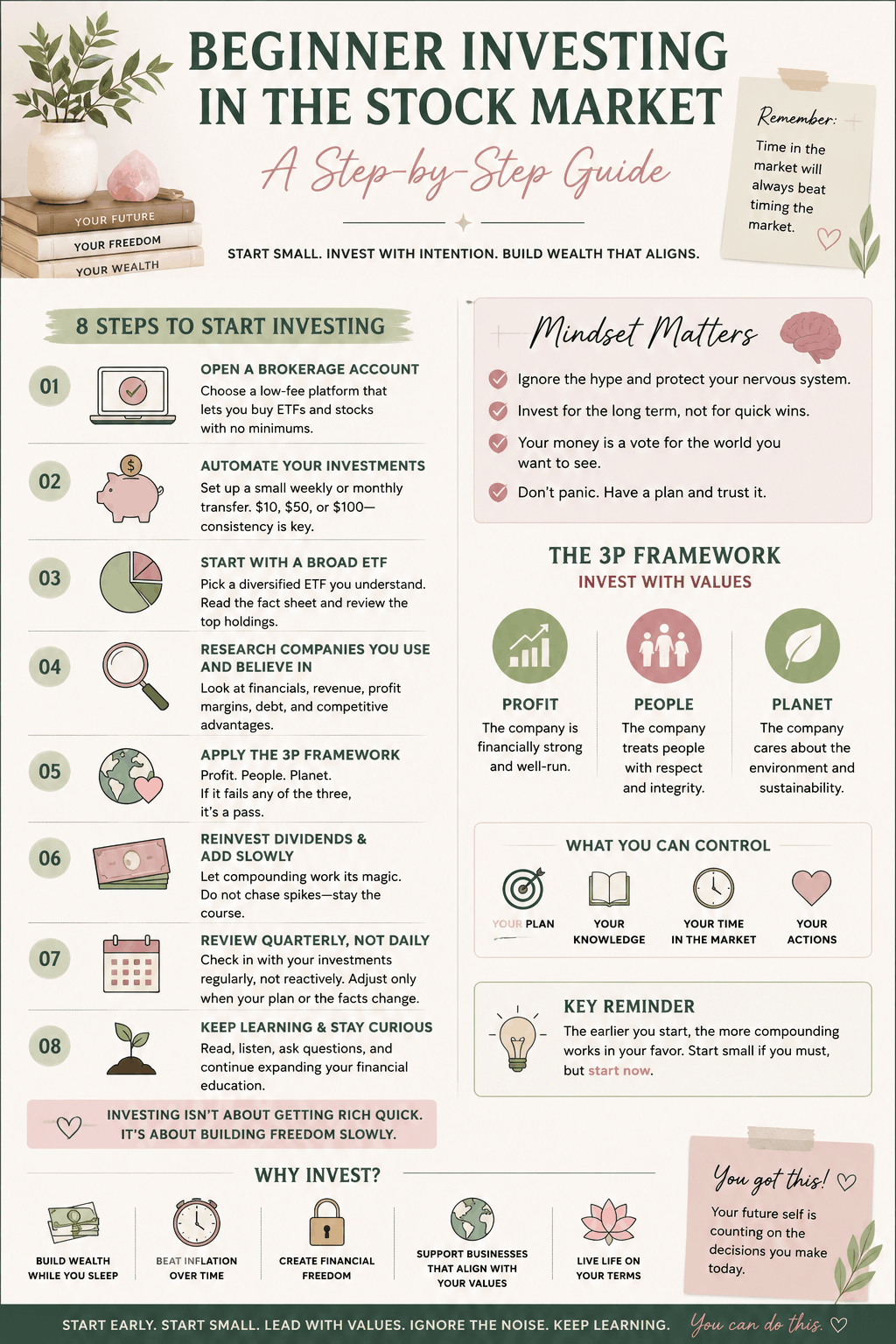
When you buy a share you become a shareholder. You own a piece of that business. Your dollars become a vote for the world you want to see. I started asking different questions. Does this company honor people. Does it care about the planet. Is it profitable and well run. That became my three P framework. Profit. People. Planet. If it fails any of the three, I pass.
You can apply this to ETFs too. Read the fact sheet. Check the top holdings. Look for screens that match your values. If a fund conflicts with you, choose a different one or build a portfolio of individual names that fit.
Ignore the hype and protect your nervous system
Let me tell on myself. My five thousand dollar day came from Beyond Meat during its IPO. I got in during the first week and the ride was wild. Up big one day. Down the next. News cycles, celebrity endorsements, and volatility had my nervous system on edge. I watched the chart every morning like it was a slot machine. I exited with a win and the next day the stock dropped by half. That experience taught me a lot. It also taught me what I do not want. I do not want to live in a constant state of fight or flight around my money.
After that I decided to ignore hype and treat IPOs with caution. If I invest early in a company now, it is because I am a real customer, I believe in the mission, and I can hold for years. If you are tempted by hot trends, pause. Ask what problem this company solves. Ask how it makes money. Ask if you can sleep while holding it.
Do not tell yourself investing is not for you
A lot of people count themselves out because they think investing is only for rich people. Most millionaires did not start rich. They became wealthy by owning assets that grew while they slept. Investing is one of the most accessible ways to do that because the barrier to entry is low. You can buy a fractional share. You can automate small amounts. You can learn as you go.
What I actually did right
It was not all mistakes. Here is what I nailed from the start.
• I diversified. I used a blend of ETFs, bonds, mutual funds, and individual stocks. Inside the stock bucket I spread across sectors like tech, plant based foods, and health. That mix helped smooth the ride and boost returns.
• I managed my emotions. I rarely sold in panic. Aside from taking profits on Beyond Meat, I stayed the course and let time do the work. I prepared for volatility by reading and studying before I invested my first dollar.
• I invested in what I used. Apple if I used an iPhone. Microsoft because I grew up on Windows. That rule of thumb made research easier because I understood the products and the customer behavior.
• I kept learning. Podcasts, books, annual letters. Over time my focus expanded from basic personal finance into business models, economics, and the bigger picture. Lately I have been curious about options. I still do not trade them, but I am learning the mechanics so I can decide with knowledge, not FOMO.

A simple path you can copy
If you are starting today, here is a gentle plan that honors both numbers and values.
Open a low fee account that lets you buy ETFs and stocks with no minimums.
Automate a small weekly or monthly transfer. Ten is fine. One hundred is fine.
Pick a broad market ETF you understand. Read the fact sheet and top holdings.
Layer in one or two individual companies you already use and believe in. Research revenue, profit margins, debt, and competitive advantages.
Apply the three P lens. Profit. People. Planet. If it fails your values, skip it.
Reinvest dividends. Add slowly. Do not chase spikes.
Review quarterly. Not daily. Adjust only when your plan or the facts change.
Why values matter for long term wealth
You can make money quickly by chasing shiny objects. I know because I did. But lasting wealth comes from alignment. When your portfolio reflects your values, you are more likely to hold through storms because the why is strong. You are also less likely to fund harm in the name of profit. That integrity tax may feel like you are leaving money on the table. In my experience it creates deeper peace and better decisions over time.
Further Reading
Continue Exploring Investing, Wealth Building & Financial Freedom
If you're learning how to invest, build long-term wealth, and create a healthier relationship with money, these articles may support you further.
Introducing the Ethical Investor Starter Kit
If you are ready to build wealth with integrity, I created something for you. The Ethical Investor Starter Kit is a free five day email series that helps you invest through my three P framework. You will get simple guides, checklists, reflection prompts, and a few surprise bonuses. I want you to feel supported, not overwhelmed. Engage with the prompts each day and I will send you the bonus tools at the end.
Start early if you can. Start small if you must. Lead with values. Ignore the noise. Keep learning. Your money can grow while you sleep and it can do it in a way that feels good in your body. Where you put your dollars is the world you are voting for. Choose wisely and give yourself time.
If you have questions or want to share what you would do differently if you started over, drop a comment. I am cheering for you.
FAQ: Beginner Investing in the Stock Market
How much money do you need to start investing?
One of the biggest myths about investing is that you need to be wealthy before you can begin. Honestly, that belief keeps a lot of people stuck longer than necessary. You do not need thousands of dollars to start building investing habits. Many platforms now allow people to buy fractional shares or invest small amounts consistently over time.
What matters most in the beginning is not the amount. It is the habit, the consistency, and the willingness to learn. Someone who learns how to invest fifty dollars consistently develops skills and discipline that can scale later as their income grows.
Is investing in the stock market risky?
Yes, investing always carries risk. Stock prices fluctuate, markets can become volatile, and there are no guaranteed returns. But I also think many people misunderstand risk because they only focus on losing money temporarily rather than the long-term risk of never investing at all.
Historically, the stock market has grown over long periods of time despite recessions, crashes, and economic uncertainty. The key is learning how to manage risk properly through diversification, emotional discipline, long-term thinking, and investing in companies or funds you genuinely understand.
What is the best investment strategy for beginners?
I honestly think the best beginner investing strategy is often the simplest one. Start small. Invest consistently. Learn gradually. Focus on long-term growth rather than trying to get rich quickly.
For many beginners, broad market ETFs can be a good starting point because they provide diversification across multiple companies rather than relying on one stock alone. Over time, people can begin researching individual companies, sectors, and investing styles that align with both their financial goals and personal values.
Should beginners invest in individual stocks or ETFs?
It really depends on someone’s comfort level, goals, and willingness to research. ETFs are often considered more beginner-friendly because they spread risk across many companies instead of relying on the success of one business. They can provide a more stable long-term foundation for newer investors.
At the same time, individual stocks can help people feel more connected to what they are investing in, especially when they understand the company, use its products, and believe in its mission. Personally, I think a balanced approach can work well for many people.
What should you research before investing in a company?
Before investing in any company, I think it is important to understand how the business actually makes money. Look at revenue growth, profitability, debt levels, leadership, competitive advantages, and long-term sustainability. Beyond the numbers, I also think values matter deeply.
One thing I discussed in this post was my three P framework:
Profit
People
Planet
A company may be profitable financially, but if it conflicts deeply with your ethics or values, that matters too. Investing is not only financial. It is also a reflection of what kind of world we are collectively supporting through our dollars.
How do you avoid emotional investing?
Emotional investing is one of the hardest things to manage because money naturally triggers fear, excitement, greed, anxiety, and urgency. I learned this personally during the Beyond Meat IPO experience when the stock was moving aggressively day to day.
What helped me most was shifting toward long-term thinking instead of constantly reacting emotionally to short-term market swings. Researching before investing, diversifying properly, limiting panic-checking, and reviewing investments less frequently can all help protect your nervous system and improve decision-making over time.
Is it too late to start investing in your 30s or 40s?
Absolutely not. While starting earlier gives compounding more time to work, building wealth later in life is still possible. I think many people become discouraged because social media constantly highlights young investors or overnight success stories, but long-term investing is not a race.
Starting in your thirties, forties, or even later is still infinitely more powerful than never starting at all. Consistency, patience, financial education, and long-term habits matter much more than perfection.
Why does investing feel intimidating for beginners?
I think investing feels intimidating because money already carries emotional weight for so many people. Fear of losing money, fear of making mistakes, financial trauma, lack of education, and growing up without investing being modeled can all create anxiety around getting started.
And honestly, financial spaces can sometimes feel unnecessarily overwhelming or elitist too. But investing does not require perfection. Most people learn gradually over time through experience, education, mistakes, and consistency. The important thing is beginning.
Can you invest ethically and still build wealth?
Yes, absolutely. One of the biggest shifts in my investing journey happened when I started paying closer attention to whether my investments aligned with my actual values.
I realized some funds labeled “sustainable” still held companies I personally did not feel aligned with. That pushed me to become more intentional about investing through the lens of profit, people, and planet. Ethical investing may require more research and discernment, but I honestly believe financial growth feels more sustainable when your investments align with your integrity.
If you’d like to keep journeying together…
→ Start Here: free tools and reflections to help you feel grounded, clear, and more confident with your money.
→Work With Me: private coaching, strategy sessions, and programs designed to help you build wealth that feels aligned, stable, and sustainable.
→ Subscribe to the Channel: If this resonated, come hang out with me on YouTube where I break this down in real life — the habits, the mindset shifts, and what this actually looks like day-to-day.
→ Or Join My Email List: This is where I share deeper insights, behind-the-scenes thoughts, and the kind of conversations we don’t always have publicly.
