
The Emotional Reality of Wealth Building for Black Women
Wealth building for Black women is rarely just about numbers. It is emotional, cultural, and deeply tied to survival, burnout, caregiving, and healing. In this guide, Morgan Blackman explores what holistic wealth truly means and how Black women can begin building wealth beyond survival mode.
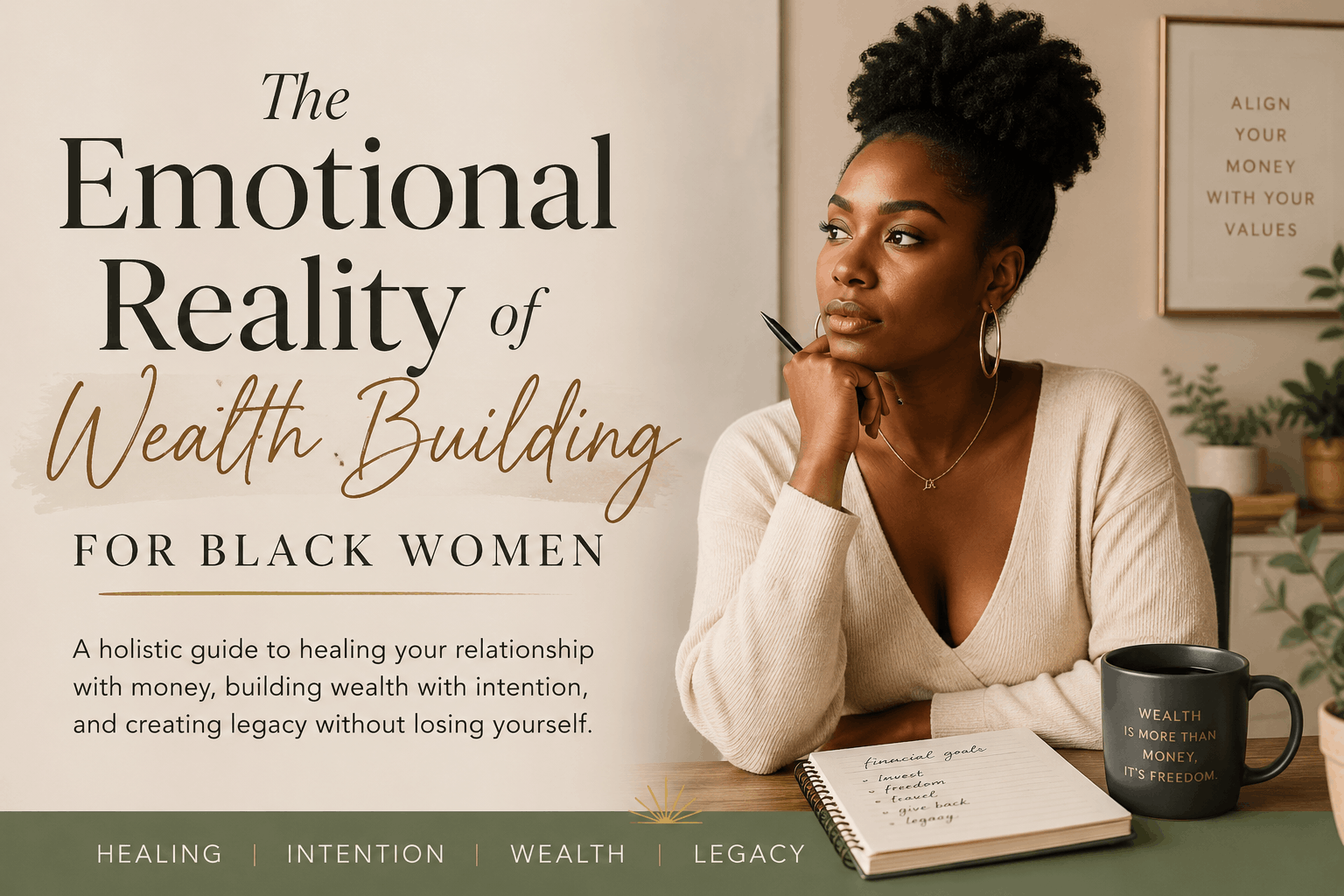
For many Black women, wealth building is not just about earning more money. It is emotional. It is nervous-system based. It is deeply connected to safety, survival, family, identity, and the invisible pressure to hold everything together.
A lot of traditional financial advice tells us to budget harder, save more, invest earlier, or simply “be disciplined.” But what happens when your relationship with money has been shaped by instability, overworking, caregiving, generational pressure, or feeling like you can never fully exhale?
This is the emotional reality of wealth building for Black women.
And honestly, it’s something we don’t talk about enough.

The Emotional Reality of Wealth Building for Black Women
There’s a very specific kind of exhaustion that comes from earning more money, becoming more financially responsible, and still not feeling emotionally safe around money.
I think a lot of Black women quietly carry this experience.
You can be doing all the “right” things financially — building your savings, paying down debt, investing consistently, increasing your income — and still feel a constant underlying pressure sitting in your body. A pressure to keep going, keep producing, keep preparing for something to fall apart. That’s the part of wealth building that traditional financial advice rarely talks about.
Most mainstream financial conversations focus heavily on strategy. Budget more. Spend less. Invest earlier. Increase your income. Build multiple streams of revenue. While those things absolutely matter, they often ignore the emotional realities many Black women are carrying while trying to build wealth.
Because for many of us, money has never been just money.
Money can feel tied to survival, stability, family expectations, caregiving, and safety. It can feel connected to whether or not we’re allowed to finally rest. A lot of Black women are navigating invisible emotional pressure while simultaneously trying to create financial stability for themselves, support family members, heal generational patterns, and build futures they may have never seen modeled growing up.
That’s why wealth building for Black women deserves a deeper conversation.
Not just a conversation about numbers, but a conversation about emotional capacity, nervous-system safety, burnout, scarcity conditioning, and what it actually means to build a life that feels sustainable.
Research from the American Psychological Association continues to show that financial stress is one of the leading sources of chronic stress for adults. At the same time, Black women disproportionately experience higher levels of burnout, workplace stress, and caregiving pressure, which naturally impacts how money is experienced emotionally.
I think that context matters.
Because when someone has spent years emotionally surviving, overworking, or carrying responsibility for everyone around them, wealth building is going to feel very different than what traditional finance spaces often portray online.
And honestly, I think that’s why so many women still feel anxious even when they’re technically doing well financially. Income alone does not automatically create emotional safety.
That realization completely changed the way I personally started thinking about wealth.
Why Many Black Women Feel Emotionally Exhausted Around Money
I think emotional exhaustion around money is far more common than people realize, especially among Black women who have spent years operating from survival mode.
A lot of women are carrying multiple layers of responsibility at once. There’s career pressure, family pressure, caregiving responsibilities, rising living costs, and often an internalized belief that slowing down is somehow irresponsible. Over time, that creates a relationship with money that feels incredibly heavy.
Even when financial progress is happening, many women still feel emotionally on edge. They still feel guilty resting. They still feel pressure to overwork. They still feel like one unexpected situation could undo everything they’ve worked for.
That’s what scarcity conditioning can look like emotionally.
And the difficult part is that scarcity conditioning does not automatically disappear once income increases. Someone can move into a better financial situation while still emotionally carrying years of instability, fear, or hyper-vigilance around money.
I think this is especially important to acknowledge because traditional financial advice often frames money struggles as purely behavioral. But emotional experiences shape financial behavior far more than most people realize.
If someone grew up around financial instability, emotional stress, or constant uncertainty, their nervous system adapts to that environment. They may become hyper-independent, overprepared, or emotionally attached to productivity because those patterns once helped them feel safe.
Research around chronic stress and financial anxiety continues to show that long-term exposure to instability can impact emotional regulation, decision-making, and overall wellbeing. That’s why wealth building cannot only focus on financial strategy while ignoring emotional wellness.
I think this is also why so many high-achieving women still feel deeply exhausted around money despite being financially responsible. They are not just managing finances. They are managing emotional pressure at the same time.
And that emotional labor deserves acknowledgment.
The Relationship Between Financial Trauma and Burnout
One of the biggest shifts I’ve had personally was realizing that burnout is not always caused by doing too much.
Sometimes burnout comes from never feeling emotionally safe enough to stop.
Financial trauma can look like:
Constantly expecting something to go wrong
Feeling anxious even when money is stable
Overworking because rest feels unsafe
Obsessively checking accounts
Feeling guilt around spending
Avoiding finances entirely because they feel emotionally overwhelming
A report from Deloitte found that women experience significantly higher levels of workplace burnout than men, especially women balancing caregiving and professional responsibilities. Add financial pressure into that equation and the emotional load becomes even heavier.
A lot of hustle culture teaches women that exhaustion is proof of ambition.
But constantly living in financial vigilance keeps the nervous system activated.
That’s not sustainable wealth.
That’s survival.
And survival mode makes it difficult to think long term.
It becomes harder to invest.
Harder to plan.
Harder to rest.
Harder to trust yourself.
Harder to hold wealth without fear.
If this is something you’re navigating right now, I also dive deeper into this emotional pattern in Financial Stress Management: 7 Ways to Reduce Money Stress.

Why Representation Matters in Financial Coaching
I think one of the reasons so many Black women feel disconnected from traditional finance spaces is because those spaces often remove the emotional and cultural realities attached to money.
Sometimes financial advice can feel cold.
Very numbers-driven.
Very transactional.
Very disconnected from lived experience.
But financial decisions don’t happen in a vacuum.
Our experiences shape how we save, spend, invest, negotiate, rest, and build wealth.
Representation matters because emotional safety matters.
There is something powerful about being supported by someone who understands the complexity of being ambitious while also carrying invisible pressure.
Someone who understands that first-generation wealth building often comes with guilt.
Someone who understands how exhausting hyper-independence can become.
Someone who understands that wealth building is not just about becoming rich.
It is about becoming free.
Free to breathe.
Free to rest.
Free to make decisions from intention instead of fear.
What Holistic Wealth Means to Me as a Black Woman
When I first started learning about personal finance, I noticed something immediately.
Most financial conversations centered around accumulation.
More money.
More productivity.
More assets.
More status.
But very few conversations asked:
What kind of life are we actually trying to build?
Coming from my background studying political economies, I became deeply aware of how systems shape financial access, opportunity, stress, and wealth inequality.
And honestly, that changed how I viewed wealth completely.
To me, holistic wealth means having the capacity to live well emotionally, financially, physically, and spiritually.
It means autonomy.
It means rest.
It means choice.
It means ethical wealth.
It means investing.
It means sustainability.
It means being able to support yourself without abandoning yourself.
That’s also why I believe investing is such an important part of long-term wealth building for women.
Not because money is everything.
But because access, freedom, and flexibility matter.
This is something I expand on further in Beginner Investing Tips: How to Start Investing Today and Saving vs Investing: Which Should You Focus on First?
Building Wealth Beyond Survival Mode
This phrase means so much to me because I think so many women are exhausted from constantly reacting instead of intentionally building.
Building wealth beyond survival mode means shifting from:
reactive spending → intentional spending
fear-based decisions → values-based decisions
overworking → sustainability
constant stress → nervous system safety
short-term survival → long-term vision
And no, this shift does not happen overnight.
Sometimes it starts with simply allowing yourself to believe stability is possible.
Sometimes it starts with creating an emergency fund.
Sometimes it starts with resting without guilt.
Sometimes it starts with finally learning how investing works.
Sometimes it starts with realizing that you deserve support.
A Federal Reserve report found that many adults still struggle to cover unexpected expenses, which explains why financial anxiety can remain deeply embedded emotionally even after income increases.
That’s why sustainable wealth building matters.
Not performative wealth.
Not hustle culture.
Not burnout disguised as ambition.
Real wealth should support your wellbeing.
If you’re currently trying to create healthier financial habits, I also talk more about this in Pay Yourself First: The Wealth Habit That Changes Everything.
Why High-Earning Women Still Feel Financial Anxiety
This is one of the most important conversations we need to have.
Because income does not automatically create emotional safety.
I’ve seen women double or triple their income and still feel terrified financially.
Why?
Because financial anxiety is not always logical.
Sometimes it’s rooted in:
Childhood instability
Generational scarcity
First-generation pressure
Financial literacy gaps
Fear of losing everything
Lack of long-term strategy
Feeling responsible for others
Many women were never taught how to hold wealth emotionally.
We were taught how to survive.
There’s a difference.
And when nobody teaches you wealth strategy, investing, boundaries, or nervous-system regulation around money, earning more can still feel emotionally unsafe.
This is something I break down further in How to Improve Your Relationship With Money (Beginner Guide).
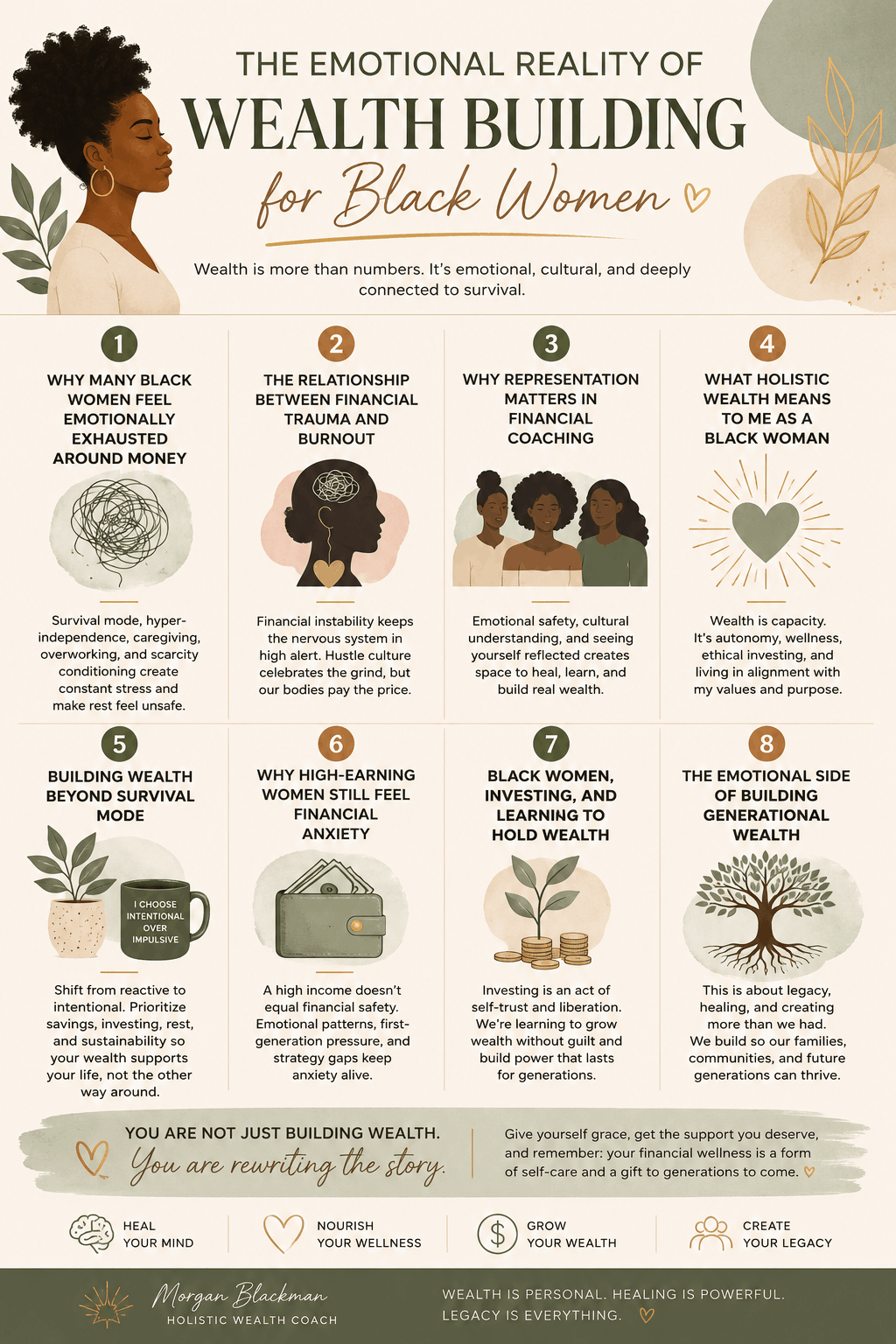
Black Women, Investing, and Learning to Hold Wealth
I think investing can feel deeply emotional for a lot of women.
Especially Black women.
Because investing requires long-term thinking.
It requires trust.
It requires visibility.
It requires believing you deserve to build wealth beyond basic survival.
And for many women, that can feel unfamiliar at first.
There can also be guilt attached to wealth.
Guilt around having more.
Guilt around boundaries.
Guilt around saying no.
Guilt around prioritizing your future.
But learning to hold wealth without shame is part of healing.
For me, ethical investing became one of the most empowering parts of my financial journey because it allowed me to view wealth as a tool for autonomy and impact instead of greed.
Investing is not just about numbers.
It is about creating options.
And options create freedom.
If investing still feels intimidating, Beginner Investing Tips: How to Start Investing Today is a really supportive place to begin.
The Emotional Side of Building Generational Wealth
I think generational wealth conversations can sometimes become very performative online.
People talk about “legacy” constantly without acknowledging the emotional pressure that often comes with it.
Because for many Black women, building generational wealth can feel like trying to heal while simultaneously building.
There’s pressure.
There’s responsibility.
There’s grief.
There’s hope.
Sometimes you’re trying to create financial stability while also becoming the first person in your family to even have access to certain opportunities.
That emotional weight matters.
But I also think there’s something incredibly beautiful about redefining wealth on our own terms.
Not just wealth as status.
But wealth as wellness.
Wealth as rest.
Wealth as community.
Wealth as safety.
Wealth as time.
Wealth as healing.
Wealth as choice.
And maybe that’s the real work.
Not simply accumulating more money.
But building lives that feel sustainable, emotionally safe, and deeply aligned.
Because true wealth should not cost you your wellbeing.
Free Resource To Share
If you’ve been trying to build wealth while also healing your relationship with money, I really want you to know you’re not alone in that.
I created the Money Mindset Ebook as a supportive resource for women navigating financial anxiety, scarcity patterns, emotional spending, and rebuilding trust with themselves around money.
Product Recommendation
One tool I genuinely think can be incredibly supportive during a wealth-building journey is Skillshare, especially if you’re trying to learn more about investing, productivity, emotional wellness, or financial literacy in a low-pressure way.
Sometimes building wealth starts with simply giving yourself permission to learn differently and expand your mindset at your own pace.
FAQs
Why do many Black women feel anxious about money even when earning well?
Because financial anxiety is often connected to emotional experiences, survival patterns, caregiving pressure, and generational scarcity — not just income levels.
What does holistic wealth mean?
Holistic wealth means viewing wealth as more than money. It includes emotional wellbeing, autonomy, nervous-system safety, rest, sustainability, and long-term financial stability.
How does financial trauma affect wealth building?
Financial trauma can impact decision-making, investing confidence, spending habits, nervous-system regulation, and long-term financial planning.
Why is representation important in financial coaching?
Representation creates emotional safety and cultural understanding, which helps women feel more supported and understood in their financial journeys.
Can high-income earners still struggle financially emotionally?
Absolutely. Income does not automatically create emotional safety or financial confidence.
How can Black women start building wealth beyond survival mode?
By focusing on sustainable habits like saving, investing, nervous-system regulation, intentional spending, and long-term financial education.
