
The pay yourself first method is one of the most powerful financial habits for building long-term wealth and financial security. Instead of saving whatever money is “left over” at the end of the month, this strategy prioritizes saving money automatically before spending. In this guide, we’re diving into how to build better savings habits, simplify your finances, and create more stability through intentional money management.

The Simple Money Habit That Changed My Finances
The pay yourself first principle is one of the most powerful wealth-building habits you can develop. By saving money automatically before spending, you prioritize your future financial security. Building strong savings habits through this strategy can completely transform the way you manage money.
One of the biggest myths I think people believe about saving money is that you need to make a lot of money before you can finally start being financially responsible.
And honestly? That simply isn’t true.
We hear so much advice online about six-figure salaries, luxury lifestyles, investing, and “rich girl” aesthetics that it can start to feel like financial wellness is only accessible once you reach a certain income level.
But sustainable financial habits usually aren’t built overnight through huge income jumps.
They’re built through consistency.
Take it from me: before becoming an entrepreneur, I was a suburban Black girl making around $40K a year. And even during that season of my life, I still managed to:
pay off debt
build an emergency fund
start investing
improve my relationship with money
Not because I was making an extraordinary amount of money, but because I started treating my savings like a non-negotiable bill.
That mindset shift changed everything for me.

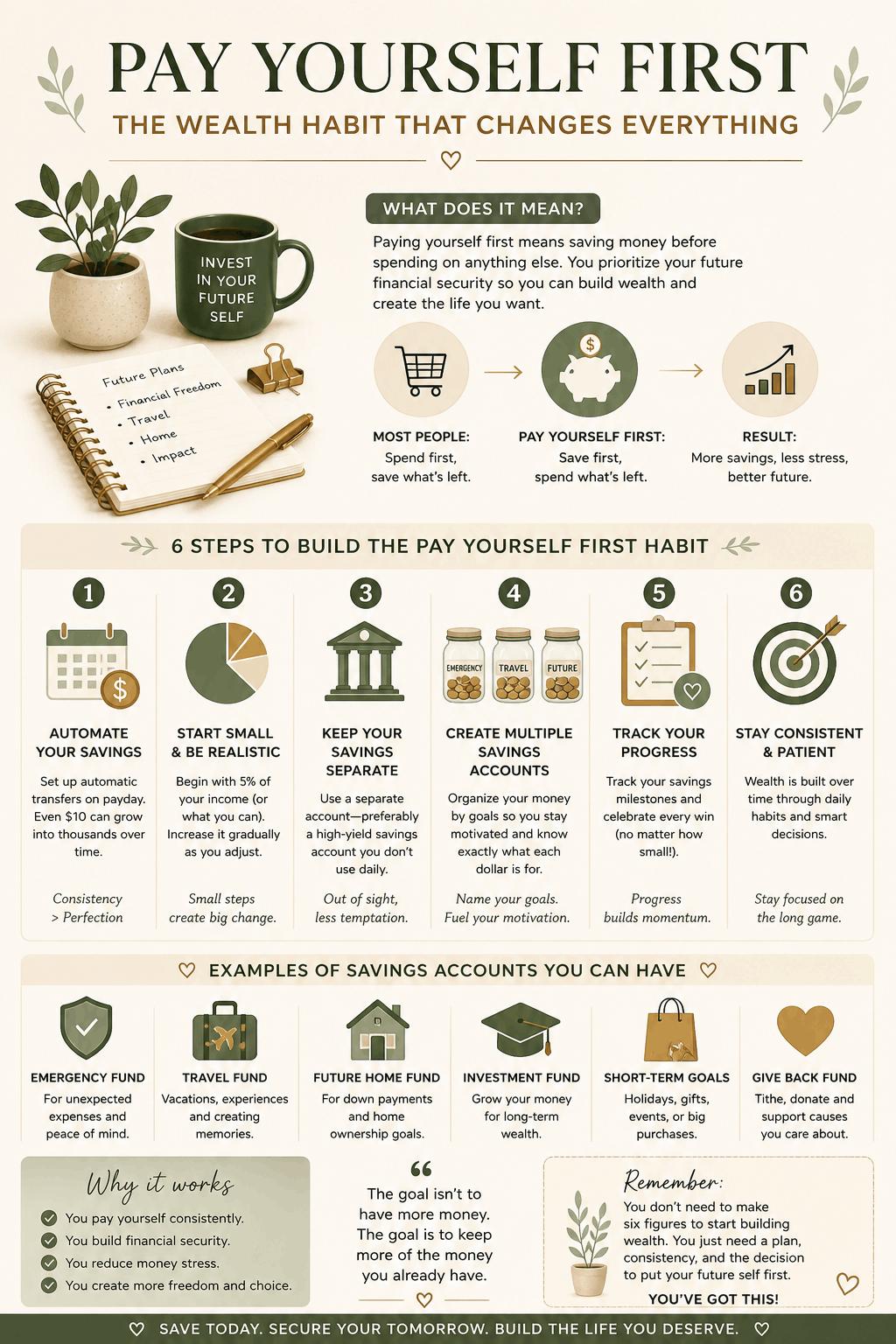
What Does “Pay Yourself First” Mean?
The pay yourself first strategy means prioritizing your savings before discretionary spending.
Instead of:
spending first
saving whatever is left
hoping there’s enough remaining
…you reverse the process.
You save first.
Then build your spending around what remains.
And honestly, I think this is one of the most supportive forms of financial self-care.
Because it’s hard to feel emotionally safe or financially grounded when you’re constantly living one unexpected expense away from stress or panic.
Research from Bankrate has consistently shown that many adults struggle to cover unexpected emergency expenses, which highlights how important even small savings habits can become over time.
Paying yourself first helps create:
financial stability
emotional peace
long-term consistency
healthier spending habits
stronger boundaries with money
And the beautiful part is that you don’t need to start perfectly.
You just need to start.
Automating Your Savings Makes Everything Easier
One of the easiest ways to build savings habits is through automation.
Because honestly, relying on motivation alone usually doesn’t work long-term.
Life gets busy.
Unexpected expenses happen.
Emotions fluctuate.
And if saving money depends on “remembering” every month, it becomes much easier to skip.
Automation removes some of the emotional decision-making entirely.
For me, paying yourself first starts with deciding where my money needs to go before planning extra spending. Essentials and required payments still need to be covered. Then savings and any additional debt repayment get a place in the budget before I decide what’s available for fun. I’m making room for those commitments at the start, instead of hoping something is left for them later.
Before choosing an automatic transfer amount, review your recent bank statements and upcoming bills. You can use that information to work out what needs to stay in your everyday account for essentials, minimum debt payments, and other commitments before your next income arrives. Then choose savings and additional debt amounts that fit alongside those obligations. This can be a simple review of your accounts; you don’t need to build a spreadsheet before you begin.
Check the dates too. Having enough money over the whole month doesn’t necessarily mean it will be in the account when a transfer or bill goes through. Schedule savings around when income is available, and revisit the amount if your income or essential costs change. If there isn’t room to save while covering the essentials and required payments, start by reviewing that shortfall before setting up a transfer.
One of the first things I recommend is setting up automatic transfers on payday so money moves directly into savings before you even have the chance to spend it.
Even if it’s:
$10 per paycheck
5% of your income
one small transfer per week
…it still counts.
Consistency matters far more than perfection.
This is something I talk more about in “How to Build Better Money Habits That Actually Stick” because long-term wealth is usually built through supportive systems, not constant willpower.

Why Strict Budgeting Often Doesn’t Work
I think one reason many people struggle financially is because they believe budgeting has to feel restrictive, rigid, or overwhelming.
Color-coded spreadsheets.
Tracking every dollar obsessively.
Cutting out everything enjoyable.
And honestly? That approach can become emotionally exhausting very quickly.
Instead of focusing on perfection, I think it’s more supportive to simplify your finances first.
Start by understanding:
your fixed expenses
your financial priorities
your savings goals
what actually matters to you
Then automate what you can.
The simpler your financial system feels, the easier it becomes to sustain long-term.
Research in behavioral finance continues to show that reducing friction and automating positive financial habits significantly improves consistency over time.
Financial wellness should feel supportive.
Not punishing.

Keep Your Savings Separate
One of the best financial decisions I made was keeping my savings separate from my everyday spending account.
Because let’s be honest:
if your savings are constantly visible and easily accessible, it becomes much easier to dip into them impulsively.
Creating even small barriers between you and your savings can help protect the habit you’re trying to build.
This could look like:
opening a high-yield savings account
using a separate bank
limiting transfer access
creating intentional friction around withdrawals
The goal isn’t to make your money inaccessible.
It’s to make impulsive spending less convenient.
And honestly, protecting your future self sometimes requires creating systems your current self can lean on.
Create Multiple Savings Accounts for Different Goals
One of my favorite saving strategies is creating separate savings accounts for different goals.
Instead of putting all your money into one large account, dividing your savings into categories can help your goals feel more tangible and emotionally motivating.
For example:
Emergency fund
Travel fund
Future home fund
Tax savings
Business savings
Holiday spending
Wellness fund
And honestly, naming your accounts something meaningful can make a bigger psychological difference than people realize.
“Emergency Fund” feels very different emotionally than:
“Freedom Fund”
“Peace of Mind Fund”
“Future Me Fund”
Behavioral psychology research has shown that emotional connection and visualization often improve goal commitment and consistency.
Saving money becomes much easier when your goals actually feel personal.
Tracking Progress Helps Build Momentum
I think people underestimate how motivating small financial wins can be.
Your first:
$100 saved
$500 emergency fund
paid-off credit card
automated transfer
fully funded sinking fund
…all matter.
Financial confidence usually isn’t built through one giant moment.
It’s built through repeated evidence that you can trust yourself with money.
And honestly, I think that trust is one of the most important parts of financial wellness.
Because the more progress you see, the less impossible your larger financial goals begin to feel.
Building Wealth Starts With Small Habits
Saving money isn’t about deprivation.
And it’s not about waiting until you finally make “enough” money to become financially organized.
It’s about creating supportive habits now that your future self will benefit from later.
The pay yourself first strategy works because it shifts saving from an afterthought into a priority.
And over time, those small consistent habits can completely change your financial reality.
Not overnight.
Not perfectly.
But gradually.
And honestly? That’s usually how real wealth is built.
Further Reading
Build Stronger Financial Habits
If you're currently working on saving money, building healthier habits, or creating more financial stability, these posts may support you further.
Free Resource to Start With
If you’re currently trying to build stronger savings habits or feel more organized financially, my Wealth Well Tracker can help you simplify your finances and stay consistent with your money goals in a way that feels supportive instead of overwhelming.
Product Recommendation
One financial tool I genuinely recommend for building better savings habits is Wealthsimple, especially for setting up separate savings accounts and automating transfers. Having your savings organized and slightly separated from everyday spending can make it much easier to stay consistent long-term.
Frequently Asked Questions
What does pay yourself first mean?
Pay yourself first means saving money before spending on non-essential expenses. It prioritizes your future financial goals before discretionary spending.
Why is paying yourself first important?
This strategy helps build consistent savings habits, financial security, and long-term wealth by making saving a regular priority instead of an afterthought.
How much should I save each month?
The amount depends on your income and financial situation. Even small consistent amounts like 5–10% of your income can create meaningful progress over time.
Is automating savings a good idea?
Yes. Automating savings removes emotional decision-making and helps build consistency by transferring money into savings automatically.
Should I have multiple savings accounts?
Having multiple savings accounts can help organize different financial goals like emergencies, travel, taxes, or future purchases.
Can I save money on a low income?
Yes. Building savings habits is more about consistency and prioritization than income level alone. Small amounts saved consistently still create progress.
〰️ WORK WITH ME
↳ my coaching services https://bit.ly/3ZAs0NZ
↴ additional resources and perks:
→ Download my free ebook on mastering your money mindset https://bit.ly/3fAfj33 💵
→ Download my free Wealth Tracker - https://bit.ly/48H8Rxj 🧮
→ Invest in stocks with Wealthsimple https://bit.ly/3PJYscp 📈
→ Invest in crypto and receive $25 USD https://bit.ly/3TxD4dr 🪙
→ Invest like the rich in art and receive a $200 bonus (USD only) https://bit.ly/3Popuqh 🖼️
→ Sign up for my bi-weekly newsletters https://bit.ly/466g09H 📨
〰️ CONTACT ME
✉️ hello@morganblackman.com
