
Finances for Women: How Financial Literacy Protects Women From Abuse
Finances for women are about so much more than money. Financial literacy can create safety, freedom, confidence, and choice — especially for women navigating unhealthy relationships, financial dependence, or systems designed to keep them small. The more I’ve learned about women financial independence, the more I’ve realized that understanding money isn’t just empowering for women — sometimes it’s life-changing.
Let’s talk about something deeply personal and painfully common: intimate partner violence. Specifically, I want to focus on financial abuse — a form of control that often hides in plain sight — and how financial literacy can become a lifeline for women trapped in these dynamics.
This topic hits close to home for me.
I won’t go into every detail, but I grew up witnessing abuse far too closely. In my immediate and extended family, many of the women around me were survivors of violence and control. I remember police showing up to homes. I remember fear sitting heavily in rooms that were supposed to feel safe. I remember hearing women whisper about survival.
And honestly, those experiences shaped me deeply.
From a very young age, I internalized the belief that I never wanted to fully depend on anyone financially — especially not a man. I promised myself I would always know how to make my own money, support myself, and create options for my future.
At the time, I didn’t realize I was responding to trauma.
But now, years later, I understand something important: finances for women are not just about wealth-building. They’re about autonomy. Safety. Choice. Stability. Survival.
And for many women, women financial independence becomes the very thing that allows them to leave situations that are harming them.
What Is Financial Abuse?
When most people hear “domestic violence,” they immediately picture physical abuse — bruises, black eyes, visible injuries.
But abuse does not always leave physical marks.
Sometimes it sounds like:
manipulation
guilt
intimidation
control
monitoring
isolation
financial dependence
If you constantly feel powerless in your relationship, unable to make decisions freely, fearful around money conversations, or dependent on someone else for survival, those can all be signs of abuse.
And one of the most overlooked forms of abuse is financial abuse.
Financial abuse happens when someone uses money, debt, employment, or financial control to limit another person’s independence. Sometimes it’s obvious. Sometimes it’s subtle enough that women don’t recognize it until years later.
The statistics around this are heartbreaking.
Research consistently shows that financial abuse is present in the vast majority of abusive relationships. In fact, approximately 99% of women experiencing intimate partner violence also experience financial abuse in some form.
That statistic honestly stayed with me for a long time.
Because it highlights something we don’t talk about enough: women financial independence is deeply connected to personal safety.
Why Finances for Women Matter So Much
Financial literacy is often framed as a luxury topic online.
People talk about investing portfolios, passive income, or retiring early — and while those things matter, I think we need to widen the conversation around finances for women.
Because understanding money can literally create options.
And options create freedom.
Women who understand budgeting, saving, debt, credit, employment rights, investing, and long-term planning are often in a much stronger position to leave unhealthy environments if they ever need to.
Financial independence creates breathing room.
It creates the ability to:
leave unsafe relationships
afford housing independently
support children
access transportation
pay legal fees
build emergency savings
make decisions from alignment instead of desperation
And honestly, this is why I believe women financial independence is one of the most important forms of self-care women can build.
Not because money solves everything.
But because dependence can make survival incredibly difficult.
My Personal Experience With Financial Manipulation
The first man I ever loved used money as a form of emotional control.
At the time, I didn’t fully recognize it for what it was.
There was pressure to “prove” my love through financial sacrifice and purchasing of gifts. Pressure to overextend myself emotionally and financially. Guilt when I set boundaries. Manipulation disguised as need.
And honestly, I think many women experience versions of this dynamic without realizing how harmful it can become.
Because financial abuse doesn’t always look dramatic.
Sometimes it looks like:
constantly lending money you can’t afford to give
feeling responsible for “saving” someone financially
having your generosity exploited
being guilted for wanting boundaries
sacrificing your own financial wellbeing to keep someone else comfortable
And I really want women to hear this clearly:
You are allowed to protect your financial wellbeing.
You are allowed to say no.
You are allowed to prioritize your stability.
You are allowed to create boundaries around money.
Helping others should not require abandoning yourself in the process.
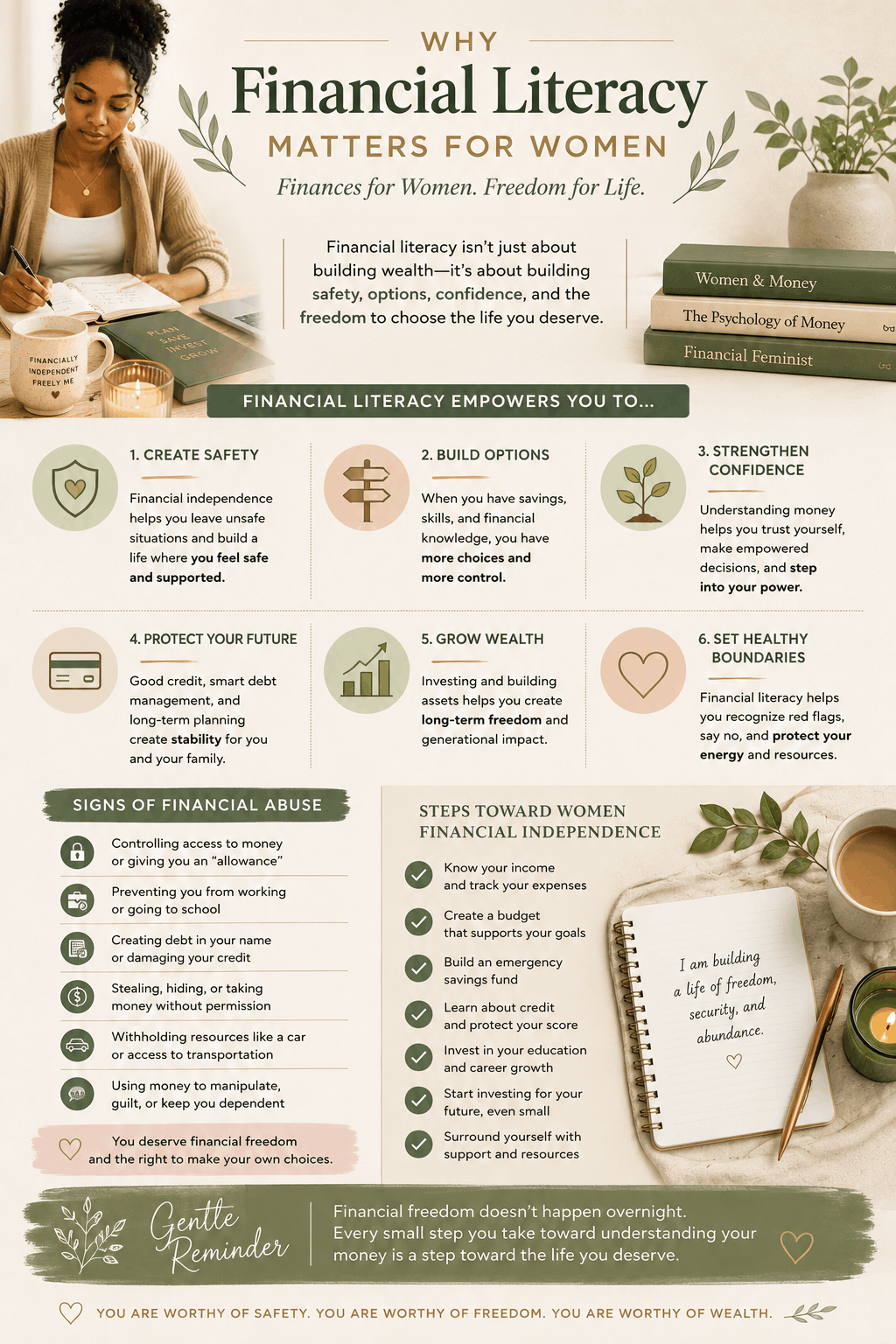
Signs of Financial Abuse Women Should Know
Financial abuse can show up in many different ways. Some are obvious, while others become normalized over time.
A few common signs include:
Controlling Access to Money
If someone dictates how much access you have to your own money, monitors your spending excessively, or forces financial dependence, that’s a major red flag.
Limiting Your Ability to Work
Preventing someone from working, going to school, or building career opportunities is another form of control. Education and employment are often pathways toward women financial independence.
Creating Debt in Your Name
Ruining someone’s credit, opening accounts without consent, or creating debt under someone else’s identity can have long-term consequences that make leaving difficult.
Stealing or Hiding Financial Resources
Taking money, hiding assets, or restricting access to transportation and necessities can isolate women financially and emotionally.
And sometimes financial abuse is emotional rather than logistical.
It’s the constant guilt.
The pressure.
The obligation.
The fear of disappointing people if you prioritize yourself.

The “Strong Independent Woman” Pressure
I especially want to speak to Black women here for a moment.
Many of us were raised to believe we must always be strong. Always resilient. Always capable. Always self-sacrificing.
And while resilience can absolutely be beautiful, hyper-independence can also become a trauma response.
Sometimes we overgive financially because we feel responsible for everyone.
Sometimes we struggle to ask for help.
Sometimes we carry entire families emotionally and financially while silently drowning ourselves.
And honestly, I’ve had to unlearn a lot around this too.
Women financial independence should not mean isolation.
It should mean having healthy support systems, healthy boundaries, and the ability to make empowered choices without losing yourself in the process.
I think true freedom is interdependence — not hyper-independence.
Why Financial Literacy Can Change a Woman’s Life
The more I teach finances for women, the more I realize financial literacy impacts every area of life.
Confidence.
Relationships.
Mental health.
Stress levels.
Career decisions.
Future planning.
Safety.
Research from behavioral psychology even shows that financial stress significantly impacts emotional wellbeing, nervous system regulation, and decision-making capacity.
Which honestly makes sense.
It’s hard to think clearly about your future when you’re in survival mode.
That’s why I believe every woman deserves access to financial education — regardless of her income level, relationship status, or background.
Every woman deserves to understand:
budgeting
saving
debt management
credit scores
investing
emergency funds
negotiating salary
retirement planning
wealth-building
Because women financial independence is not just about becoming wealthy.
It’s about becoming resourced enough to choose your life from freedom instead of fear.
Why This Conversation Matters
Abuse rarely starts loudly.
It often builds slowly over time.
By the time many women realize they’re in unsafe situations, they may already feel trapped financially, emotionally, or psychologically.
That’s why building financial literacy before you “need it” matters so much.
Learn how to budget.
Build savings slowly.
Understand your credit.
Learn about investing.
Know where your money is going.
Create financial boundaries.
Protect your peace.
Even if you’re in a healthy relationship today, these skills still matter.
Because finances for women are ultimately about creating safety, stability, and long-term choice.
And if you are currently navigating abuse or financial dependence, I want you to know this:
You are not weak.
You are not failing.
You are not alone.
Support exists.
Resources exist.
And your life can still become yours again.
Because financial literacy isn’t only about building wealth.
Sometimes it’s about building a way out.
Further Reading
Continue Exploring Women & Financial Freedom
If you're working toward financial independence, emotional healing, or building a healthier relationship with money, these posts may support you further.
Free Resource To Share
If you’re currently working on building healthier money habits, creating financial stability, or learning the foundations of personal finance, I’d recommend starting with the Financial Clarity Webinar.
It’s designed to help women feel more confident understanding money, budgeting, financial planning, and long-term wealth-building in a supportive and approachable way.
Product Recommendation
One book I often recommend to women beginning their financial independence journey is Financial Feminist.
It breaks down financial literacy in a very approachable, empowering, and emotionally aware way while also acknowledging the systemic challenges women face around money and wealth-building.
FAQs
Why are finances for women important?
Finances for women are important because financial literacy creates independence, safety, confidence, and long-term stability. Understanding money allows women to make empowered decisions about their future and wellbeing.
What is women financial independence?
Women financial independence means having enough financial stability, knowledge, and resources to support yourself without relying entirely on another person for survival or security.
What is financial abuse?
Financial abuse is a form of control where someone manipulates, restricts, or sabotages another person’s access to money, employment, credit, or financial resources.
How can women become financially independent?
Women can build financial independence by learning budgeting, saving, investing, debt management, salary negotiation, and long-term financial planning skills.
Why does financial literacy matter in relationships?
Financial literacy helps women recognize unhealthy financial dynamics, create boundaries, and maintain autonomy within relationships instead of becoming financially dependent or controlled.
Can financial independence improve mental health?
Yes. Financial stability and literacy can reduce chronic stress, improve confidence, support emotional wellbeing, and create more freedom and security in daily life.
〰️ LISTEN TO THE PODCAST OR WATCH THE VIDEO
↳ Listen to the full podcast version HERE
↳ Watch the YouTube Video for this blog post HERE
〰️ WORK WITH ME
↳ my coaching services https://bit.ly/3ZAs0NZ
↴ additional resources and perks:
→ Watch my FREE Webinar 'From Financial Confusion to Clarity' - https://bit.ly/4h7dXqq 📺
→ Download my free ebook on mastering your money mindset https://bit.ly/3fAfj33 💵
→ Download my free Wealth Tracker - https://bit.ly/48H8Rxj 🧮
→ Invest in stocks with Wealthsimple https://bit.ly/3PJYscp 📈
→ Invest in crypto and receive $25 USD https://bit.ly/3TxD4dr 🪙
→ Invest like the rich in art and receive a $200 bonus (USD only) https://bit.ly/3Popuqh 🖼️
→ Sign up for my bi-weekly newsletters https://bit.ly/466g09H 📨
〰️ CONTACT ME
✉️ hello@morganblackman.com
