
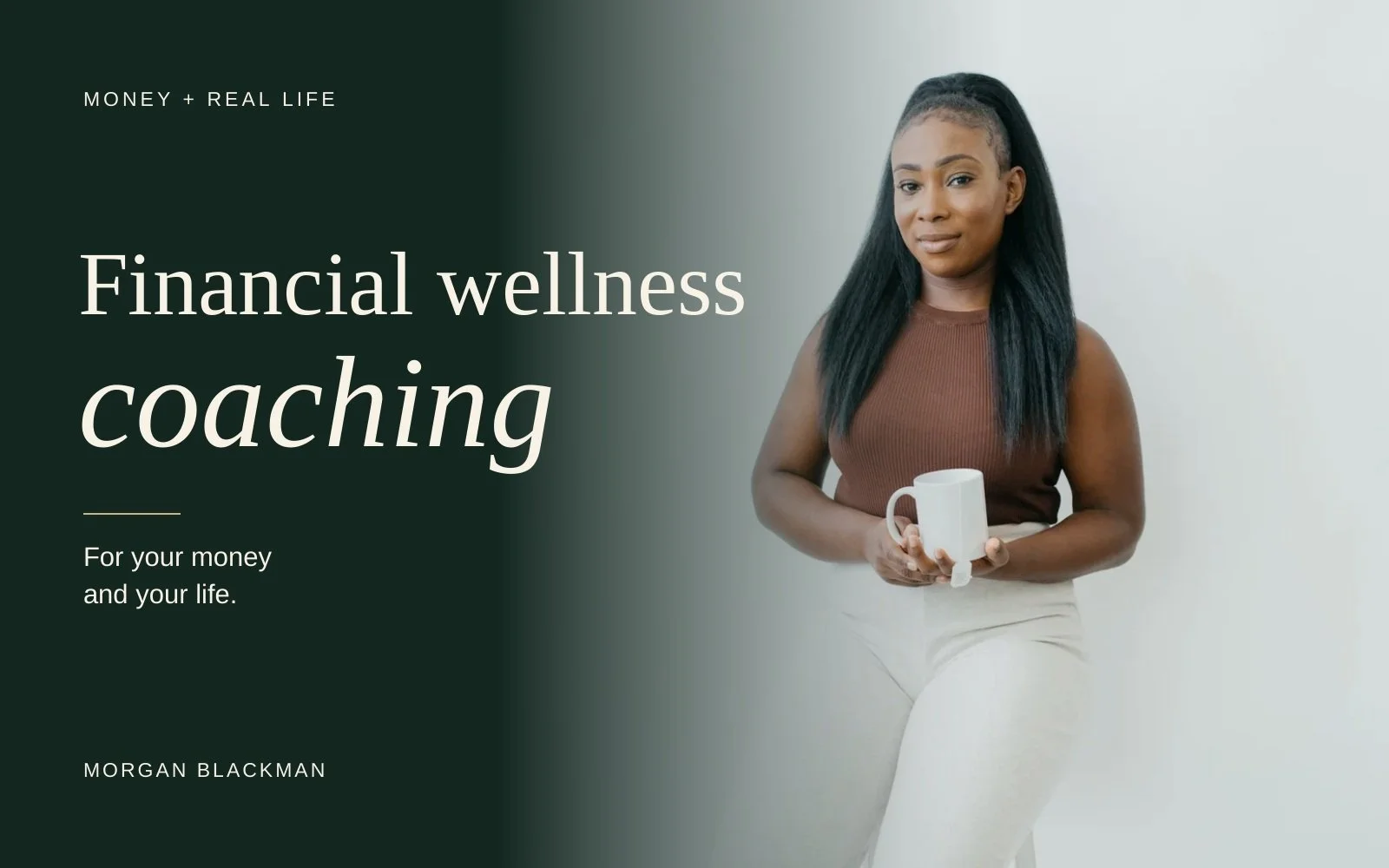
By Morgan Blackman
I would say financial wellness coaching is looking at your money through a holistic lens. We look at what is coming in, what is going out, and what you want your money to do for you. But I also want the bigger background story. What is happening in your relationships? What kind of work are you doing? How is your health? How much time do you actually have to show up for yourself?
Because we cannot look at your money in isolation and expect to understand your whole situation. Your money is part of the life you are living, and that life needs a seat at the table.
Maybe you are making the six figures now, but you are thinking, “Okay, why does this still not feel like the life I wanted?” Maybe you have your own business and love the freedom, but one month the money is coming in and the next month it is quiet. Or maybe you are working hard and there genuinely is not enough to cover everything. I do not want to hand all three people the same spreadsheet and call it a day. I want to understand what is going on.
The wellness piece hits heavy in my work. Sometimes I wish I could say wellness first, finances second, because I see such a connection between how we relate to ourselves and how we approach money. That still means getting practical. My Wealth Well framework brings together Wealth Wellness, Wealth Strategy, and Wealth Creation so we can connect your relationship with money with what you know, what you do, and the life you are trying to build.
What financial wellness means in everyday life
When I ask how you feel with money, I really mean that. Do you feel confident? Do you feel competent? Can you look at your accounts without immediately feeling ashamed of yourself? Can you have a money conversation without wanting to avoid it altogether? And when you are making money, is it giving you more room to live, or does earning it seem to take everything out of you?
These questions sit alongside the practical ones. Feeling calmer does not pay an overdue bill, and a healthy balance does not tell us everything about how a person feels. We need space for both.
In a survey of 411 UK adults, people who felt more capable of managing money also reported more positive financial behaviours, which were linked with better financial wellbeing. The study cannot tell us what caused what. But it gives us another useful question alongside the numbers: how confident do you feel putting what you know into practice?
The Consumer Financial Protection Bureau describes financial well-being in terms of managing everyday finances, being able to handle a financial shock, moving toward goals, and having room to make choices that allow you to enjoy life. That is a useful reminder that financial well-being includes security and freedom of choice, rather than a single income target.
For me, wealth is being able to buy your time back. Having more choice about whether you work, how much you work, and what you do with the rest of your life. You can love your work and still want the option to step away from it. Honestly, that freedom matters to me far more than earning a bigger number just so I can say I earned it. I want to know what your version looks like, because we need to match your expectations of money to what is actually important to you.
Why I look at the whole picture
Your spending can make much more sense when we understand its context. If your days are packed with work and caregiving, convenience may be something you rely on. If family support is important to you, money going to relatives cannot be understood only as an expense to cut. If your income changes every month, a budget built around the same paycheque arriving twice a month may not fit.
So I am going to ask questions. What are your values? Are they in alignment with how you are spending your money? Is this choice supporting you, or are you repeatedly justifying something that is hurting more than helping? We can be honest about that without ignoring the pressures around you or turning the conversation into a judgment of your character.
Money worries can also extend beyond the moment you open your banking app. The Financial Consumer Agency of Canada explains that financial stress can affect sleep, relationships, health, and work. That connection is a reason to take money concerns seriously. It is not a basis for diagnosing yourself, and it does not mean a coach can treat a health condition.
I also need to be clear about something: I am not here to spiritually gaslight you. I come to this work as a woman of colour, with an awareness of the barriers that systems can put in our way. Housing costs, discrimination, caregiving, and access to opportunities all belong in this conversation. We can believe that change is possible and still tell the truth about what makes it difficult. A person struggling to meet their basic needs does not need to be told they simply failed to think positively enough.
The question is what support and choices are available in your circumstances. Sometimes we can change a habit. Sometimes we need better information. Sometimes the priority is more income, practical assistance, or a professional whose work is outside coaching. Being resourceful includes knowing when to ask for that help.
Who might find this kind of coaching useful
You might recognize yourself in that pendulum of avoiding your finances and then looking at them in a panic. You want more structure, but you are not sure what is coming in or going out. You have so much happening with your career, your family, or your business that your finances keep coming last. Then you finally sit down and think, “I do not know enough. I am not smart enough to handle this.” That is exactly the kind of conversation I want us to be able to have openly.
Or you might be really good at earning money. The question is how to have that money provide the quality of life you actually want. How do you work toward your goals when your income is inconsistent? How do you stop feeling as though the only answer is to keep grinding? Sometimes making more is important. Sometimes making more has come with sacrificing more of your health, your time, or your relationships. I want us to look at the exchange you are making.
You do not need to arrive with every answer or a perfect routine. You do need to be willing to show up for yourself and communicate. If something is not working, tell me: “Hey, this is not working. Let's figure out another way.” That gives us something to work with. Making time is part of the work too. If you are busy, we can look at where that time could come from rather than pretending your calendar is empty.
There is no income threshold you have to meet to start a conversation. I want the support to fit your needs, your capacity to participate, and what feels comfortable for you to invest. On a free Clarity Call, we can talk about your goals and budget, then look at an offer or resource that makes sense for you. That might mean free resources to start, a one-off Strategy Call, or a Wealth Audit. Longer-term coaching is an option when you have the money available without sacrificing essentials or taking on burdensome debt. You do not have to commit to a long-term programme to get help.
The three pillars of my Wealth Well framework
All of my work comes back to my Wealth Well framework: Wealth Wellness, Wealth Strategy, and Wealth Creation. These are the three pillars we move through together. I often start with Wealth Wellness because I want to understand your relationship with money before piling on more information. But we can move between the pillars depending on what you need. You do not have to wait until you feel perfectly calm about money before we deal with a practical question or an urgent bill.
Wealth Wellness
Wealth Wellness is where we look at the story you have learned to tell about money and yourself. What did you see growing up? How did the people around you relate to money, and how did that become your story? What do you now believe you are capable of? I want us to get curious about those beliefs instead of treating every one of them as a fact about your future.
I care about how safe you feel approaching your finances. In this context, feeling safe might mean being able to look at a statement, ask a question you think is basic, or admit that a plan is not working without expecting shame. It is a personal experience we can discuss, not a clinical measure or a promise that coaching will resolve anxiety.
Then we get clear on your values. What holds true for you, aside from everybody else's expectations? Who is the future version of you that you want to grow into, and what matters to that person? If rest is important, we need to leave room for rest. If supporting family matters, we can talk about what you can offer while still meeting your own needs. Your goals need to belong to you.
A reflective exercise might help you notice the thought that appears before you avoid a money task. It might help you separate an old expectation from a current priority. The point is to understand yourself well enough to choose a useful next step. You do not need to explain every difficult experience in your past to deserve practical support now. For more on how difficult money experiences can shape your relationship with money, read Understanding Financial Trauma and Finding the Right Support.
Wealth Strategy
With Wealth Strategy, we move into, “Okay, now that I understand what I want from my money, how do I manage it?” This is where a lot of the education comes in: budgeting, savings, debt, credit, and learning about investing. You may be thinking, “I did not learn this in school. Nobody taught me how to do this.” We can start there. I want you to understand the information well enough to use it in your own life, rather than just collect another list of tips.
A starting point may be as straightforward as gathering your income, bills, balances, and due dates in one place. We can look at what is happening now before creating a plan for what you hope will happen next. A spreadsheet, tracker, or written list is useful if it helps you see clearly and you can realistically keep using it.
The Financial Consumer Agency of Canada's budgeting guidance recommends understanding your income and spending and making your goals part of the budget. In coaching, we connect that basic structure to your circumstances. A plan for somebody with steady employment may need different assumptions from one for somebody whose invoices are paid at irregular intervals.
One shift might be realizing, “I have been waiting until the end of the month to see what is left to save.” Could we treat an affordable savings amount like a bill and give it a place in the plan? That does not mean forcing a savings target when your essentials or required payments are not covered. We look at the actual numbers. If there is a shortfall, that needs an honest conversation, not a prettier budget that assumes the money exists.
We can also distinguish predictable costs from emergencies. An annual fee needs planning even though it does not arrive every month. An unexpected loss of income is a different problem. The FCAC's emergency fund guide explains that distinction and encourages building savings gradually from a realistic starting amount.
Investing education belongs here too, but learning about investing does not mean you must invest immediately. We can discuss concepts, risks, and research questions. I do not tell you which stock or investment to buy. You may need a qualified financial professional to assess recommendations for your particular situation.
Wealth Creation
With Wealth Creation, we get to ask, “Okay, how could we expand?” Could you build on work you are already doing? Explore another income stream? Move toward work that feels more meaningful? Or is what you really want more freedom and more time back? Time is a resource too, and I want us to be thoughtful about how you are spending it.
I want to understand what you are good at and interested in, as well as what an opportunity would require. A new income stream comes with questions about costs, effort, uncertainty, and whether there is real demand. Calling something passive does not remove those questions. We need to look past how attractive an idea sounds and consider what it would involve for you.
Sometimes the goal is higher earnings. Sometimes it is more flexibility or a gradual move toward work that feels meaningful. Those priorities can conflict. A new business might initially require more time rather than less, and a lower-pressure role might come with lower pay. Coaching can help you identify the trade-offs and the information you need before making a decision.
I also want you to know how to be resourceful. What do you already have in your skills, your relationships, your knowledge, or your practical resources? What could you learn, and who could you learn with? I teach about how economic systems shape our choices, including capitalism, and how we can think about building wealth ethically and collectively. I am interested in how we support ourselves and each other, not only how an individual accumulates more. No system or income idea removes uncertainty, but understanding the bigger picture can help us ask better questions.
If you are reading this and thinking, “Okay, I want someone to help me put these pieces together,” book a free 30-minute Clarity Call. Bring the questions you have been sitting with. We can talk about what you need, where you feel stuck, and whether my approach is the right support for you.
How the pillars can work together
Imagine a self-employed wellness practitioner whose income varies. This is a hypothetical example, not a client story or a promised result. She enjoys the work, but when revenue is low she avoids checking her accounts. When a large payment arrives, it becomes hard to know how much is available to spend.
Through Wealth Wellness, she could reflect on what feels difficult about looking at the numbers and what would make a short money check-in more manageable. Through Wealth Strategy, she could gather her actual income and expenses, map payment dates, and prepare questions for an accountant about tax obligations. Through Wealth Creation, she could examine whether a new offer makes sense or would simply add more work to an already full week.
The next step might be modest: identifying essential monthly costs or setting a regular time to review cash flow. The emotional and practical questions inform each other as she decides what to do next.
Now consider someone earning a steady salary whose biggest concern is time. Her plan might involve understanding the financial implications of reducing hours or changing jobs. A higher income target would not automatically answer her question. We would need to understand what she wants her money to make possible.
Where the Wealth Ecosystem life audit fits
The Wealth Ecosystem is a personal reflection exercise: a look at your life at this particular time. It asks you to step back and notice what is supporting you and where something feels out of balance. You can return to that check-in as your life changes. You are not supposed to fill it in once and then be the exact same person forever.
It is different from the three-pillar Wealth Well coaching framework. The framework guides how I teach and support the coaching work. The life audit helps you step back and notice where your attention might be needed across health, relationships, time, work, your environment, finances, and meaning or purpose.
You might discover that the money task you keep postponing is competing with an exhausting schedule. You might notice that a goal you have been funding no longer matters as much as it once did. Those observations give us questions worth exploring.
If you want to try that broader check-in, my guide to doing a life audit offers a place to begin. You can use what is helpful without trying to overhaul your entire life at once.
What working together can look like
Usually, we start with a call so we can both get a feel for the fit. Is this someone you want to work with? Do you feel able to ask your questions and trust me to support you through the work? A focused session is different from an ongoing coaching relationship. If we have one call about one concern, I want us to stay focused. Covering every area of your life in an hour could leave you feeling as though you have even more on your plate to tackle.
In longer-term work, we have space to move through the three pillars, practise, and come back to what needs more attention. My work is hands-on. We might look at a spreadsheet or a tracker together, work through a reflection on a call, or have you try an exercise before we meet again. Journalling, educational resources, and practical money tools all have a place. We choose what helps with the question in front of us.
Between sessions, your observations matter. Did the check-in happen? If not, was the timing unrealistic, the task unclear, or the process uncomfortable? Did the plan rely on money that had not arrived? Telling me what actually happened gives us something concrete to work with.
For me, accountability is showing up for yourself, including when it feels easier to avoid the conversation. Ask the questions. Let me know what you tried, what helped, and what did not. I can offer guidance and support, but I cannot do every part of your life for you. I want you to become more confident making your own decisions, with the knowledge and resources to keep using what you learn.
Before we begin working together, I ask separately whether video recording and transcription are okay with you. You can agree to either, both, or neither, and our sessions can go ahead without recording or transcription. A video can help you revisit what we talked about. A transcript helps me take notes, prepare a follow-up email or summary, and stay present with you during the call.
I store session recordings in private folders in my business Google Drive. Access is limited to me and the client whose session it is; no one else is authorized to access them. I intend for you to have ongoing access to your session materials, and I will delete your recording or transcript if you ask. Course materials are separate and hosted in ThriveCart.
The precise session schedule, materials, and between-session support depend on the offer. Confirm those details before committing, including what you can access afterwards and how questions between calls are handled.
Values and spiritual reflection in my approach
Integrity is a huge value for me. I practise what I share. I do not want to be someone who is simply regurgitating information without ever applying it in my own life. My financial habits, my emotional wellbeing, and my spiritual practice all matter to how I show up. And I am human. I do not do everything perfectly every day. The commitment is to keep making time to come back to myself and do the work.
I grew up Christian, and as I gained independence and left home, I began exploring different religions and philosophies and what they taught about happiness. A lot of what I was looking for had very little to do with money. That experience shapes my perspective. I care about meaning, trust, and your relationship with yourself. You can earn more and still have questions about what brings you peace. For me, those questions deserve attention alongside the practical money work.
I talk about that connection in Money Is Energy. Money is something we use in the material world, and we also bring feelings, beliefs, attention, and expectations to it. I find that a useful way to reflect on the exchange we are making with our time and energy. It does not mean money magically appears because you think positively, or that a spiritual practice can predict investment returns. We still need to look at what is actually happening with your finances.
And yes, if it interests you, we can have some fun exploring astrology or Human Design as prompts for reflection. I have a basic understanding of them, and they can open a conversation about how you see yourself, your interests, and your patterns. They are not validated financial or career assessments. We do not use them to choose investments or decide that a particular job is destined to work out. The practical research and decision-making still need to happen.
You can decline any practice or conversation that does not feel comfortable or is inconsistent with your religion or beliefs. You do not have to share my beliefs to work with me. Tell me what works for you and what does not, and we can adapt the approach. Respecting who you are is part of the work, not something you have to set aside to participate.
You can simply say it on the call. If you need time to think, you can let me know afterwards by email or on a call: “Hey, I was not comfortable with that,” or, “That does not fit my beliefs. Can we try something else?” There is no special safe word you have to remember. If having one would make it easier for you, we can agree on one. What matters is that you know you can speak up, pause, or decline without having to defend your choice.
If you enjoy these reflection tools, you can explore my Intuitive Wealth Building Blueprint below. It is an optional reflection resource, not a validated financial assessment or personalised investment advice.
Training and the boundaries of coaching
I have completed the Trauma of Money program. Its interdisciplinary approach considers money in the context of personal experience, relationships, and wider systems. My training in EFT tapping, breathwork, and meditation is still in progress. I also use journalling in my own learning and personal practice. I do not want a list of tools to obscure the most important boundary: I am a coach, not a licensed financial adviser or a licensed counsellor.
These reflective or calming practices are not treatment for trauma, anxiety, or another health condition. Ask me what an exercise involves and what training I have. We can talk about another way to approach the task, and you can stop. You also do not owe me the details of every painful thing you have been through. We can respect your boundaries and be honest about when another kind of support is needed.
The National Center for Complementary and Integrative Health cautions that meditation and mindfulness research has limitations and that negative experiences can occur. These practices should not replace or delay appropriate health care. If a practice feels distressing, stop and discuss it with a qualified health professional rather than assuming discomfort is something you need to push through.
For personalized investment recommendations, seek an appropriately qualified financial professional. For tax questions that require professional assessment, an accountant may be needed. If difficult experiences or symptoms are affecting your daily life, a licensed mental health professional can assess what support is appropriate. Questions about changes to sleep, exercise, diet, or other health routines belong with the relevant health professional.
Coaching can sometimes sit alongside those services. I have not previously worked directly alongside a client's advisor or accountant, but I am open to arranging that with your permission. Clear roles matter. Ask each person what they do, what they do not do, how they are paid, and what information would be shared. Having access to advice through a bank does not automatically mean every service is free; ask about fees, commissions, and other costs. If you are deciding which kind of help fits your needs, my guide to financial coaches and financial advisors explains the different roles and questions to ask.
What realistic progress might look like
One of the first things I want you to walk away with is clarity. That moment of, “Oh, okay. I understand what is happening here, and I know what I need to look at next.” Progress can also be how you feel with money. Are you more comfortable having the conversation? Do you feel a little more confident opening your accounts? Can you ask a question without deciding you should already know the answer? Those shifts count too.
There can be practical changes too. You might establish a check-in you can maintain, adjust a savings plan, or make a debt payment that fits your budget. These are examples of possible goals, not outcomes that every client will achieve on the same schedule. Your starting point, resources, decisions, and circumstances affect what is possible.
Clients describe their progress in different ways. In a testimonial on my private-coaching page, Vanessa M. says, “Morgan is wonderful! She really helped simplify budgeting and savings.” That kind of practical clarity matters alongside the bigger financial goals.
Liana M. shares a different experience: “I doubled my income coming in through my small business in under six months.” She describes this as happening during the pandemic. This is her self-reported income result, not a statement about profit, and neither testimonial establishes what another person will experience. They are individual accounts, not typical results or promises about what coaching will deliver.
Honestly, the internal shifts matter a lot to me. I want you to feel more competent, more at ease, and more able to show up for yourself. We keep looking at the numbers alongside that. If there is an unpaid bill or a widening shortfall, we need to see it and decide what support would help. Feeling better and understanding your real situation need to stay connected.
You can define a small sign of progress before starting. Perhaps it is being able to explain your monthly essentials or setting a boundary around an expense you cannot sustain. If we use projections to explore what financial freedom could look like for you, we need to look at the assumptions and your circumstances. They are planning tools, not promises about income, investment returns, or when you will reach a goal. Review that goal as you learn more. If the work is not helping, say so. It may need adjusting, or a different kind of support may fit better.
A gentle place to begin
You can start by asking yourself one question: what do I want my money to make more possible in my life?
Take a moment to make the answer specific. “More freedom” might mean a day off each week, a visit to family, or enough savings to consider changing jobs. Then ask what you know about that goal and what you still need to understand. There is no need to turn the reflection into a test of whether you are doing enough.
You might write down one money task you have been avoiding and the smallest useful version of it. Opening a statement without making a decision may be enough for today. If the numbers show a gap you cannot close through spending changes, let that information point you toward practical support rather than another round of self-blame.
What I want is for your money to support a life that feels more like yours. A life where you understand what matters to you and can make more intentional decisions with the resources you have. You will still have things to learn. So will I. This is an ongoing practice of showing up, asking questions, and making adjustments as your life changes.
I am based in Toronto, Ontario, and offer virtual coaching internationally. Ready to talk about what this could look like for you? Book a free 30-minute Clarity Call. You do not need to have your whole financial life figured out before we speak. Bring your questions, tell me what you want to change, and let's see whether working together feels like a fit.
