
8 Budgeting Challenges (And How to Overcome Them)
A budgeting challenge can feel incredibly frustrating, especially when you’re trying your best to improve your finances but still feel stuck, overwhelmed, or inconsistent. And honestly, many budgeting mistakes have less to do with discipline and more to do with emotional habits, unrealistic expectations, or financial systems that simply don’t fit your life. Learning how to budget effectively starts with understanding the challenges that may be keeping you stuck in the first place.
Budgeting can feel overwhelming, especially if you’ve struggled with it in the past or constantly feel like your budget “fails” no matter how hard you try. And honestly, I think one of the biggest misconceptions about budgeting is believing that if you’re struggling financially, you must simply lack discipline.
But in reality, budgeting is emotional too.
Our spending habits, money patterns, nervous system responses, lifestyle, and financial beliefs all influence the way we manage money. That’s why budgeting challenges often go much deeper than spreadsheets or numbers alone.
I know for me personally, budgeting became much easier once I stopped trying to create the “perfect” financial system and started building one that actually fit my real life. The more realistic, flexible, and supportive my budget became, the more sustainable my financial habits became too.
Research from the Consumer Financial Protection Bureau has shown that financial stress significantly impacts emotional wellbeing and decision making. At the same time, studies continue showing that people who consistently track spending and create intentional financial goals tend to experience stronger long-term financial stability.
That’s why learning how to overcome budgeting mistakes matters so much.
Because budgeting isn’t about restriction.
It’s about creating support, clarity, freedom, and long-term financial wellbeing.
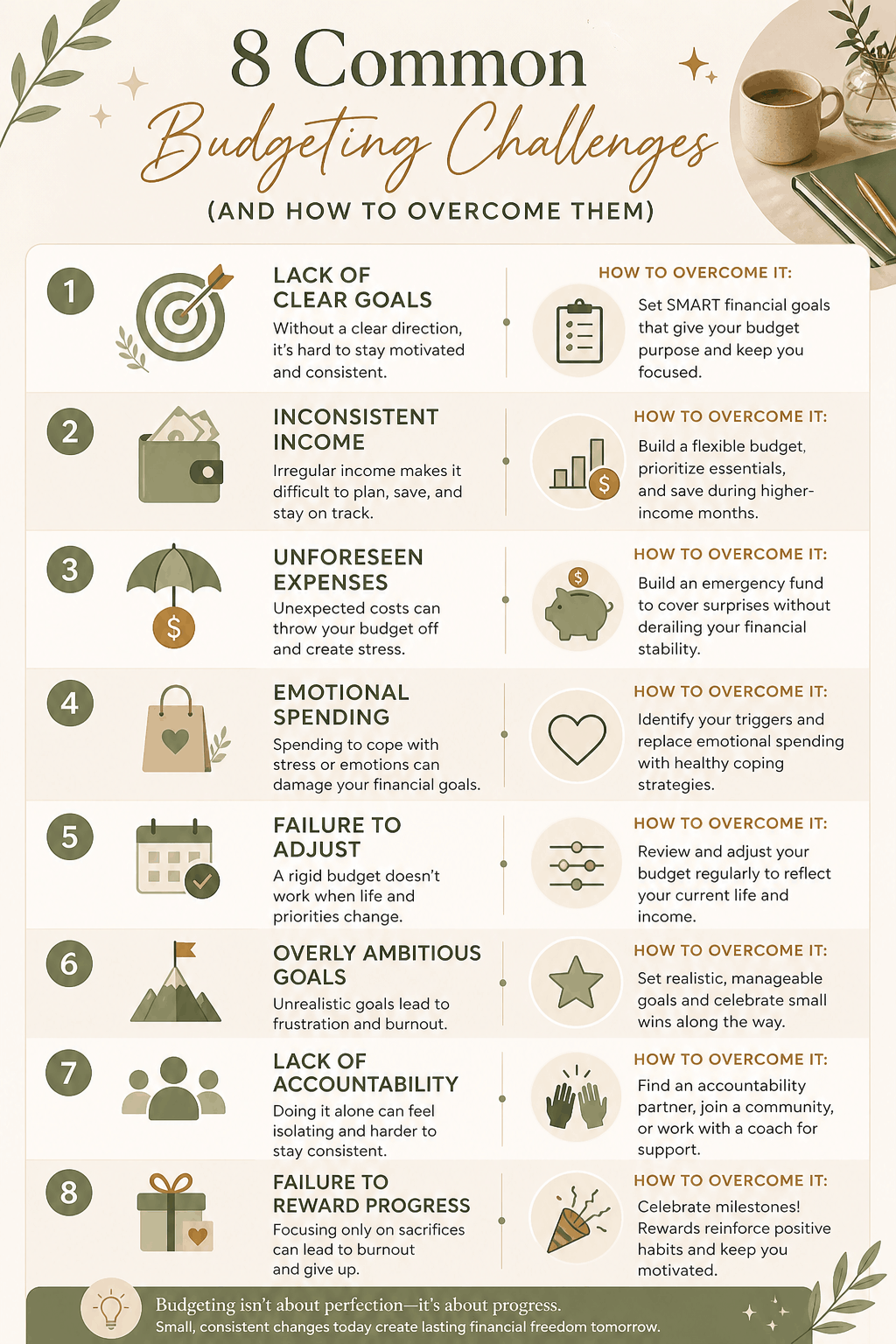
1. Lack of Clear Financial Goals
One of the most common budgeting challenges is not having a clear reason behind your budget in the first place. Without meaningful financial goals, budgeting can quickly start feeling restrictive, repetitive, or emotionally draining.
And honestly, motivation becomes much harder when you don’t feel emotionally connected to what you’re working toward.
For some people, financial goals may include:
paying off debt
building emergency savings
investing
buying a home
traveling
starting a business
reducing financial anxiety
creating more freedom and flexibility
The clearer your “why,” the easier it becomes to stay consistent long term.
This is something I also talk more about in “How to Build Wealth: 7 Simple Strategies That Actually Work,” especially around how intentional financial habits compound over time.
2. Inconsistent Income
Budgeting with inconsistent income can feel incredibly stressful.
When your income fluctuates month to month, it’s easy to feel like budgeting becomes impossible altogether. Freelancers, entrepreneurs, commission-based workers, and creatives often experience this challenge regularly.
I’ve personally experienced seasons where income felt unpredictable, and honestly, it can create a lot of emotional stress around money if you don’t have systems in place.
What helped me most was learning to create a more flexible budget instead of expecting my finances to look exactly the same every month. Prioritizing essentials first, building emergency savings gradually, and planning from a “minimum income” perspective helped create more emotional stability financially.
Flexibility matters far more than perfection here.
✨ Gentle Reminder
Your Budget Should Support Your Life — Not Control It
Budgeting is not supposed to feel like constant punishment or restriction. A healthy budget should create more clarity, emotional safety, and freedom in your life — not guilt every time you spend money.
The more realistic and supportive your financial system becomes, the easier it is to stay consistent long term. Sustainable budgeting almost always works better than extreme budgeting.
3. Unforeseen Expenses
One of the most frustrating budgeting mistakes people make is assuming life will always go according to plan.
But honestly, unexpected expenses are not unusual.
They’re part of life.
Car repairs, medical bills, emergencies, travel, pet expenses, or sudden income changes can quickly disrupt even the best financial plans if there’s no flexibility built in.
That’s why emergency funds matter so much emotionally and financially.
Having even a small financial cushion can reduce stress significantly during difficult seasons and help prevent relying on high-interest debt when unexpected situations happen.
4. Emotional Spending
Emotional spending is one of the biggest budgeting challenges many people silently struggle with.
And honestly, emotional spending is rarely about the actual purchase itself.
Most of the time, it’s connected to stress, boredom, loneliness, burnout, anxiety, comparison, or emotional avoidance.
I’ve absolutely had moments where I convinced myself I “deserved” a purchase simply because I was emotionally overwhelmed or exhausted. And while there’s nothing wrong with enjoying your money intentionally, emotional spending patterns can become financially draining when shopping becomes a coping mechanism instead of a conscious choice.
This is something I also dive deeper into in “How to Improve Your Relationship With Money (Beginner Guide),” especially around emotional spending habits and nervous system regulation.
Learning healthier emotional coping tools can completely change your relationship with budgeting long term.

5. Failure to Adjust Your Budget
Another common budgeting mistake is treating your budget like a rigid set of rules instead of a flexible financial tool.
Your life changes constantly.
Your budget should too.
Income changes. Priorities shift. Unexpected opportunities arise. Expenses increase or decrease throughout different seasons of life. A budget that worked six months ago may not work now, and honestly, that’s completely normal.
The more adaptable your budget becomes, the more sustainable it usually feels emotionally.
6. Overly Ambitious Financial Goals
One thing I see often is people setting financial goals that are technically inspiring but emotionally unrealistic.
And honestly, unrealistic goals can create burnout incredibly quickly.
For example, trying to save huge amounts of money in a very short timeframe while also completely cutting out every enjoyable expense often becomes emotionally exhausting and difficult to maintain long term.
Smaller, realistic milestones usually create more consistency because they feel achievable. And consistency matters so much more than perfection financially.
Progress builds confidence.
7. Lack of Accountability
Budgeting alone can sometimes feel isolating.
And honestly, financial growth becomes much easier when you feel supported.
Whether that support comes from:
a financial coach
a supportive partner
a trusted friend
a financial community
accountability groups
therapy
mentorship
…having support can make a huge difference emotionally and practically.
I think one of the most healing things about financial wellness is realizing you do not have to figure everything out entirely alone.
8. Never Celebrating Progress
One budgeting mistake that often gets overlooked is focusing so heavily on sacrifice that you never acknowledge your progress.
And honestly, constantly feeling deprived can quickly create resentment around budgeting altogether.
Celebrating small wins matters.
Paid off a credit card?
Built your first emergency fund?
Reduced emotional spending?
Started tracking your finances consistently?
Those milestones deserve recognition.
Because financial growth is not only about reaching the final goal.
It’s also about becoming the version of yourself who learns how to manage money with more confidence, awareness, and intentionality over time.
Budgeting Is About Consistency, Not Perfection
At the end of the day, budgeting is not about becoming perfect with money overnight. And honestly, I think that’s one of the biggest mindset shifts people need to hear. So many of us approach budgeting from a place of pressure, guilt, or perfectionism, believing we need to get everything exactly right immediately or we’ve somehow failed financially.
But real financial wellness usually doesn’t happen that way.
It’s built slowly through consistency, flexibility, and small intentional habits repeated over time. The goal is not to create a rigid financial system that makes you feel stressed, restricted, or ashamed every time life changes. The goal is to build a budget that actually supports your real life — your priorities, your emotional wellbeing, your responsibilities, and your long-term goals.
For me personally, budgeting became much more sustainable once I stopped trying to force perfection and started focusing on awareness instead. Some months will feel easier than others. Unexpected expenses will happen. You may overspend sometimes or need to adjust your goals along the way. That doesn’t mean you’ve failed. It simply means you’re human.
And honestly, every budgeting challenge becomes easier to navigate when you approach your finances with more self-awareness and less shame. Because financial growth is rarely about doing everything perfectly. It’s about continuing to show up for yourself, learning as you go, and creating habits that support the life you genuinely want to build.
Further Reading
Build Healthier Financial Habits
If you're working through budgeting challenges or trying to improve your relationship with money, these posts can support you further.
Resource to Start With
If budgeting has been feeling overwhelming or emotionally draining lately, I’d start with the Wealth Well Tracker. It’s designed to help you organize your finances, build healthier money habits, and create a more supportive budgeting system without feeling restricted or ashamed.
Access The Wealth Well Tracker
Product Recommendation
One tool that can genuinely make budgeting feel less overwhelming is YNAB (You Need A Budget). What I appreciate most about it is that it encourages intentional spending and financial awareness in a much more hands-off way. Simply link your card to your accountt, and watch the insights come in. This makes budgeting feel less rigid or shame-based.
For people navigating budgeting challenges or inconsistent spending habits, having a system that creates visibility and flexibility can make a huge emotional difference. Budgeting becomes much easier when your financial tools actually support your lifestyle instead of making you feel constantly behind.

FAQs
What is the biggest budgeting challenge?
One of the biggest budgeting challenges is staying consistent while balancing emotional spending, unexpected expenses, and changing financial priorities.
What are common budgeting mistakes?
Common budgeting mistakes include unrealistic financial goals, failing to track spending, emotional spending, not adjusting budgets regularly, and not building emergency savings.
How can I improve my budgeting habits?
Improving budgeting habits often starts with creating realistic goals, tracking spending consistently, reducing emotional spending triggers, and building flexible financial systems.
Why do budgets fail?
Budgets often fail because they are too restrictive, unrealistic, emotionally unsustainable, or disconnected from someone’s actual lifestyle and spending patterns.
How do I stop emotional spending?
Stopping emotional spending starts with identifying emotional triggers, creating healthier coping mechanisms, and becoming more intentional with spending decisions.
How often should I update my budget?
Most people benefit from reviewing and adjusting their budget monthly or whenever major financial changes occur.
〰️ WORK WITH ME
↳ my coaching services https://bit.ly/3ZAs0NZ
↴ additional resources and perks:
→ Download my free ebook on mastering your money mindset https://bit.ly/3fAfj33 💵
→ Download my free Wealth Tracker - https://bit.ly/48H8Rxj 🧮
→ Invest in stocks with Wealthsimple https://bit.ly/3PJYscp 📈
→ Invest in crypto and receive $25 USD https://bit.ly/3TxD4dr 🪙
→ Invest like the rich in art and receive a $200 bonus (USD only) https://bit.ly/3Popuqh 🖼️
→ Sign up for my bi-weekly newsletters https://bit.ly/466g09H 📨
〰️ CONTACT ME
✉️ hello@morganblackman.com
