
How to Set New Year Goals That Actually Stick
Every year, millions of people set New Year goals hoping this will finally be the year things change. Whether your goals involve finances, health, relationships, business, or personal growth, the beginning of a new year naturally creates space for reflection and possibility. But honestly, setting goals for the new year is not just about motivation. It’s about creating realistic systems, emotional alignment, and intentional habits that help those goals actually last beyond January.
There’s something about the start of a new year that makes people reflect on life differently.
We begin thinking about the habits we want to change, the goals we want to accomplish, the version of ourselves we want to become, and the life we hope to build moving forward. And honestly, I think there’s something beautiful about giving ourselves permission to begin again.
Because whether the previous year felt incredible, difficult, messy, transformative, or somewhere in between, a new year often creates space for clarity and intention.
And if I’m being honest, I’ve always loved this time of year.
Usually around Christmas going into January, I spend a lot of time reflecting on what’s working in my life, what no longer feels aligned, and what I genuinely want to focus on moving forward. I journal a lot during this season. I revisit old goals. I create vision boards. I organize my calendar. I think deeply about the kind of life I want to build emotionally, financially, professionally, and personally.
Because setting New Year goals is not really about becoming a completely different person overnight.
It’s about becoming more intentional over time.
Research around goal setting and behavioral psychology consistently shows that people are more likely to achieve goals when they are specific, measurable, emotionally meaningful, and supported by consistent systems rather than motivation alone. Studies around habit formation also suggest that small repeated behaviors often create more sustainable long-term change than extreme short-term resolutions.
And honestly, I think many people fail their New Year goals not because they lack ambition, but because they create goals without creating supportive systems around them.
Why Most New Year Goals Don’t Last
One thing I’ve noticed over the years is that many people approach goal setting from a place of pressure instead of alignment.
There’s often this intense energy at the beginning of January where people feel like they need to completely reinvent themselves immediately.
Suddenly everyone wants to:
wake up at 5 AM
go to the gym daily
save thousands of dollars
quit bad habits
build businesses
become perfectly productive
change their entire lives overnight
And honestly, that’s a lot.
I think social media sometimes creates unrealistic expectations around transformation, especially during the new year. But real change is usually much slower, quieter, and more repetitive than people expect.
The truth is, sustainable growth often comes from:
consistency
self-awareness
realistic habits
emotional resilience
patience
supportive systems
Not perfection.
This is something I had to learn personally too. There were years where I set goals that sounded exciting but honestly were not realistic for my current season of life. I overloaded myself with too many goals, too much pressure, and timelines that didn’t actually match my capacity.
And eventually, that creates burnout instead of momentum.

The SMART Goal Method Still Works
One of the most effective systems I still use for setting New Year goals is the SMART Goal Method.
I know it sounds simple, but honestly, clarity changes everything.
SMART goals are:
Specific
Measurable
Achievable
Relevant
Time-based
For example, instead of saying:
“I want to save more money.”
You could say:
“I want to save $5,000 by December by automatically transferring money into savings every month.”
That level of specificity creates direction.
And honestly, I’ve used this method for years across different areas of my life including:
business
finances
fitness
investing
personal development
travel goals
Because vague goals create vague results.
Break Big Goals Into Smaller Goals
One of the biggest mindset shifts that changed my relationship with goal setting was realizing that large goals are usually achieved through much smaller repeated actions.
And honestly, this is where many people get discouraged.
They focus so heavily on the final outcome that they overlook the smaller habits required to actually get there.
For example:
writing a book starts with writing pages consistently
saving money starts with smaller financial habits
growing a business starts with daily visibility and consistency
improving health starts with repeated choices over time
Research from habit expert James Clear, author of Atomic Habits, emphasizes that small repeated habits compound significantly over time. Tiny consistent improvements often create far more sustainable results than dramatic short bursts of motivation.
This is why I personally love breaking goals into:
monthly goals
weekly goals
smaller milestones
habit-based systems
Because smaller wins create momentum.
And momentum builds confidence.
Staying Organized Creates Clarity
One thing that genuinely helps me stay connected to my New Year goals is organization.
Not in a perfectionist way.
But in a supportive way.
I personally love using:
Google Calendar
Notion
physical planners
sticky notes
vision boards
journaling systems
There have honestly been periods where my bathroom mirror, fridge, desk, and laptop were covered in reminders of my goals because visual reminders help keep me emotionally connected to what I’m building.
And honestly, organization reduces decision fatigue too.
When you already know:
your priorities
your schedule
your habits
your systems
…it becomes much easier to stay consistent.

Accountability Changes Everything
One thing I genuinely underestimated early in my own growth journey was how important accountability can be.
Because honestly, achieving goals can feel incredibly difficult when you’re trying to do everything alone.
When I first started building my business, hiring a coach completely shifted things for me. Not because she magically changed my life overnight, but because having accountability, structure, and support helped me stay focused and consistent.
And this applies to so many areas of life:
fitness
finances
entrepreneurship
wellness
personal growth
Community matters.
Support matters.
Encouragement matters.
Research around goal achievement consistently shows that people are often more likely to follow through on goals when they have accountability systems or social support involved.
This is also something I explore more deeply in “Goal Setting Examples That Help You Achieve More,” especially around creating systems that support long-term consistency.
✨ Gentle Reminder
Progress Is Still Progress
You do not need to transform your entire life overnight in order to make meaningful changes. Small consistent actions repeated over time often create far more lasting results than perfection or burnout ever will.
Give yourself permission to move slowly, adjust your goals when needed, and celebrate progress along the way instead of constantly chasing unrealistic standards.
Flexibility Is Important Too
One thing I wish more people talked about during the new year is that goals are allowed to evolve.
Life changes.
People change.
Priorities shift.
And honestly, sometimes the goals we set in January no longer feel aligned by July.
That does not mean you failed.
It simply means you’re growing.
I think flexibility is incredibly important when it comes to New Year goals because rigid perfectionism often creates unnecessary shame.
Sometimes you may need to:
adjust timelines
simplify goals
pivot directions
rest more
reprioritize
let certain goals go entirely
And honestly, that’s part of the process too.
Visualization and Emotional Connection Matter
I genuinely believe visualization can be incredibly powerful when paired with intentional action.
That’s a huge reason I love vision boards, journaling, affirmations, and emotional reflection practices.
Because your goals become much more sustainable when you feel emotionally connected to them.
Instead of only asking:
“What do I want?”
Try also asking:
“How do I want my life to feel?”
Because sometimes the deeper desire underneath the goal is:
peace
freedom
security
confidence
flexibility
purpose
connection
And honestly, understanding the emotional reason behind your goals often helps you stay committed long term.
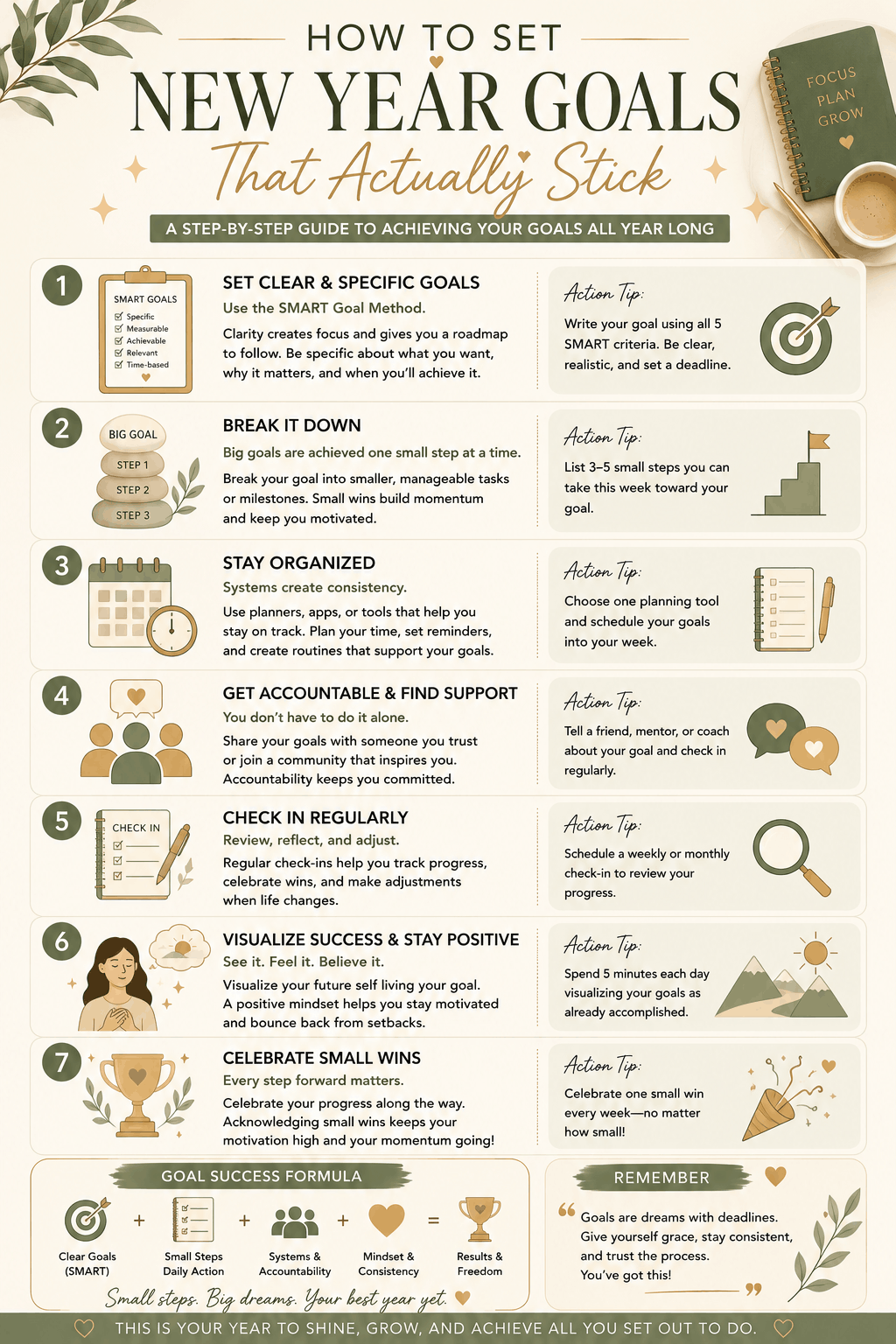
Celebrate Small Wins Along the Way
I think many people wait until they’ve fully achieved a goal before allowing themselves to feel proud.
But honestly, the journey deserves recognition too.
Small wins matter.
The first $500 saved matters.
The first month of consistency matters.
The first client matters.
The first healthy habit matters.
The first difficult conversation matters.
The first step matters.
Because long-term transformation is usually built through many smaller moments that compound over time.
And honestly, learning how to celebrate yourself throughout the process creates a much healthier relationship with growth overall.
New Year Goals Are Really About Intentional Living
At the end of the day, I don’t think New Year goals are really about becoming a “better” person.
I think they’re about becoming more intentional.
More honest.
More aligned.
More connected to the life you genuinely want to build.
Because the truth is, your life is often shaped by the small habits, choices, routines, and beliefs you consistently return to over time.
Not by one perfect month in January.
And honestly, I think people underestimate how much growth can happen through small consistent changes repeated over the course of a year.
You do not need to have your entire life figured out right now.
You do not need perfect discipline.
You do not need to achieve every single goal immediately.
You simply need to keep reconnecting with yourself, your vision, and the direction you want to move toward.
And sometimes that’s enough to completely change your life over time.
Further Reading
Continue Building Your Dream Life Intentionally
If you're working on goal setting, mindset shifts, personal growth, and creating a more intentional future, these posts may support you further.
Resource to Start With
If you’re currently working on improving your mindset, financial wellness, and long-term goals, I’d start with the Money Mindset Ebook. It’s designed to help you shift limiting beliefs around money, abundance, and personal growth in a way that feels supportive and realistic.
Product Recommendation
One platform I genuinely recommend for new entrepreneurs is Notion. What I appreciate most is how flexible it is for organizing ideas, tracking goals, planning content, managing workflows, and building systems without feeling overly complicated.
When you’re first starting a business, having simple systems can reduce overwhelm significantly and help you stay more consistent long term.
A few of my own resources, like My Well(th) List, which is a personal storefront for you to shop my favs in business, finance, and health, was built with Notion.
FAQs
How do I set realistic New Year goals?
Set realistic New Year goals by focusing on specific, measurable, and achievable goals that align with your current lifestyle, priorities, and emotional capacity.
Why do most New Year goals fail?
Many New Year goals fail because people rely on motivation alone without creating supportive habits, systems, accountability, or realistic expectations.
What are SMART goals?
SMART goals are goals that are Specific, Measurable, Achievable, Relevant, and Time-based.
How many New Year goals should I set?
Many people find it more sustainable to focus on a smaller number of meaningful goals rather than trying to completely transform every area of life at once.
How can I stay consistent with my goals?
Consistency often improves through supportive systems, smaller habits, accountability, organization, and emotional connection to your goals.
What if my goals change during the year?
That’s completely normal. Goals can evolve as your priorities, circumstances, and personal growth change throughout the year.
〰️ WORK WITH ME
↳ my coaching services https://bit.ly/3ZAs0NZ
↴ additional resources and perks:
→ Download my free ebook on mastering your money mindset https://bit.ly/3fAfj33 💵
→ Download my free Wealth Tracker - https://bit.ly/48H8Rxj 🧮
→ Invest in stocks with Wealthsimple https://bit.ly/3PJYscp 📈
→ Invest in crypto and receive $25 USD https://bit.ly/3TxD4dr 🪙
→ Invest like the rich in art and receive a $200 bonus (USD only) https://bit.ly/3Popuqh 🖼️
→ Sign up for my bi-weekly newsletters https://bit.ly/466g09H 📨
〰️ CONTACT ME
✉️ hello@morganblackman.com
