
My Worst Purchase Ever & the Best Money I’ve Ever Spent
Some purchases leave us with regret. Others quietly transform the trajectory of our lives. In this reflective post, Morgan shares the story behind her worst purchase ever, the best money she’s ever spent, and the deeper financial lessons about investing, self-worth, and long-term thinking that emerged through both experiences.

I think one of the hardest things about money is how emotionally attached so many of our purchases actually are.
People often talk about spending as if it’s purely logical.
But honestly, most financial decisions are emotional long before they become practical.
Some purchases come from insecurity.
Some come from fear.
Some come from boredom, loneliness, validation, or wanting to feel successful for a moment.
And sometimes, the purchases we regret most are not even the biggest ones financially. Sometimes they’re the opportunities we delayed, the investments we avoided, or the years we spent disconnected from the future we could have started building earlier.
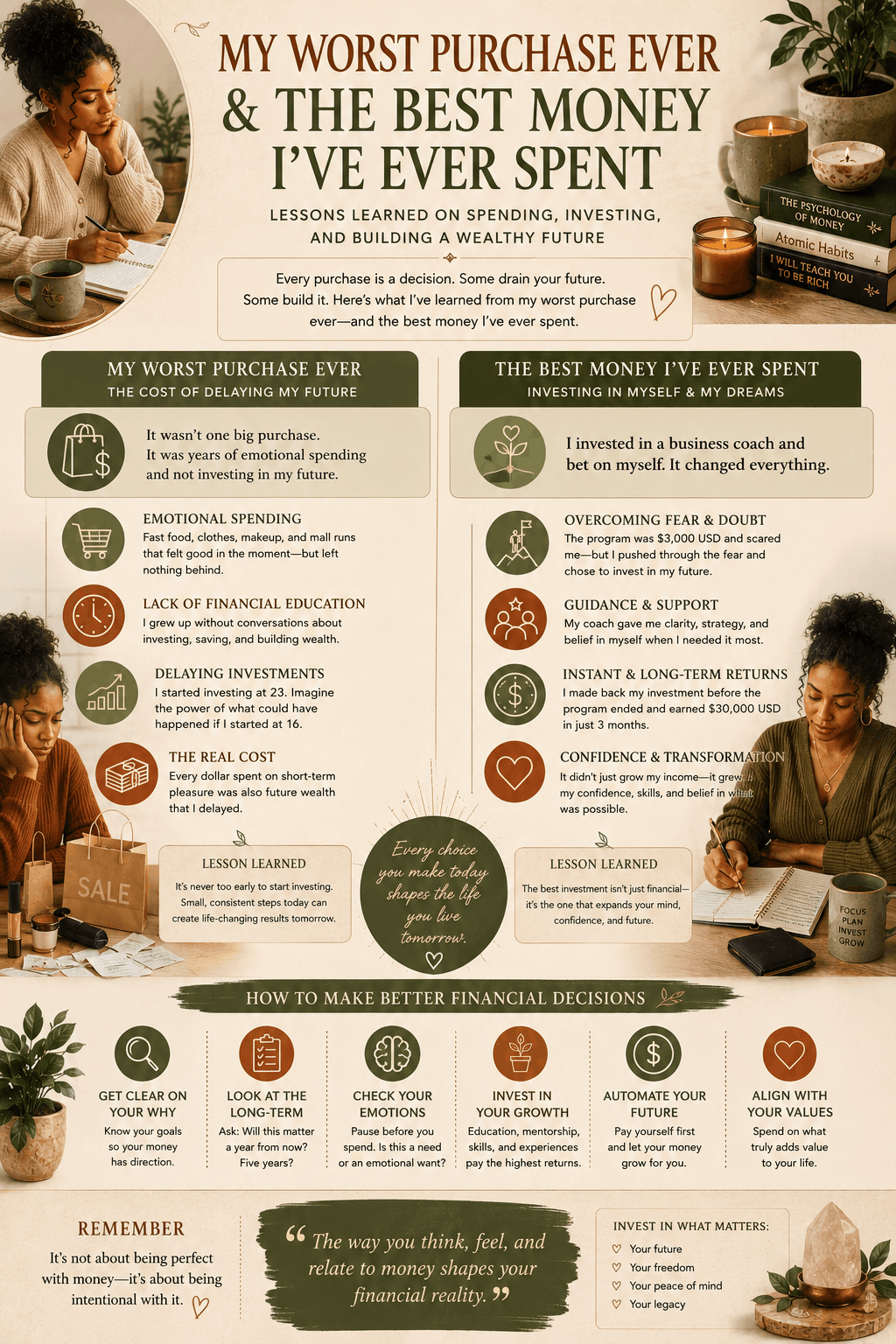
When I reflect on my own financial journey, I think my worst purchase ever wasn’t necessarily one dramatic transaction. It was the accumulation of years spent prioritizing short-term gratification over long-term investment.
And honestly, I understand now why that happened.
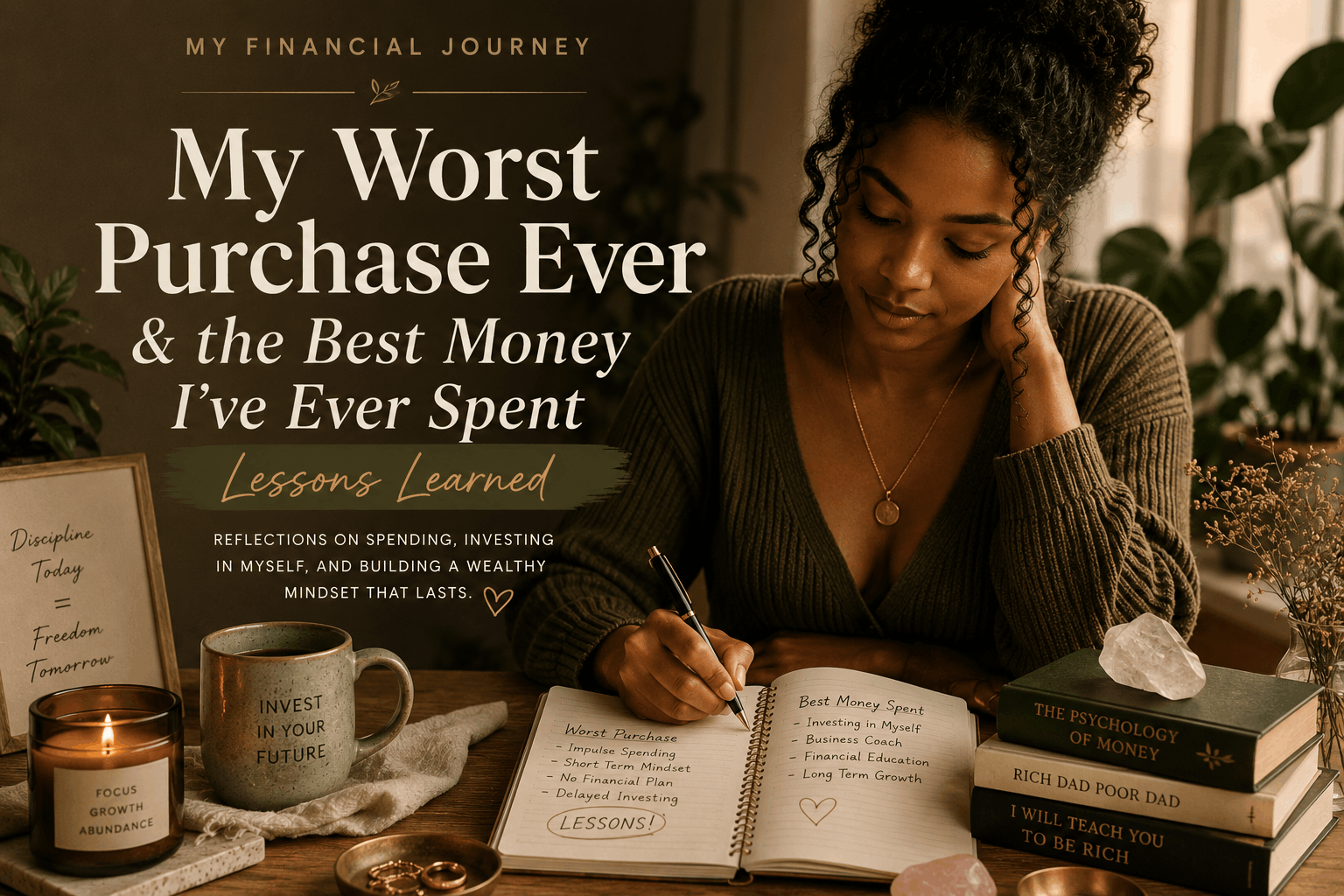
My Worst Purchase Ever Wasn’t Just One Thing
I’ve never lost thousands gambling.
I’ve never made some catastrophic stock market decision.
I’ve never completely financially ruined myself.
But if I’m being honest, my worst purchase habits were rooted in emotional spending and financial avoidance during my younger years.
When I got my first job as a teenager, most of my money disappeared almost immediately.
Fast food.
Clothes.
Makeup.
Random mall purchases.
Small things that felt exciting in the moment but left nothing meaningful behind afterward.
And honestly, I don’t even blame my younger self entirely for that.
I grew up in an environment where conversations around investing, wealth building, and long-term financial planning simply weren’t normalized. Financial literacy wasn’t deeply modeled around me, so naturally I repeated many of the same patterns I had witnessed growing up.
I think this is something many people quietly carry shame around.
People blame themselves for not understanding money earlier while ignoring the reality that many of us were never truly taught how wealth actually works in the first place.
Looking back now, I think the worst purchase ever is often not a single item.
It’s years of unconscious spending that quietly delays future freedom.
Because every impulsive purchase is not only money spent.
It’s also potential growth delayed.
The Cost of Delaying Investments
One of my biggest financial regrets was not starting to invest earlier.
I started investing at 23, which honestly is still relatively young compared to many people. But I often think about what could have happened if I had started even earlier — when I first began earning money as a teenager.
Not because I’m obsessed with perfection or maximizing every dollar now, but because I understand the power of time differently.
Compounding interest is powerful.
Consistency is powerful.
Long-term investing is powerful.
And honestly, I think many people underestimate how much wealth building is less about intensity and more about time.
Small amounts invested consistently over years can completely transform someone’s financial future.
But when you grow up without exposure to investing conversations, wealth can feel distant or inaccessible. Spending money becomes immediate and emotionally tangible while investing feels abstract and far away.
I think that’s why financial education matters so deeply.
Because once someone understands how money actually grows, their relationship with spending often begins changing naturally.

The Best Money I’ve Ever Spent
At the same time, some purchases completely change your life in the opposite direction.
And honestly, the best money I’ve ever spent was investing in myself through mentorship and business coaching.
At the time, it felt terrifying.
The coaching program cost thousands of dollars, and every fear imaginable surfaced immediately.
What if it didn’t work?
What if I wasted the money?
What if I failed?
What if I wasn’t good enough?
I think many people experience this internal conflict when investing in themselves because growth often requires financial risk before certainty exists.
But deep down, I knew staying where I was would cost me more long-term than taking the leap forward.
And honestly, that investment changed everything.
Before I even finished the program, I had already earned back my investment through new clients and opportunities. More importantly though, it shifted my confidence, clarity, and belief in what was possible for my life.
I think this is something people misunderstand about the best money spent.
Sometimes the greatest return is not only financial.
Sometimes it’s psychological.
The right investment can expand your self-belief in ways that permanently change your trajectory.

Emotional Spending vs Intentional Investing
I think one of the biggest financial shifts people eventually make is learning the difference between emotional spending and intentional investing.
Emotional spending usually creates temporary relief.
Intentional investing creates long-term expansion.
One is often reactive.
The other is rooted in vision.
And honestly, this doesn’t only apply to money.
People emotionally spend energy too.
Time too.
Attention too.
Sometimes the worst purchase ever is investing years into environments, relationships, or lifestyles that quietly drain your potential.
Meanwhile, the best money spent is often connected to growth:
education
mentorship
therapy
health
financial literacy
skill-building
supportive environments
experiences that expand your perspective
The older I get, the more I realize wealth is deeply connected to what you consistently choose to invest in.
Breaking Generational Financial Patterns
I also think many financial habits are inherited emotionally long before they become conscious financially.
If you grow up around instability, scarcity, avoidance, or survival mode, those patterns often shape your relationship with money automatically.
For a long time, I didn’t realize how much of my financial behavior was learned rather than intentional.
And honestly, I think financial healing often begins when you stop shaming yourself and start becoming curious about your patterns instead.
Why do you overspend?
Why do you avoid investing?
Why does money trigger fear?
Why does financial success feel emotionally uncomfortable sometimes?
Those questions matter.
Because once you understand the emotional roots beneath your habits, it becomes easier to build something healthier.
The Best Money Spent Is Often Future-Oriented
I think the best financial decisions are usually the ones that support your future self instead of only your current emotions.
That doesn’t mean never enjoying your life.
It doesn’t mean becoming hyper-restrictive or obsessed with productivity.
But it does mean learning how to balance present enjoyment with future wellbeing.
And honestly, that balance takes practice.
The older I get, the more I realize financial wellness is less about perfection and more about alignment.
Are your purchases aligned with the future you’re trying to build?
Are your habits supporting long-term peace?
Are your investments helping you grow?
Because eventually, every financial decision compounds into something.
And sometimes the best money spent is simply the decision to finally invest in a different future for yourself.
Further Reading
Continue Exploring Spending Habits, Wealth & Financial Growth
If you're trying to heal your relationship with money, stop emotional spending, and build long-term wealth more intentionally, these articles may support you further.
Free Resource
If you’re trying to stop emotional spending, build healthier financial habits, and create long-term wealth intentionally, download my free Money Mindset E-Book to begin shifting the patterns shaping your relationship with money.
Product Recommendation
One of the best financial decisions I made was learning how to invest consistently instead of only spending reactively. I personally love Wealthsimple because it made investing feel more approachable, automated, and aligned with long-term financial growth.
FAQs
What was your worst purchase ever?
My worst purchase ever wasn’t one dramatic item — it was years of emotional spending and delaying investments that could have supported my long-term financial future.
What is the best money you’ve ever spent?
The best money I’ve ever spent was investing in mentorship and business coaching. It helped expand my confidence, financial opportunities, mindset, and long-term income potential.
Why do people emotionally overspend?
People often overspend emotionally because spending temporarily relieves stress, insecurity, boredom, loneliness, or comparison. Many financial habits are emotionally driven rather than purely logical.
Is investing in yourself worth it?
Honestly, investing in yourself can become one of the highest-return investments you make when it supports your growth, education, confidence, skills, or long-term wellbeing.
How can I stop wasting money on unnecessary purchases?
Becoming more intentional with spending starts by understanding the emotional patterns behind your purchases. Creating financial goals, practicing mindful spending, and focusing on long-term priorities can help reduce impulsive spending habits.
