

I thought I had done everything right. I compared vehicles, read CARFAX reports, asked questions and even took the car for another inspection. Then, about two weeks after buying my used 2017 Hyundai Santa Fe, the check-engine light came on.
A mechanic suspected a catalytic-converter problem that could mean a repair bill of several thousand dollars. The light later disappeared, which made the whole situation feel even more confusing. Clutch ultimately accepted the return. I was relieved, but I was also frustrated. How could I have put so much time into researching a car and still feel so unprepared?
That experience sent me down a very long rabbit hole. What does an inspection actually tell you? What does a warranty cover? How much of a vehicle’s history can you really know? And how do you make a decision when everyone has a different opinion?
This is the guide I wish I had before buying a used car in Ontario. It brings together the practical checks and the money questions, because a car can support your freedom or quietly take a lot of it away.
And no, understanding cars is not a “guy thing.” These are life skills. We deserve to learn them without being made to feel silly for asking basic questions.
I’m sharing my experience as a buyer and financial wellness coach, not diagnosing vehicles or providing legal advice. A qualified mechanic, your insurer and the relevant provincial authorities can help with the details of your specific purchase.
Start With Your Life, Not the Car Listing
Before you open another listing, ask yourself: What problem am I actually trying to solve?
When I sold my previous car in 2022, I wanted fewer expenses and more room to take a gap year and rethink my life. When I wanted another car, I was looking for independence: earning income through Instacart, visiting my partner and getting around without coordinating everything around someone else’s vehicle.
Selling a car gave me freedom in one chapter. Buying one could give me freedom in another. My circumstances had changed. That doesn’t make either decision wrong.
Write down your actual needs: your commute, passengers, groceries, winter routes, parking and how often you drive. Separate those from the features you would simply love to have. You can want a beautiful car. Just know what you are paying for.
Do You Need to Own One Right Now?
Compare ownership with the alternatives available where you live: transit, occasional rentals, car sharing or keeping your current vehicle. In a rural area, a car might be essential. In another situation, the cost of owning something that mostly sits in a driveway may not make sense.
Build a Budget That Includes the Boring Parts
The purchase price is only the beginning. Before making an offer, price out:
The vehicle, applicable tax, registration and any agreed fees.
An insurance quote for the actual vehicle and how you will use it.
Fuel or charging, parking and regular maintenance.
Tires, seasonal tire changes and upcoming service.
A repair cushion that does not depend on the car never breaking down.
Interest and financing costs, if you are borrowing.
If you plan to use the car for deliveries or rent it out, tell your insurer before you rely on that income. Do not assume ordinary personal coverage covers every use. Check financing and warranty restrictions too.
A useful calculation is: purchase cost + tax and fees + borrowing cost + expected running costs − estimated resale value. Compare vehicles over the same number of years. The resale figure is an estimate, not money you are guaranteed to get back.
Cash, Financing or Buying Something Less Expensive?
Paying cash is not automatically a win if it empties your emergency fund. Financing is not automatically affordable because the payment looks small. A longer loan can make the monthly number easier while increasing the total interest you pay.
Compare the total amount financed, interest rate, term, payment frequency, fees and total repayment. Get more than one quote. The Financial Consumer Agency of Canada points out that a dealer does not have to offer you the lowest available rate. Its guide to shopping for car financing is a useful starting point.
Also ask what you would owe if you needed to sell sooner than expected. A car can lose value faster than you pay down the loan. Future investment returns are not a guaranteed way to cancel out borrowing costs.
Think About What This Purchase Leaves Room For
An extra $10,000 spent on a car is $10,000 that cannot go toward something else. That might be debt repayment, savings, a move or simply feeling less stretched each month.
This is not about making yourself feel guilty for wanting nice things. It is about choosing deliberately. Can you afford the car and the rest of your life?
Want a clearer picture of your money before buying? My free Wealth Well Tracker can help you track income, spending, savings and debt as you plan for the car and the rest of your life.
Choose the Specific Vehicle, Not Just the Badge
My brother suggested a Toyota RAV4 or Honda CR-V. Other people had completely different recommendations. Everyone had a story about a car that lasted forever or one that cost a fortune.
Those experiences can help you build a shortlist, but they are not a guarantee about the car in front of you. Research the exact model year, engine, transmission and maintenance history, not just the manufacturer.
A brand’s reputation cannot tell you whether a particular owner skipped oil changes, ignored a leak or drove through deep water. Equally, one bad experience does not prove every vehicle from that brand is a bad purchase.
Sedan, SUV or Something Else?
Think about the space you actually use, not the biggest vehicle you could qualify to finance. Compare fuel consumption, tire prices, insurance, parking and visibility. Test whether your everyday things fit comfortably, including child seats if relevant to your life.
All-wheel drive can help with traction, but it does not replace appropriate tires, sensible speed or safe following distance. Ask what extra servicing the drivetrain needs. A feature only adds value if it serves your real use.
Gas, Hybrid or Electric?
Compare the whole ownership picture. For an electric vehicle, can you charge reliably at home or nearby, and what will it cost? For a hybrid or EV, ask about battery condition, remaining coverage and whether the inspection includes the relevant systems.
For any vehicle, get local estimates for routine service and likely repairs. A lower sticker price is less exciting when the parts and labour do not fit your budget.
Research Recalls and Service Requirements
Look for information about the specific year and powertrain, then check the actual VIN. Ask a manufacturer-authorized dealer to confirm whether outstanding recalls have been completed and whether any coverage applies to that vehicle. A recall listing alone does not prove the repair has been done. OMVIC explains how to check safety recalls.
Read the manufacturer’s maintenance schedule. Find out whether a timing belt, transmission service or another major scheduled job is approaching, and ask for receipts rather than relying on “it’s all been done.”
Read the History Without Treating It as a Guarantee
A vehicle-history report can help you identify reported accidents, registration history, odometer information and other records. But a report is only as complete as the information supplied to it. An incident or repair that was never reported may not appear.
Read it alongside maintenance receipts, the seller’s answers and an independent inspection. Look for mileage inconsistencies, gaps you cannot explain, repeated sales or repairs, and whether the history matches the story you were told.
An accident entry needs context. What was damaged? Who repaired it? Are there invoices? Was structural damage involved? A dollar figure by itself does not tell the whole story, and a “clean” report does not mean a car is mechanically perfect.
For an Ontario private sale, ask for the Used Vehicle Information Package (UVIP). It includes information such as Ontario registration history and lien information. Check the VIN against the car and paperwork, and confirm the person selling it is entitled to do so. Do not assume a vehicle is free of debt because the seller says it is.
A Safety Certificate Is Not a Mechanical Guarantee
This was one of the biggest lessons from my own experience. “Inspected” sounds reassuring, but you need to ask: inspected for what?
Ontario’s Safety Standards Certificate shows that a vehicle met minimum safety standards when inspected. It is not a warranty or a promise that nothing will fail afterward. The certificate is valid for 36 calendar days after the inspection.
A pre-purchase inspection is a different conversation. Choose an independent, qualified mechanic familiar with the vehicle and ask for the inspection’s scope in writing. Even a thorough inspection cannot predict every future failure or reveal every internal issue without additional testing.
With my Santa Fe, I had already sought another inspection. That did not stop a warning light appearing later. The lesson is not to skip inspections. It is to understand what they can and cannot tell you, then decide how much uncertainty you can afford.
What to Ask Your Mechanic to Check
Structural rust, signs of collision repairs and leaks.
Brakes, tires, steering and suspension.
Engine and transmission operation during a road test.
Warning lights, diagnostic codes and relevant readiness information.
Battery and charging systems, with hybrid/EV-specific checks where appropriate.
Upcoming maintenance and repairs, with written cost estimates.
Ask whether additional tests are warranted by what the mechanic finds. A diagnostic code is a clue, not a complete diagnosis. Do not assume a converter, engine or transmission needs replacing based on a code alone, and do not ask every car to undergo invasive tests without a reason.
If a seller will not allow a reasonable independent inspection before you are committed, treat that as a serious reason to reconsider. If you agree to an inspection condition, have it clearly written into the contract rather than relying on a verbal promise.
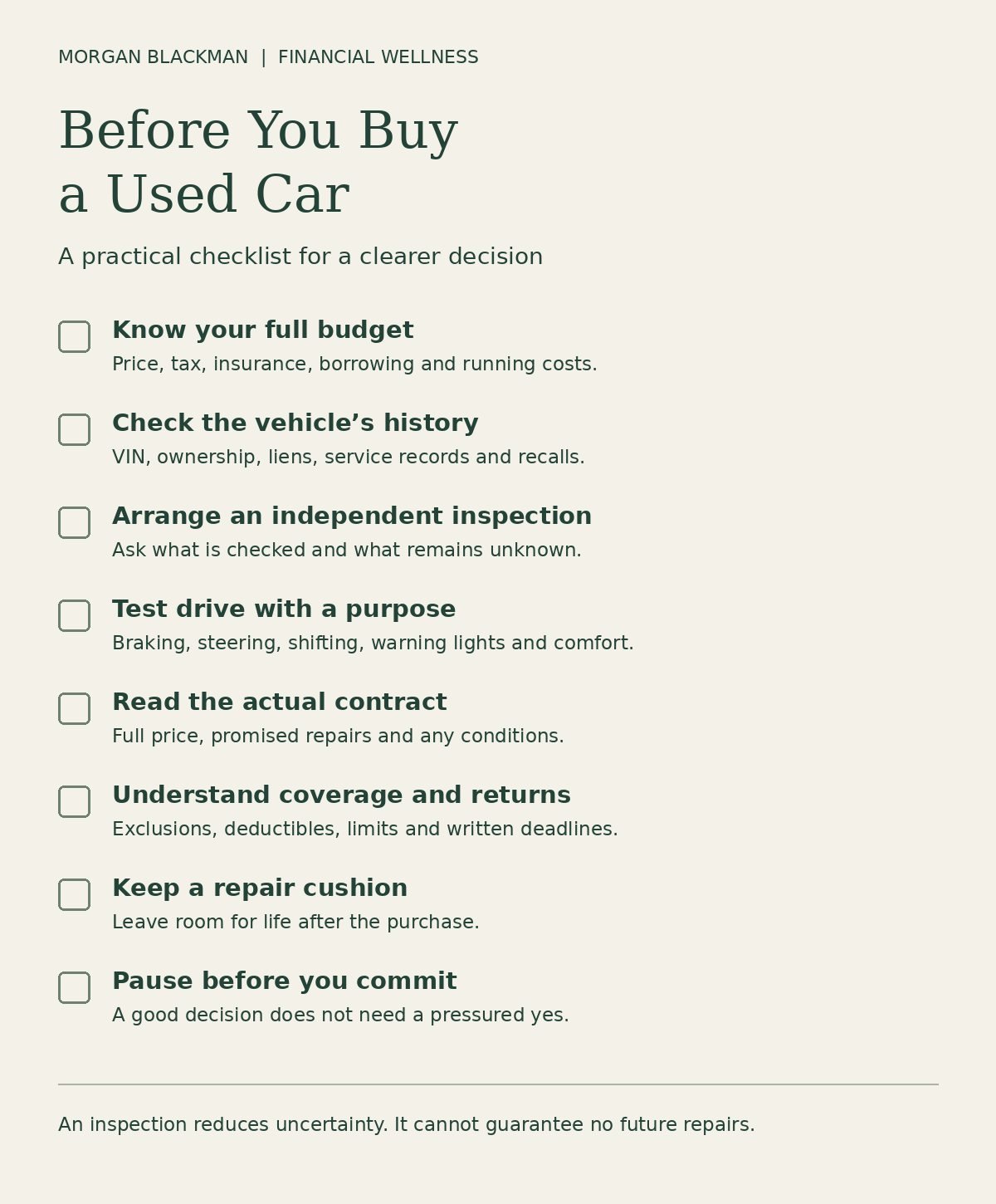
Your Used Car Inspection Checklist
You do not need to pretend to be a mechanic. Your job is to notice, ask and bring in someone qualified before your money is committed.
Before the Viewing
Confirm the VIN, price, mileage and seller’s identity.
Review the history, ownership documents and available service records.
Get an insurance quote and check any work-related use.
Arrange an independent inspection and clarify who pays for it.
Set your maximum total cost and keep room for repairs.
During the Viewing and Test Drive
View the car in good daylight and ask to start it cold when possible.
Look for rust, uneven panel gaps, leaks, tire wear and signs of water damage.
Check lights, windows, locks, heating, air conditioning and other features.
Check that warning lights behave as described in the owner’s manual.
Drive a suitable route that lets you assess braking, steering, acceleration and reversing safely.
Note unusual noises, vibration, smells or shifting behaviour for the mechanic.
Never crawl under an unsupported vehicle, touch hot components or open a hot cooling system. A test drive is not the place to experiment with risky manoeuvres.
Before You Commit
Read the written inspection findings and repair estimates.
Resolve ownership, lien, recall and history questions.
Get the full price, promised repairs and conditions in writing.
Read warranty and return terms before paying.
Confirm the financing terms, insurance start date and registration requirements.
Keep copies of the advertisement, contract, receipts and messages.
Questions to Ask When Buying a Used Car
Save these before your next viewing:
Why is the vehicle being sold, and how long have you owned it?
Has it had collision, flood or other damage? What documentation is available?
Has it been used as a rental, taxi, rideshare or for other commercial work?
What maintenance is due soon, and which records can I review?
Have warning lights appeared recently or have codes been cleared? What was diagnosed or repaired?
Can my mechanic inspect it before I am committed to buying?
Are there outstanding liens or recalls, and how will they be resolved?
What is the complete price, including tax and agreed charges?
What warranty, return or exchange terms apply, and where are they written?
Which promised repairs or accessories will be included in the signed contract?
Listen to how someone answers as well as what they say. “Don’t worry about it” is not a substitute for a document you can read.
Dealer, Online Seller or Private Sale?
The place you find a listing is not necessarily the seller. A vehicle advertised on a marketplace may belong to a registered dealer or a private individual. Check who you are actually buying from.
In Ontario, buying from an OMVIC-registered dealer gives you protections that do not apply in the same way to private sales. Franchise and independent dealers both need to follow the applicable rules. Registration is worth checking; a familiar logo or professional-looking website is not enough. Read OMVIC’s explanation of your rights.
Registered dealers have disclosure obligations about certain vehicle history and condition information. Ask for those disclosures in writing and read them before signing. OMVIC’s disclosure guide explains what dealers must tell buyers.
For private purchases, check the UVIP and ownership paperwork carefully. Follow Ontario’s used-vehicle buying and registration requirements, including the applicable tax and safety-document requirements. Ontario generally requires registration within six days of purchase. Arrange insurance and confirm what documents you need before collecting the car.
Private sales are not automatically bad, and dealers are not automatically risk-free. The important thing is understanding the checks, paperwork and recourse available in each situation.
Do Not Assume You Can Return It
Ontario does not have a general cooling-off period for motor-vehicle purchase agreements. Some circumstances may provide cancellation rights, but buyer’s remorse alone does not create one. Read OMVIC’s guidance on cancelling an agreement before assuming a deposit or signed contract can simply be reversed.
Some sellers offer their own return policies. Read the deadlines, mileage limits, fees, condition requirements and exclusions. My return was accepted, but my experience is not a promise about anyone else’s purchase. Check the terms that apply when you buy.
Is an Extended Warranty Worth It?
After facing the possibility of a large repair bill, I understand why a warranty can feel comforting. But I would not tell you to buy one without reading what it actually covers.
Ask who provides it, which components are covered, what is excluded, the deductible, claim limits and expiry by time or mileage. Find out whether repairs require advance approval, where you can have work done and what maintenance records you must keep. Wear, pre-existing problems and diagnostic work may be treated differently from a covered breakdown.
Compare the premium with your repair cushion and any remaining manufacturer coverage. A warranty can overlap coverage you already have. Financing it also adds borrowing cost. OMVIC’s warranty checklist helps explain the questions to ask.
The right answer may be buying suitable coverage, choosing a different vehicle or keeping more money aside. It is not automatically buying the most expensive package because you are scared.
Five Questions That Make This a Money Decision, Not Just a Car Decision
This experience reminded me that information is only part of making a good decision. We also need to understand what is happening inside us while we make it.
Who is affected? Think about your household, anyone sharing the vehicle and any income that depends on it.
What am I really deciding? Is the goal reliable transport, independence, earning potential or a particular image?
When do I actually need to decide? Separate a genuine transport deadline from pressure to grab an offer immediately.
How am I feeling? Excited, exhausted, embarrassed or desperate to stop searching? Those feelings deserve attention, especially before signing.
Why this option? Can you explain why this specific car fits your needs and budget without relying on the seller’s pitch?
If you are so exhausted by the search that you want to say yes just to make it end, pause. Ask someone you trust to review the numbers and the unanswered questions with you. You do not need to prove that you can handle a big purchase alone.
This is also why I talk about financial wellness beyond budgets. Your money decisions live inside your actual life: your relationships, time, responsibilities and hopes for the future.
What I Want You to Take Away
I cannot promise that doing every check will mean a car never breaks down. I wish buying well came with that kind of certainty. It does not.
What you can do is slow the process down enough to understand what you are buying, what remains unknown and what a problem would mean for your finances. Keep the inspection independent, put promises in writing and leave yourself room to handle life after the purchase.
You are allowed to ask questions. You are allowed to bring someone with you. You are allowed to walk away from a car you love if the numbers or the answers do not feel right.
And if a car, home or another major purchase has you feeling pulled in ten directions, that is something we can work through in coaching: getting clear on your goals, budget and trade-offs before making a commitment. I do not replace your mechanic, lawyer or other qualified specialist. I can help you approach the money decision with more clarity.
Book a Clarity Call if you would like to talk about the support you need and whether working together is a good fit.
My car-buying experience was stressful. But it also taught me skills I get to carry forward. I hope this guide gives you a head start, without having to learn every lesson the expensive way.
