
7 Reasons Why Businesses Fail (And How to Avoid Them)
When people talk about why businesses fail, they usually focus on money. Not enough funding. Poor sales. Bad timing. And while those things absolutely matter, I’ve learned that some of the biggest threats to a business are often much quieter than that. They build slowly in the background through burnout, self-doubt, lack of direction, people-pleasing, isolation, and trying to do everything alone. Entrepreneurship has stretched me emotionally, mentally, financially, and spiritually in ways I never expected. And honestly, I think a lot of business owners silently struggle with these things more than they admit.
Entrepreneurship is interesting because from the outside, people often only see the visible parts:
the launches
the branding
the followers
the revenue milestones
the aesthetic content
the “success”
But behind almost every business is someone navigating uncertainty constantly.
Someone questioning themselves.
Someone trying to make decisions with limited information.
Someone balancing creativity with survival.
Someone carrying emotional pressure most people never fully see.
And after several years of running my own business, one thing I’ve realized is this:
Most businesses don’t fail overnight.
They usually decline slowly through patterns that seem harmless at first but eventually become unsustainable.
That’s why I wanted to talk about the quieter reasons why businesses fail — the things entrepreneurs don’t always discuss openly because they’re tied to mindset, emotional wellbeing, burnout, fear, and identity just as much as strategy itself.
Because yes, business absolutely requires practical skills and systems.
But it also requires emotional resilience.
And I honestly think that part gets overlooked far too often.
Why Businesses Fail Often Starts With Misalignment
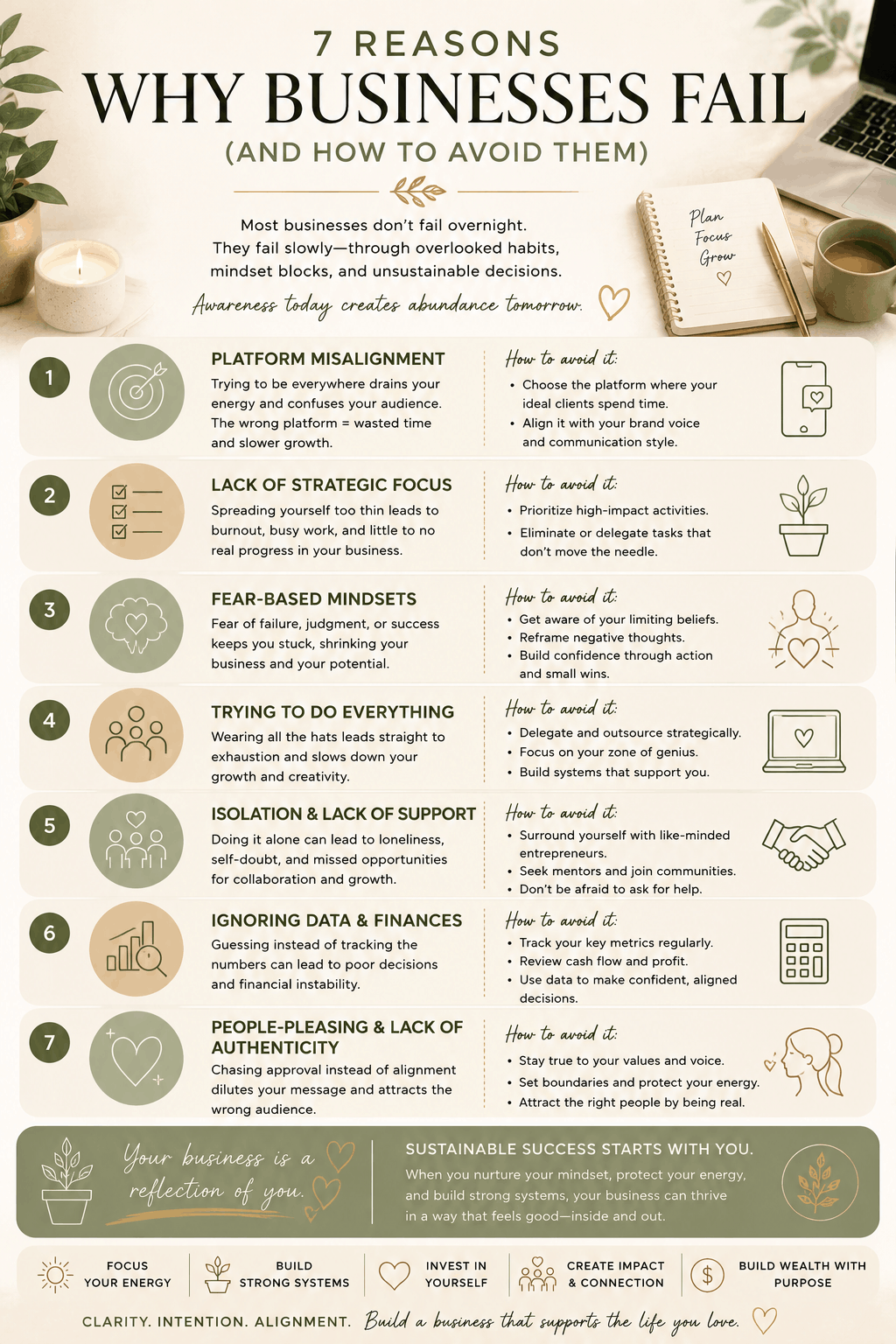
One of the biggest mistakes I see entrepreneurs make is trying to force themselves onto platforms, business models, or marketing strategies that don’t actually align with who they are.
In the online business world especially, there’s constant pressure to:
be everywhere
post constantly
follow every trend
master every platform
grow as fast as possible
But not every business grows the same way.
And not every entrepreneur communicates the same way either.
Some people thrive on video.
Others are stronger writers.
Some are educators.
Others are community builders.
Some are better in long-form content.
Others connect through speaking.
I think one of the reasons businesses fail is because entrepreneurs become disconnected from their actual strengths while trying to imitate someone else’s formula for success.
I’ve personally experienced this too.
There were seasons where I felt pressure to constantly create, constantly show up, constantly optimize every area of my business at once. And honestly, it became exhausting very quickly.
What changed things for me was realizing:
You do not need to be everywhere to be successful.
You need sustainability.
You need clarity.
You need alignment.
Research from burnout and productivity studies consistently shows that context switching and excessive multitasking reduce effectiveness and increase stress over time. Yet entrepreneurship culture often glorifies doing everything simultaneously.
The truth is, focus scales better than constant fragmentation.

Lack of Strategic Focus Slowly Drains Businesses
I genuinely think one of the quietest reasons why businesses fail is because entrepreneurs confuse movement with progress.
You can spend entire weeks:
redesigning your website
changing fonts
obsessing over branding
tweaking logos
reorganizing systems
consuming business content endlessly
while avoiding the actual high-impact work that grows a business.
And honestly, I think many of us do this unintentionally because “busy work” often feels emotionally safer than visible risk.
Launching something is vulnerable.
Selling is vulnerable.
Being seen is vulnerable.
Hearing “no” is vulnerable.
So sometimes entrepreneurs stay trapped in preparation mode instead.
One of the biggest mindset shifts I had to learn was understanding that not all tasks hold equal weight.
Some tasks maintain your business.
Others actually grow it.
And if you constantly prioritize low-impact tasks, eventually momentum starts disappearing.
That’s why sustainable entrepreneurship requires regularly asking:
What actually moves the business forward?
What activities create revenue or deeper connection?
What am I avoiding emotionally?
Am I building intentionally or just staying busy?
Because burnout without direction doesn’t create growth.
It just creates exhaustion.
Fear Quietly Impacts Business Decisions
I think fear affects entrepreneurship far more than most people realize.
Fear of failure.
Fear of judgment.
Fear of visibility.
Fear of charging more.
Fear of disappointing people.
Fear of success.
Fear of being misunderstood.
And the difficult part is that fear rarely announces itself clearly.
Sometimes it disguises itself as procrastination.
Sometimes perfectionism.
Sometimes overthinking.
Sometimes constantly pivoting.
Sometimes never starting at all.
I’ve had moments in business where I knew exactly what I needed to do logically, but emotionally I still felt resistance because growth requires vulnerability.
Especially online.
When your business is deeply tied to your voice, creativity, ideas, or personal story, rejection can feel intensely personal.
Psychology research has shown that fear-based decision-making often keeps people in short-term safety behaviors that limit long-term growth. And honestly, entrepreneurship constantly asks you to move through uncertainty anyway.
That doesn’t mean becoming fearless.
It means learning how to act despite fear.
And I think emotional self-awareness becomes incredibly important here because if you don’t recognize how fear is influencing your business decisions, it can quietly keep you stuck for years.
Trying to Do Everything Alone Leads to Burnout
This one took me a long time to learn.
In the early stages of entrepreneurship, many of us become conditioned to wear every single hat:
marketing
accounting
design
content creation
customer service
admin work
strategy
operations
And while that’s sometimes necessary initially, eventually it becomes unsustainable.
One major reason why businesses fail is because business owners become the bottleneck for everything.
They’re exhausted.
Overextended.
Emotionally depleted.
Unable to scale because every task depends entirely on them.
I think there’s also emotional resistance around outsourcing sometimes too.
Many entrepreneurs fear:
losing control
spending money
trusting others
asking for help
not doing things “perfectly”
But trying to do everything alone often slows growth more than imperfect delegation ever will.
Research around leadership and organizational growth consistently shows that delegation improves long-term scalability, efficiency, and innovation.
And honestly, outsourcing doesn’t necessarily mean building a huge team overnight.
Sometimes it’s simply:
hiring support for tasks draining your energy
automating repetitive systems
investing in mentorship
asking for guidance sooner
allowing yourself to receive help
Because sustainable businesses require support systems too.
Isolation Is One of the Most Underrated Reasons Why Businesses Fail
Entrepreneurship can feel deeply lonely sometimes.
Especially when people around you don’t fully understand what you’re building.
There’s emotional pressure that comes with being responsible for your own income, your own decisions, and your own direction constantly.
And when entrepreneurs isolate themselves too much, it becomes easier to spiral into:
self-doubt
comparison
burnout
overthinking
emotional exhaustion
I think community matters far more in business than people realize.
Not just networking for opportunities, but genuine support.
Having conversations with people who understand entrepreneurship emotionally can make such a difference during difficult seasons.
Some of the biggest breakthroughs in my own business came through relationships:
mentors
collaborations
peers
supportive friendships
communities
Because sometimes growth doesn’t come from another strategy.
Sometimes it comes from feeling supported enough to keep going.
✨ Gentle Reminder
Your business doesn’t need you to be perfect. It needs you to be present.
If you’re noticing one of these patterns in your business, try not to shame yourself for it. Awareness is where change begins. You can pause, reassess, and choose one small aligned shift that supports both your growth and your wellbeing.
Ignoring Data and Financial Awareness Creates Problems Later
I know a lot of creative entrepreneurs resist looking at numbers because emotionally it can feel overwhelming or intimidating.
But avoiding your data doesn’t protect your business.
It disconnects you from reality.
You don’t need to become obsessed with analytics, but understanding:
revenue
expenses
profit margins
conversion rates
audience behavior
marketing performance
helps you make more grounded decisions long term.
Financial literacy matters in entrepreneurship because creativity alone unfortunately isn’t always enough to sustain a business.
And honestly, one reason why businesses fail is because entrepreneurs continue investing time, energy, or money into strategies that simply aren’t working — often because they’re too afraid to evaluate the data honestly.
Awareness creates options.
Avoidance creates instability.
Why Businesses Fail Isn’t Always About Intelligence
I think this is important to say because many entrepreneurs internalize business struggles as personal failure.
But business challenges don’t automatically mean you’re unintelligent, incapable, or not meant for entrepreneurship.
Sometimes people simply:
lack support
burn out
avoid rest
stay isolated too long
ignore emotional health
overwork without strategy
fear visibility
lose alignment
struggle financially
try to sustain impossible workloads
Entrepreneurship asks a lot from people emotionally.
And honestly, I think we need more conversations around building businesses sustainably instead of glorifying constant hustle and exhaustion.
Because success built at the cost of your health, relationships, identity, or peace eventually stops feeling successful at all.
Building a Sustainable Business Requires Both Strategy and Self-Awareness
At the end of the day, learning why businesses fail has taught me something much deeper about entrepreneurship itself:
Business growth and personal growth are often happening simultaneously.
Your business reflects:
your habits
your boundaries
your fears
your resilience
your mindset
your ability to adapt
your emotional capacity
your relationship with uncertainty
And while strategy absolutely matters, sustainability matters too.
Because a business that constantly drains your nervous system, disconnects you from yourself, and leaves you emotionally depleted isn’t truly supporting your life long term.
I think the goal isn’t just building a profitable business.
It’s building one that feels aligned, sustainable, emotionally healthy, and supportive of the life you actually want to live.
And honestly, that kind of success usually takes longer to build.
But it lasts longer too.
Further Reading
Continue Exploring Entrepreneurship & Financial Wellness
If you're building a business, navigating burnout, or trying to create more sustainable success, these articles may support you further.
Free Resource To Share
If fear, burnout, or scarcity mindset have been affecting how you show up in your business, you may really enjoy this free Money Mindset Ebook. It’s designed to help you shift limiting beliefs around money, success, and self-worth in a more supportive and grounded way.
Product Recommendation
Building a sustainable business often requires the right tools, resources, and support systems. The Well(th) List is a curated collection of wellness, business, and financial tools that can support entrepreneurs navigating growth, burnout recovery, productivity, and intentional wealth building.
FAQs
Why do businesses fail most often?
Businesses often fail because of poor financial management, lack of strategic focus, burnout, fear-based decision-making, weak marketing, and unsustainable growth patterns.
What is the biggest reason why businesses fail?
One of the biggest reasons why businesses fail is lack of sustainability. Many entrepreneurs overwork, neglect financial awareness, or operate without clear strategy and support systems.
Can mindset affect business success?
Yes. Fear, scarcity mindset, perfectionism, and self-doubt can heavily influence decision-making, pricing, visibility, and long-term business growth.
Why is burnout dangerous for entrepreneurs?
Burnout impacts creativity, productivity, emotional wellbeing, decision-making, and consistency. Over time, chronic stress can make running a business emotionally and physically unsustainable.
How can entrepreneurs avoid business failure?
Entrepreneurs can reduce the risk of business failure by focusing on strategic priorities, tracking finances, building support systems, delegating tasks, and creating sustainable routines.
Does social media pressure contribute to business failure?
Yes. Constant comparison, people-pleasing, trend chasing, and pressure for visibility can disconnect entrepreneurs from authenticity and long-term business alignment.
Why is community important in entrepreneurship?
Community provides emotional support, mentorship, collaboration opportunities, accountability, and guidance during difficult seasons of business growth.
