
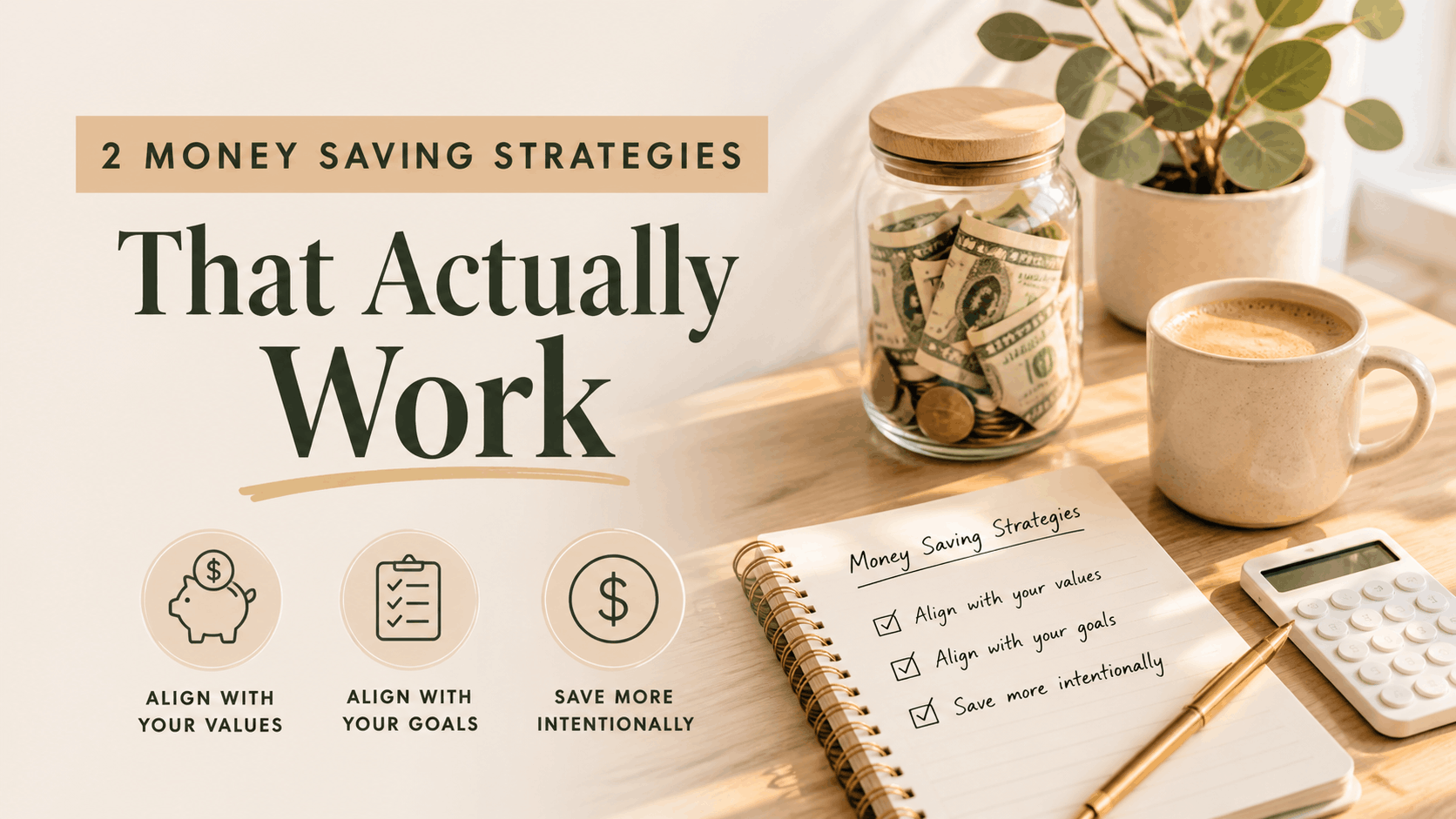
2 Money Saving Strategies That Actually Work
The best money saving strategies aren’t always about cutting out coffee or restricting yourself financially. Sometimes saving money starts with becoming more intentional about why you spend in the first place. These two money saving strategies can help you reduce impulse spending, align your purchases with your values, and create healthier financial habits that support your long-term goals.
How Aligning Your Values and Goals Can Transform Your Financial Wellbeing
In today’s fast-paced world, it’s easy to get caught up in the endless cycle of consumerism. Advertisements constantly bombard us with the idea that more is better, pushing us toward purchases we may not need. Social media makes it even harder. We’re constantly exposed to curated lifestyles, luxury routines, influencer recommendations, and subtle messaging that tells us we’d somehow feel happier, prettier, or more successful if we just bought one more thing.
But honestly? Most people don’t struggle financially simply because they don’t make enough money. Many of us struggle because we’ve never really learned how to spend intentionally.
And that realization can change everything.
There was a point in my own financial journey where I noticed I was spending emotionally without even realizing it. Shopping became entertainment, stress relief, distraction, and sometimes even validation. I’d convince myself I “deserved” something after a hard week, or I’d buy things impulsively because everyone else online seemed to have them.
The purchases would feel exciting for a moment, but afterward I usually felt the same — except now I had less money and more clutter.
That’s when I started becoming more intentional about my spending habits.
Not from a place of restriction or guilt, but from a place of wanting more alignment in my life.
Research from Capital One and The Decision Lab shows that emotional spending is incredibly common, especially during stressful periods. At the same time, financial stress continues to be one of the leading causes of anxiety for adults. It’s hard to feel emotionally grounded when your money constantly feels out of control.
The good news is that healthier financial habits can be built slowly over time.
And often, the most effective money saving strategies are actually the simplest ones.
This blog post explores two money saving strategies rooted in intentional living and minimalist principles that can help you save more money, reduce overspending, and create a healthier relationship with your finances.
Understanding Minimalism and Intentional Spending
Before diving into these money saving strategies, let’s clarify what minimalism actually means.
Minimalism is about so much more than decluttering your closet or owning fewer things. At its core, minimalism is about intentionality. It’s the conscious decision to invest your time, energy, and money into the things that genuinely matter to you.
And honestly, that looks different for everyone.
For some people, intentional living means reducing debt and simplifying their finances. For others, it means slowing down, spending more time with family, improving their mental health, or stepping away from the pressure to constantly consume.
Minimalism challenges the belief that happiness and success come from material possessions. Instead, it encourages us to align our spending habits with our values, wellbeing, and long-term goals.
This is something I dive deeper into in “The Benefits of Minimalism for Your Life and Finances,” especially around how overconsumption can quietly drain both our bank accounts and emotional energy.
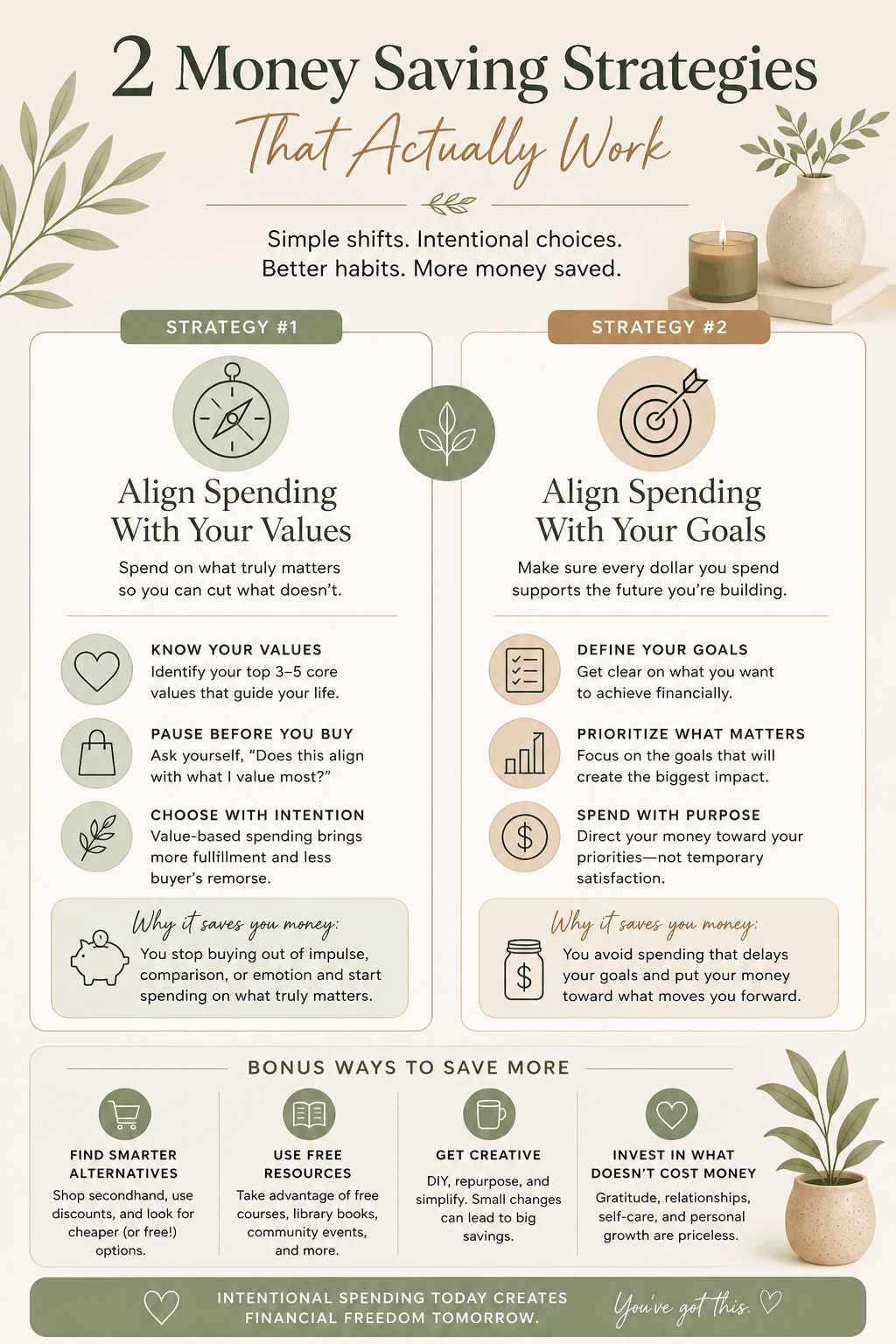
Money Saving Strategy #1: Align Spending With Your Values
The first question to ask yourself before making any purchase is:
“Is what I’m spending my money on aligned with my values?”
This one question alone can completely transform your spending habits over time.
Your values are your internal compass. They reflect what genuinely matters to you and shape how you want to experience your life. But many of us spend automatically without ever checking whether our purchases actually support those values.
And that disconnect often creates financial stress, clutter, and dissatisfaction.
Reflect on Your Core Values
Take some time to identify what truly matters to you.
Maybe you value:
Freedom
Creativity
Health
Family
Sustainability
Peace
Flexibility
Personal growth
Community
There’s no right or wrong answer here. Your values are deeply personal.
What matters is becoming aware of them.
Narrow Down Your Priorities
Choose three to five core values that feel most important to this season of your life.
When you’re clear on your priorities, financial decisions become so much easier. You stop spending money simply because everyone else is buying something.
Instead, your spending becomes more intentional.
For example, if sustainability is one of your values, you may naturally start buying secondhand clothing or supporting ethical brands instead of fast fashion. If freedom is important to you, you may prioritize saving money and paying down debt instead of overspending on temporary gratification.
These small decisions create long-term financial change.
Practice Intentional Spending
Before making a purchase, pause and ask yourself:
“Does this actually support the life I’m trying to build?”
That question has personally saved me from so many emotional or impulsive purchases.
And honestly, intentional spending isn’t about guilt or deprivation. It’s not about never enjoying your money.
It’s about making sure your spending habits genuinely support your wellbeing instead of working against it.
If emotional spending is something you’re currently working through, I talk more about this in “How to Improve Your Relationship With Money (Beginner Guide),” especially around creating healthier emotional patterns with money.

Money Saving Strategy #2: Align Spending With Your Goals
The second question to ask yourself before spending money is:
“Does this purchase support my goals?”
While your values reflect your internal priorities, your goals are the tangible things you’re actively working toward.
This might include:
Becoming debt-free
Building an emergency fund
Saving for a home
Starting a business
Traveling more
Investing consistently
Creating long-term financial freedom
When your spending habits consistently conflict with your goals, it becomes much harder to make progress financially.
Define Your Financial Goals Clearly
One of the biggest reasons people struggle financially is because their goals remain vague.
Instead of saying:
“I want to save more money.”
Try:
“I want to save $10,000 for an emergency fund over the next 18 months.”
Specific goals create clarity and direction.
Research from psychology studies on goal-setting consistently shows that people are more likely to achieve goals that are specific, measurable, and intentional.
Prioritize Your Financial Goals
Not every goal requires immediate attention at the same time.
Some goals may need to take priority first — like paying off high-interest debt or building financial stability — while others can happen more gradually.
The important thing is becoming honest about what matters most right now.
Because every financial decision is either supporting your future self or delaying the life you’re trying to create.
That doesn’t mean you can never spend money on fun things. It simply means you become more aware of trade-offs.
And awareness is powerful.
Allocate Your Resources Intentionally
One of the best money saving strategies is learning to direct your money with intention instead of reacting impulsively.
For example, if your goal is buying a home, constantly overspending on unnecessary purchases may slow down your progress significantly.
Small purchases may not seem important individually, but over time they compound.
Research from the National Endowment for Financial Education has shown that unconscious spending habits often contribute significantly to financial stress and lack of savings.
Intentional financial habits create momentum.
The Power of Conscious Spending
When you align your spending decisions with your values and goals, you embrace conscious spending.
This means your financial decisions are no longer driven purely by impulse, comparison, or societal pressure. Instead, they’re rooted in intention and purpose.
And honestly, that shift feels incredibly freeing.
Conscious spending can:
Reduce financial stress
Help you save more money
Improve your financial habits
Reduce emotional spending
Increase long-term financial stability
Help you feel more fulfilled and aligned
One thing I’ve personally noticed is that intentional spending creates so much more peace mentally.
You stop feeling trapped in constant comparison.
You stop chasing purchases that don’t genuinely improve your life.
And you begin trusting yourself more with money.
Finding Cheaper and More Intentional Alternatives
Another one of the most practical money saving strategies is learning that you don’t always need the most expensive option to improve your life.
There are often lower-cost or free alternatives available that still support your goals.
Leverage Free Resources
There’s so much valuable information available online for free.
From YouTube videos and podcasts to library resources and community programs, many forms of education and support don’t require large financial investments.
Shop More Intentionally
Before making purchases:
Compare prices
Wait 24 hours before impulse buys
Buy secondhand when possible
Look for quality over quantity
Unsubscribe from marketing emails that trigger overspending
These tiny habits can save you hundreds or even thousands of dollars over time.
Get Creative
Sometimes the best money saving strategies involve becoming more resourceful.
Cooking at home, repurposing items, borrowing instead of buying, or simplifying routines can all reduce unnecessary spending while still supporting your wellbeing.

Not Every Investment Requires Money
One of the biggest mindset shifts I’ve had over the years is realizing that some of the most valuable investments cost absolutely nothing.
Things like:
Gratitude
Rest
Journaling
Movement
Spending time with loved ones
Building healthier habits
Personal reflection
Mindfulness
These things improve your quality of life without requiring constant consumption.
And honestly, many of us are searching for fulfillment through purchases when what we truly need is deeper connection, rest, clarity, or emotional support.
Creating a Life of Purpose and Financial Wellness
In a culture that constantly encourages us to buy more, upgrade more, and consume more, these money saving strategies offer a very different perspective. A gentler one. A more intentional one. Instead of asking, “What else do I need?” they invite us to ask, “What actually matters to me?”
By aligning your spending with your values and goals, you can begin breaking free from the exhausting cycle of overconsumption and financial stress. And honestly, that shift can feel incredibly freeing. You stop spending automatically or emotionally, and instead start making decisions that genuinely support the life you want to build.
Of course, this kind of transformation doesn’t happen overnight. Most healthy financial habits are built slowly through small, consistent decisions over time. But those small shifts really do create powerful ripple effects. Every intentional purchase, every moment of awareness, and every financial decision made with purpose helps build more trust within yourself and your ability to manage money confidently.
So the next time you feel tempted to make an impulsive purchase, pause for a moment and ask yourself:
Does this align with my values?
Does this support my goals?
Those two questions alone can completely transform your relationship with money over time.
Minimalism isn’t about deprivation or perfection. It’s about alignment. It’s about creating a life that feels supportive, intentional, peaceful, and fulfilling — financially and emotionally. And sometimes the most powerful money saving strategies aren’t complicated at all. They simply require more awareness, honesty, and intention in the way we choose to spend.
Further Reading
Keep Saving With Intention
If you're learning how to spend with more purpose and save more consistently, these posts may support your next step.
Free Resource To Start With
If you’re currently trying to improve your spending habits and create healthier financial routines, I think the Wealth Well Tracker could really support you. It’s designed to help you track your savings goals, spending habits, and financial progress in a way that feels intentional instead of restrictive.
Download the Wealth Well Tracker
Product Recommendation
One thing that has genuinely helped me become more intentional with money is using tools that simplify my financial life instead of overwhelming it. That’s why I love recommending The Well(th) List. It’s a curated collection of mindful financial and wellness resources designed to support intentional living, conscious spending, and long-term wellbeing without encouraging unnecessary overconsumption. Access the list here.
FAQs
What are the best money saving strategies?
The best money saving strategies are the ones that help you spend intentionally, reduce impulse purchases, align your spending with your goals, and build healthier financial habits over time.
How can I save more money without feeling restricted?
You can save more money by becoming more intentional with your spending habits instead of focusing only on restriction. Aligning purchases with your values and long-term goals can make saving feel more supportive and sustainable.
What is conscious spending?
Conscious spending means making intentional financial decisions based on your priorities, values, and goals instead of spending impulsively or emotionally.
How do spending habits affect financial wellness?
Spending habits directly impact your ability to save money, reduce debt, build wealth, and lower financial stress over time.
Why is intentional spending important?
Intentional spending helps ensure your money supports the life you genuinely want to create rather than being driven by comparison, emotional spending, or societal pressure.
Can minimalism help save money?
Yes. Minimalism encourages intentional spending, reduced overconsumption, and healthier financial habits, which can naturally help you save more money.

References
Capital One & The Decision Lab — Emotional Spending Research
https://www.capitalone.comNational Endowment for Financial Education — Financial Habits Research
https://www.nefe.orgAmerican Psychological Association — Stress in America Report
https://www.apa.org
〰️ WORK WITH ME
↳ my coaching services https://bit.ly/3ZAs0NZ
↴ additional resources and perks:
→ Download my free ebook on mastering your money mindset https://bit.ly/3fAfj33 💵
→ Download my free Wealth Tracker - https://bit.ly/48H8Rxj 🧮
→ Invest in stocks with Wealthsimple https://bit.ly/3PJYscp 📈
→ Invest in crypto and receive $25 USD https://bit.ly/3TxD4dr 🪙
→ Invest like the rich in art and receive a $200 bonus (USD only) https://bit.ly/3Popuqh 🖼️
→ Sign up for my bi-weekly newsletters https://bit.ly/466g09H 📨
〰️ CONTACT ME
✉️ hello@morganblackman.com
