
Financial Decision Making: How to Make Smarter Money Choices
Every financial choice you make is influenced by psychology, emotions, and habits. Improving your financial decision making requires developing money psychology awareness and practicing financial mindfulness. When you understand how you think about money, you can make smarter decisions that support long-term wealth.

Why Emotional Awareness Matters in Financial Decisions
Let’s be honest—financial decisions are rarely just logical.
They’re emotional.
Whether it’s fear, stress, anxiety, or even excitement, money has a way of amplifying whatever we’re feeling. And in those moments, we’re often not making decisions from a grounded place—we’re reacting.
But how often do we actually pause and ask ourselves why we’re making a certain decision?
This is where emotional awareness becomes so powerful. Because once you start noticing the emotional state behind your choices, you create space between the feeling and the action. And that space is where better decisions happen.
This is also deeply connected to your relationship with money, which I explore more in your money story: how your past shapes your financial future.
What Is the Window of Resiliency (WOR)?
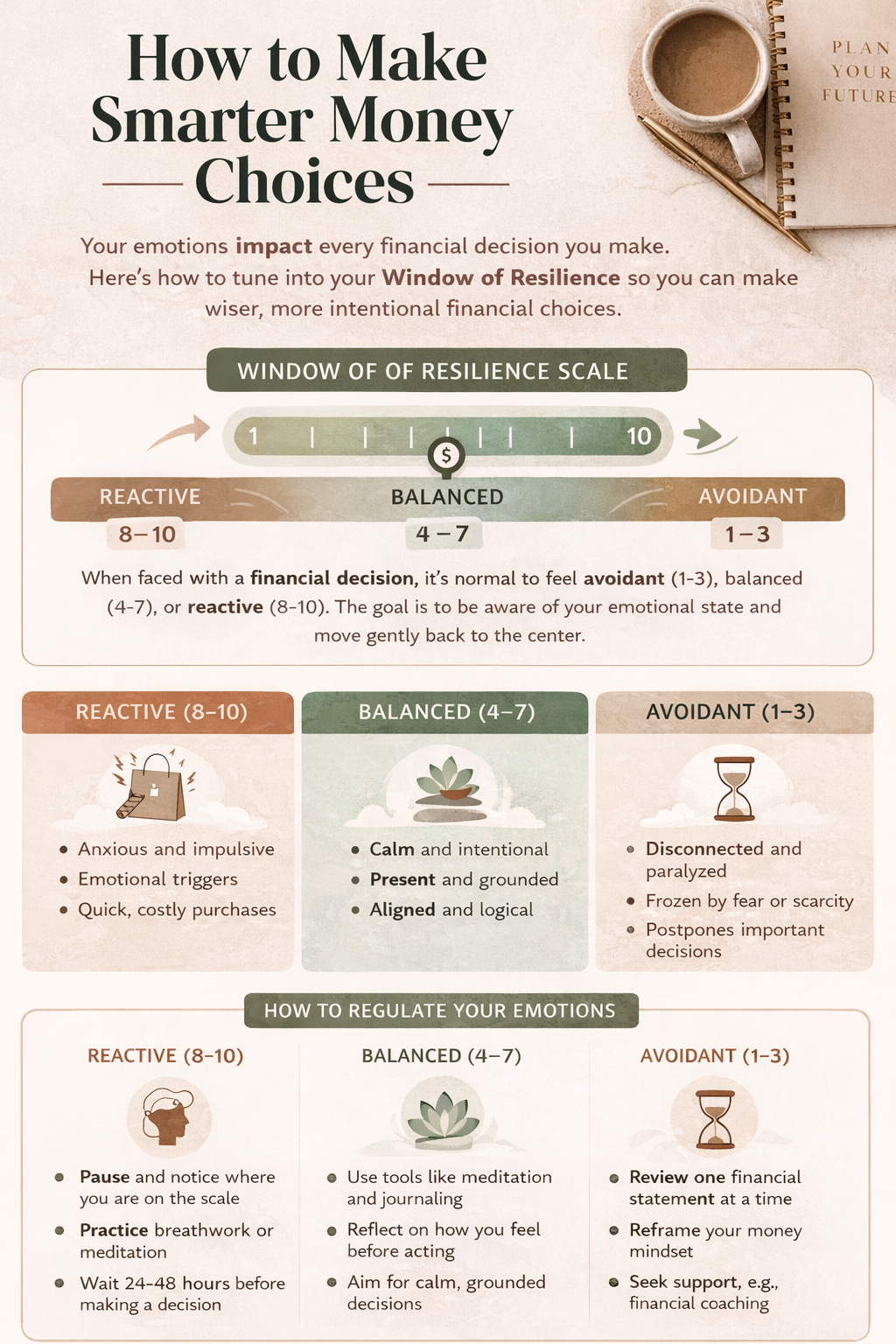
The Window of Resiliency (WOR) is a simple but powerful framework that helps you understand your emotional state when making decisions.
Think of it as a scale from 1 to 10.
At any given moment, you’re somewhere on that scale—and where you land directly impacts how you respond to money decisions.
Lower end (1–3): disconnected, avoidant
Middle (4–7): calm, grounded, intentional
Higher end (7–10): anxious, reactive, overwhelmed
Most of the financial decisions people regret don’t come from the middle—they come from the extremes.
Either from acting too quickly…
or not acting at all.
When you start using the WOR, you begin to recognize those patterns in real time—and that awareness alone can change everything.

An image of the Window of Resilience scale from The Trauma of Money educational program.
Hyper-Arousal: When Emotions Lead to Impulsive Decisions
Hyper-arousal is when your nervous system is in an elevated state—usually somewhere between a 7 and 10 on the scale. This is where emotions like stress, anxiety, and urgency take over, and decision-making becomes reactive instead of intentional.
This might look like:
going on an unplanned shopping spree after a stressful day
spending money to cope with emotional discomfort
making quick investment decisions without fully thinking them through
In these moments, the decision isn’t really about money—it’s about regulation. You’re trying to change how you feel, and money becomes the tool.
The problem is that these decisions often move you further away from your long-term goals, even if they feel good in the moment.
How to Navigate Hyper-Arousal in Financial Decisions
The goal isn’t to eliminate emotional reactions—it’s to become aware of them before acting on them.
When you notice yourself in that heightened state, a few small practices can make a big difference:
pause and check in with yourself (“Where am I on the scale right now?”)
use grounding tools like breathwork or meditation
create space by waiting 24–48 hours before making a financial decision
These aren’t complicated strategies, but they’re powerful because they interrupt the automatic response.
And over time, this is what helps you shift from reactive spending to more intentional financial habits.
Hypo-Arousal: Avoidance and Financial Disconnection
On the other end of the spectrum is hypo-arousal—when your emotional state drops too low and you disconnect from your finances altogether.
This usually shows up as avoidance.
Avoiding your bank account.
Avoiding budgeting.
Avoiding decisions you know you need to make.
It can look like:
putting off financial planning
feeling paralyzed when it comes to investing
holding onto money tightly out of fear it won’t come back
This is often tied to a scarcity mindset, where money feels limited, fragile, or unsafe to engage with.
And while it might feel protective in the moment, it actually keeps you stuck.
If this resonates, it’s often connected to deeper financial anxiety patterns, which I talk more about in financial anxiety: how to stop money stress from controlling your life.
The Optimal Range: Where Better Decisions Happen
The goal isn’t to stay perfectly calm all the time—it’s to recognize when you’re outside your optimal range and gently bring yourself back.
The “sweet spot” on the WOR scale is typically between 4 and 7. This is where you feel grounded, clear, and able to think long-term.
When you’re in this range, financial decisions feel less rushed and more intentional. You’re able to consider your options, align with your goals, and respond instead of react.
This is where financial mindfulness really starts to take shape.
Simple Practices to Stay in Your Optimal Range
Staying in that balanced state doesn’t require anything extreme—it’s usually small, consistent practices that help regulate your nervous system over time.
Some of the most effective ones include:
meditation to build awareness and reduce stress
breathwork to regulate your nervous system in real time
journaling to process emotions and identify patterns
These practices might seem simple, but they’re foundational. Because when your emotional state is regulated, your financial decisions naturally become more aligned.
Financial Mindfulness Techniques That Actually Work
Beyond awareness, there are specific tools that can help you shift your emotional state in the moment.
EFT tapping, for example, is a technique that combines physical tapping with emotional processing. It can be especially helpful for releasing financial anxiety or stress before making decisions.
Another powerful practice is meditative journaling—taking time to reflect on your financial patterns, triggers, and goals. This builds awareness over time and helps you recognize when you’re acting from emotion instead of intention.
And sometimes, the most effective strategy is simply creating space. Waiting before making a purchase allows the emotional intensity to pass so you can decide from a more grounded place.

How to Remove Financial Triggers Before They Start
One of the most practical ways to improve financial decision making is to remove the triggers that lead to reactive behavior in the first place.
This doesn’t mean eliminating everything—it just means creating more intentional friction where you need it.
For example:
unsubscribing from marketing emails that tempt you to overspend
removing saved payment information to slow down online purchases
creating small pause rituals before spending
These are simple shifts, but they make a big difference over time. And they support the kind of financial habits for wealth building that actually last.
Using Emotional Awareness to Build Financial Resilience
At the end of the day, financial decision making isn’t just about numbers—it’s about how you relate to those numbers.
When you understand your emotional patterns, you stop being controlled by them. You start making decisions that are aligned, intentional, and supportive of your long-term vision.
And that’s what financial resilience really is.
Not perfection.
Not control.
But the ability to stay grounded in the middle of uncertainty and still make choices that move you forward.

FAQ: Financial Decision Making Questions You Might Be Asking
Why do emotions affect financial decision making?
Emotions influence financial decisions because money is tied to safety, identity, and past experiences. Without awareness, emotions can lead to impulsive or avoidant behaviors.
What is financial mindfulness?
Financial mindfulness is the practice of being aware of your thoughts, emotions, and behaviors around money so you can make intentional decisions instead of reactive ones.
How can I make better financial decisions?
You can make better financial decisions by slowing down, understanding your emotional state, and using tools like the Window of Resilience to stay grounded.
auses impulsive spending?
Impulsive spending is often caused by emotional triggers like stress, anxiety, or boredom, where money is used to regulate how you feel.
If you’d like to keep journeying together…
→ Start Here: free tools and reflections to help you feel grounded, clear, and more confident with your money.
→Work With Me: private coaching, strategy sessions, and programs designed to help you build wealth that feels aligned, stable, and sustainable.
→ Subscribe to the Channel: If this resonated, come hang out with me on YouTube where I break this down in real life — the habits, the mindset shifts, and what this actually looks like day-to-day.
→ Or Join My Email List: This is where I share deeper insights, behind-the-scenes thoughts, and the kind of conversations we don’t always have publicly.
