
How to Prevent Burnout While Building a Business
Learning how to prevent burnout is one of the most important parts of building a sustainable business and life. Burnout doesn’t just affect productivity — it impacts your nervous system, creativity, emotional wellbeing, relationships, and overall quality of life. Whether you’re navigating entrepreneur burnout, business stress, or simply feeling emotionally exhausted, practicing self-care and creating healthier systems can make a massive difference long term.
I honestly think burnout has become so normalized in entrepreneurship that many people don’t even realize they’re experiencing it until their body completely forces them to slow down.
And honestly, that’s exactly what happened to me.
At the beginning of 2022, I made the bold decision to completely unplug from my business and take a gap year. At the time, it felt scary because so much of my identity had become wrapped up in creating, posting, serving, producing, and constantly thinking about the next thing I needed to do. From the outside, I probably looked productive. Maybe even successful. But internally, I was exhausted in a way that sleep alone couldn’t fix.
That break became my wake-up call.
Burnout wasn’t just physical for me. It was mental, emotional, and spiritual too. It was the feeling of being disconnected from the business I once felt excited about. It was feeling resentful toward tasks I used to enjoy. It was realizing that years of people-pleasing, saying yes to things that didn’t truly align, and trying to grow in ways that didn’t honor my energy had finally caught up with me.
And honestly, that’s what makes burnout so tricky.
It doesn’t always arrive dramatically. Sometimes it creeps in quietly through exhaustion you keep dismissing, irritability you keep explaining away, creative blocks you keep pushing through, and a low-level resentment that makes you wonder why the thing you built for freedom suddenly feels so heavy.
The World Health Organization defines burnout as an occupational phenomenon resulting from chronic workplace stress that hasn’t been successfully managed, with signs like exhaustion, mental distance from work, and reduced professional effectiveness. And even though that definition is often used in workplace settings, I think entrepreneurs and small business owners experience this deeply because the “workplace” is often our whole life.
Recognizing the Signs of Burnout
One of the most important ways to prevent burnout is learning how to recognize it before you completely crash.
Because business burnout does not usually begin with a dramatic breakdown. It often begins with subtle signs that your body and nervous system are asking for support. You may feel tired no matter how much you sleep, get sick more often, struggle to focus, procrastinate on things you normally enjoy, or feel like every task takes more energy than it should.
For me, burnout showed up as emotional heaviness. I still cared about my work, but I didn’t feel lit up by it in the same way. I started dreading certain tasks. I felt like I had to force creativity. I was still doing the things, but the joy behind them was fading.
That’s when I realized burnout wasn’t only about how many hours I was working.
It was also about how much of myself I was abandoning to keep working.
Burnout can show up physically through chronic fatigue, headaches, insomnia, muscle tension, frequent illness, and digestive issues. But it can also show up emotionally through anxiety, irritability, numbness, resentment, sadness, or a constant feeling of being behind. Spiritually, it can feel like losing connection to your purpose, your intuition, your creativity, or the deeper reason you started your business in the first place.
And honestly, when you’re a small business owner, it can be easy to dismiss all of that as “just part of the journey.”
But your body is not trying to sabotage your dreams.
It’s trying to communicate with you.
Why Entrepreneur Burnout Happens So Easily
Entrepreneur burnout is real because building a business requires so much more than people realize.
You’re not just doing the work you love. You’re also managing marketing, client communication, finances, systems, emails, content, strategy, admin, sales, customer service, and your own emotional regulation through all of it.
And unlike a traditional job, there often isn’t a clear stopping point.
There’s always something else you could do.
Another post to write.
Another email to send.
Another offer to refine.
Another system to improve.
Another client to support.
Another idea to pursue.
And honestly, that constant open loop can become exhausting.
The American Psychological Association’s 2024 Work in America survey found that 43% of workers reported typically feeling tense or stressed during the workday, and Gallup has linked burnout to things like unmanageable workload, unclear communication, lack of support, and unreasonable time pressure. For entrepreneurs, many of those pressures are self-managed, which means we have to become much more intentional about the environments and systems we create for ourselves.
I think one of the biggest reasons small business owner burnout happens is because we confuse capacity with ambition.
Just because you want something deeply does not mean your body can sustain every strategy, timeline, or expectation attached to it.
Ambition is beautiful.
But ambition without boundaries can become self-abandonment.
✨ Gentle Reminder
Rest Is Productive Too
Your worth is not measured by how exhausted you are. Sustainable success is built through balance, boundaries, rest, and consistency — not constant burnout and survival mode.
Sometimes slowing down is not falling behind. Sometimes it’s exactly what allows you to continue moving forward long term.
Choose Business Strategies That Actually Fit Your Energy
One of the biggest lessons I learned through burnout was that not every successful business strategy is meant for me.
When I first launched my business, I invested in an Instagram coach. At the time, it felt like the smart thing to do because Instagram was where so many entrepreneurs were growing. I thought, “Okay, this is clearly the path. This is what successful business owners are doing. I need to show up here if I want to grow.”
And to be fair, the strategy did help me grow initially.
But there was one major problem: I didn’t actually enjoy using Instagram in that way.
I’m not someone who naturally thrives off posting every day, constantly being visible, filming every thought, or sharing my life in real time. I already had platforms I loved, like YouTube and blogging, where I could go deeper, tell stories, and create in a way that felt more spacious and thoughtful. But instead of honoring that, I tried to force myself into a strategy that looked good on paper but felt heavy in my body.
And eventually, I started resenting my business.
That was one of the clearest signs of business burnout for me. Not because the business itself was wrong, but because I was growing it in a way that wasn’t aligned with my energy.
When I finally gave myself permission to pivot back toward YouTube, blogging, SEO, and long-form content, something in me softened. My creativity returned. My consistency became easier. I felt connected to my voice again.
That taught me something I will never forget: the best marketing strategy is not just the one that works. It’s the one you can sustain.
This is also something I explore more deeply in “How to Grow Your Business Without Social Media,” especially around building visibility in ways that don’t require constantly performing online.
Practicing Self-Care Is Not Laziness
I think practicing self-care gets talked about so much that it can start to sound cliché, but honestly, self-care is one of the most practical business tools you have.
Not because bubble baths fix systemic stress.
But because your body needs care if you expect it to carry your vision.
For a long time, I treated self-care as something I would get to after everything else was done. After the content was created. After the emails were answered. After the calls were finished. After the launch was over. After the next big milestone.
But there was always another milestone.
And eventually, I realized I was building a business around my leftovers.
Leftover energy.
Leftover creativity.
Leftover patience.
Leftover presence.
That is not sustainable.
Now, self-care looks much less performative for me and much more practical. It looks like protecting my mornings when I can. Taking walks. Journaling. Reading. Meditating. Having slower evenings. Eating food that actually nourishes me. Taking space from my phone. Letting myself have days where I am not constantly producing.
And honestly, self-care also looks like telling the truth about what I can and cannot carry.
Because sometimes the most powerful self-care is not a face mask.
It’s a boundary.

Set Boundaries Before You Feel Resentful
One of the biggest signs that you need stronger boundaries is resentment.
I’ve learned this the hard way.
If you constantly feel annoyed, depleted, overwhelmed, or frustrated by things you technically agreed to, there may be a boundary missing somewhere. And honestly, for entrepreneurs, boundaries can feel especially hard because we often care deeply about our clients, our work, and our mission.
We want to be helpful.
We want to be generous.
We want to show up.
We want people to have a good experience.
But being available all the time is not the same as being supportive.
In business, boundaries might look like setting clear response times, not checking emails late at night, creating office hours, saying no to misaligned opportunities, protecting your weekends, limiting calls on certain days, or building more spacious timelines into your projects.
And honestly, this is not just about protecting your schedule.
It’s about protecting your energy.
The more clearly you define how people can access you, the less likely you are to feel like your business is constantly pulling from you in every direction.
Create Systems That Reduce Mental Load
One thing that has helped me avoid burnout is creating systems that make my business feel less chaotic.
I love using a digital calendar that syncs across my phone and computer because it helps me see what’s coming, block time intentionally, and stop relying on my brain to remember every little thing. When everything is floating around in your head, even small tasks can start feeling overwhelming.
I also love tools that create structure without making me feel boxed in.
For example, using focus timers like Pomofocus can help break work into smaller, more manageable chunks. Notion can help organize ideas, projects, content plans, and business tasks in one place. Scheduling tools can reduce the back-and-forth of booking calls. Automation can save energy you didn’t even realize you were spending.
The goal is not to become a productivity machine.
The goal is to create enough structure that your nervous system can relax.
Because when your business is disorganized, your mind often feels disorganized too.
Prioritize What Actually Matters
One of the fastest paths to business burnout is treating every task like it’s urgent.
Everything cannot be the priority.
And honestly, I think entrepreneurs often burn out because we are constantly reacting instead of intentionally choosing what matters most.
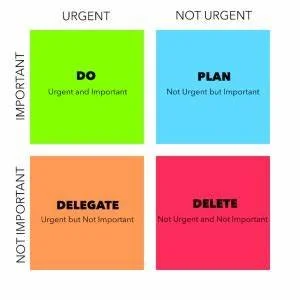
This is where I love tools like the Eisenhower Matrix because it helps you sort tasks by what is urgent, important, not urgent, or not actually necessary. Sometimes we spend so much time on low-impact tasks because they feel productive, when the real work we need to do feels harder, scarier, or more vulnerable.
Posting another random piece of content might feel easier than clarifying your offer.
Tweaking your website again might feel easier than asking for the sale.
Organizing your workspace might feel easier than having a difficult conversation.
And honestly, this is where self-awareness becomes important.
Preventing burnout is not just about doing less. It’s about doing what actually matters with more intention.
When you know your highest-impact tasks, you can stop filling every empty space with busywork.
Delegate and Ask for Support
As entrepreneurs, we often wear way too many hats for way too long.
At first, it makes sense. You’re building something from the ground up, and you may not have the budget to hire support right away. But eventually, trying to do everything yourself can become one of the biggest causes of small business owner burnout.
Support can look different depending on your season.
It could be hiring a virtual assistant, working with a bookkeeper, using a meal delivery service during a busy season, outsourcing design work, using templates, asking for help at home, or investing in tools that save you time.
And honestly, support does not always have to be expensive.
Sometimes support looks like simplifying.
Using fewer platforms.
Having fewer offers.
Creating repeatable systems.
Batching content.
Repurposing what you already created.
Giving yourself permission to stop doing things that no longer make sense.
You do not get extra points for suffering through everything alone.

Manage Stress Before It Manages You
Stress is part of entrepreneurship, but unmanaged stress is what becomes dangerous.
I don’t believe we can create a completely stress-free life or business, but I do believe we can build a better relationship with stress so it doesn’t run our entire nervous system.
Some of the simplest things have helped me the most: walking, journaling, meditation, reading, playing with pets, taking real breaks, listening to calming music, and giving myself space to process what I’m feeling instead of immediately pushing through it.
And honestly, these things sound simple because they are.
But simple doesn’t mean ineffective.
Sometimes the things that regulate us are not complicated. They’re just the things we stop prioritizing when life gets busy.
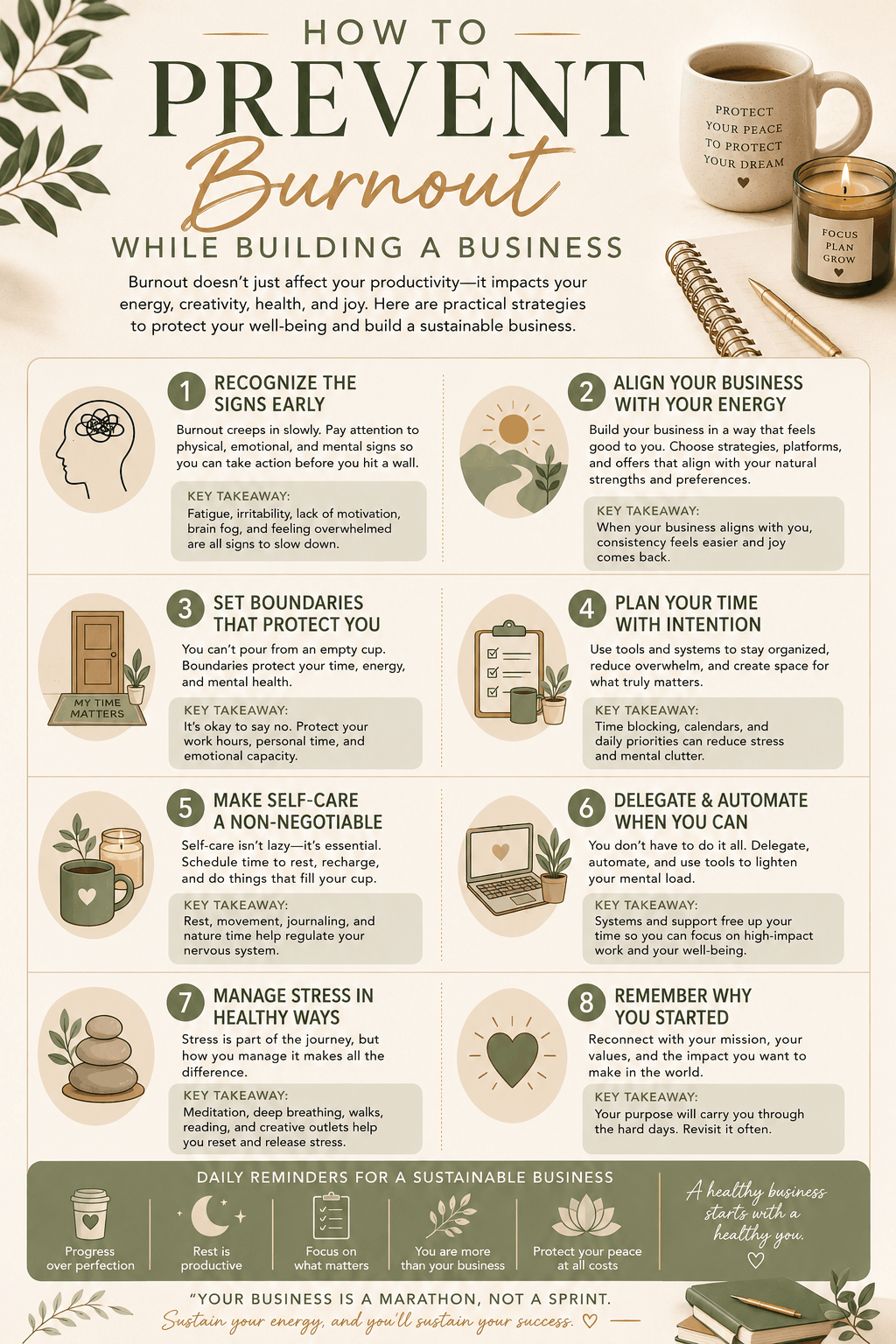
Build a Business That Supports Your Life
At the end of the day, learning how to prevent burnout is really about learning how to build a business that supports your life instead of consuming it.
Because honestly, what is the point of creating a business for freedom if you feel trapped inside of it?
I think so many entrepreneurs start businesses because they want more flexibility, more purpose, more creativity, and more control over their lives. But without boundaries, systems, self-care, and aligned strategies, that same business can quietly become another version of the pressure you were trying to escape.
For me, burnout taught me that success cannot only be measured by revenue, visibility, or productivity.
Success also has to include peace.
It has to include health.
It has to include space to be a person outside of your work.
And honestly, I care much more now about building a business I can sustain than building one that looks impressive for a short period of time but leaves me completely depleted.
Burnout is not inevitable.
But preventing burnout does require honesty.
It requires noticing when something no longer feels aligned. It requires practicing self-care before your body is begging for it. It requires creating boundaries before resentment builds. It requires choosing strategies that fit your energy instead of copying everyone else online.
And most of all, it requires remembering that you are more than your business.
Your dreams matter.
But so does the person carrying them.
Further Reading
Continue Building a More Sustainable Business
If you’re navigating entrepreneur burnout, building a business intentionally, and trying to create more balance in your life, these posts may support you further.
Resource to Start With
If you’re building a business and trying to create more alignment, peace, and abundance without constantly running yourself into the ground, I’d start with the Intuitive Wealth Blueprint.
It’s a supportive resource for reconnecting with your vision, your energy, and the kind of wealth-building path that actually feels aligned with your life instead of forcing you into constant burnout.
Explore Your Unique Wealth Blueprint
Product Recommendation
One tool I genuinely recommend for preventing entrepreneur burnout is Othership, the breathwork app.
When you’re building a business, your nervous system can spend so much time in go-mode that slowing down starts to feel uncomfortable. What I appreciate about Othership is that it gives you guided breathwork sessions that can help you reset, release stress, and reconnect with your body in a way that feels accessible.
For business owners who are constantly thinking, planning, creating, and holding so much responsibility, having a tool that helps you regulate your stress can be incredibly supportive. It’s not about adding another thing to your to-do list. It’s about having something simple to come back to when your body needs a reset.
FAQs
How do I prevent burnout as an entrepreneur?
You can prevent burnout as an entrepreneur by setting stronger boundaries, choosing business strategies that align with your energy, practicing self-care consistently, delegating when possible, and creating systems that reduce overwhelm.
What causes business burnout?
Business burnout is often caused by chronic stress, overworking, unclear boundaries, financial pressure, misaligned strategies, lack of support, and constantly feeling responsible for every part of the business.
What are signs of entrepreneur burnout?
Signs of entrepreneur burnout can include chronic fatigue, resentment toward your business, creative blocks, anxiety, irritability, trouble sleeping, emotional numbness, loss of motivation, and feeling disconnected from your purpose.
How can small business owners avoid burnout?
Small business owners can avoid burnout by simplifying operations, outsourcing when possible, setting realistic goals, protecting personal time, reducing unnecessary tasks, and creating a business model that supports their wellbeing.
Is practicing self-care important for business owners?
Yes. Practicing self-care is essential for business owners because your energy, creativity, decision-making, and emotional resilience all impact how sustainably you can run your business.
Can burnout affect business growth?
Absolutely. Burnout can reduce creativity, consistency, focus, emotional capacity, client experience, and decision-making, which can all impact long-term business growth.
If you’d like to keep journeying together…
→ Start Here: free tools and reflections to help you feel grounded, clear, and more confident with your money.
→Work With Me: private coaching, strategy sessions, and programs designed to help you build wealth that feels aligned, stable, and sustainable.
→ Subscribe to the Channel: If this resonated, come hang out with me on YouTube where I break this down in real life — the habits, the mindset shifts, and what this actually looks like day-to-day.
→ Or Join My Email List: This is where I share deeper insights, behind-the-scenes thoughts, and the kind of conversations we don’t always have publicly.
