
Holistic Finances: Building a Wealth Ecosystem That Supports Your Whole Life
For a long time, personal finance felt incomplete to me. Most conversations about money focused on budgeting harder, making more, investing earlier, or cutting back. And while those things absolutely matter, I realized something deeper: your financial life can’t truly thrive if the rest of your life is falling apart. That’s where the idea of holistic finances came from for me. Wealth isn’t just numbers on a screen. It’s your health, your relationships, your environment, your emotional wellbeing, your purpose, and your ability to actually enjoy the life you’re building. This is the foundation of what I call a wealth ecosystem — a more connected, sustainable, and human approach to money.
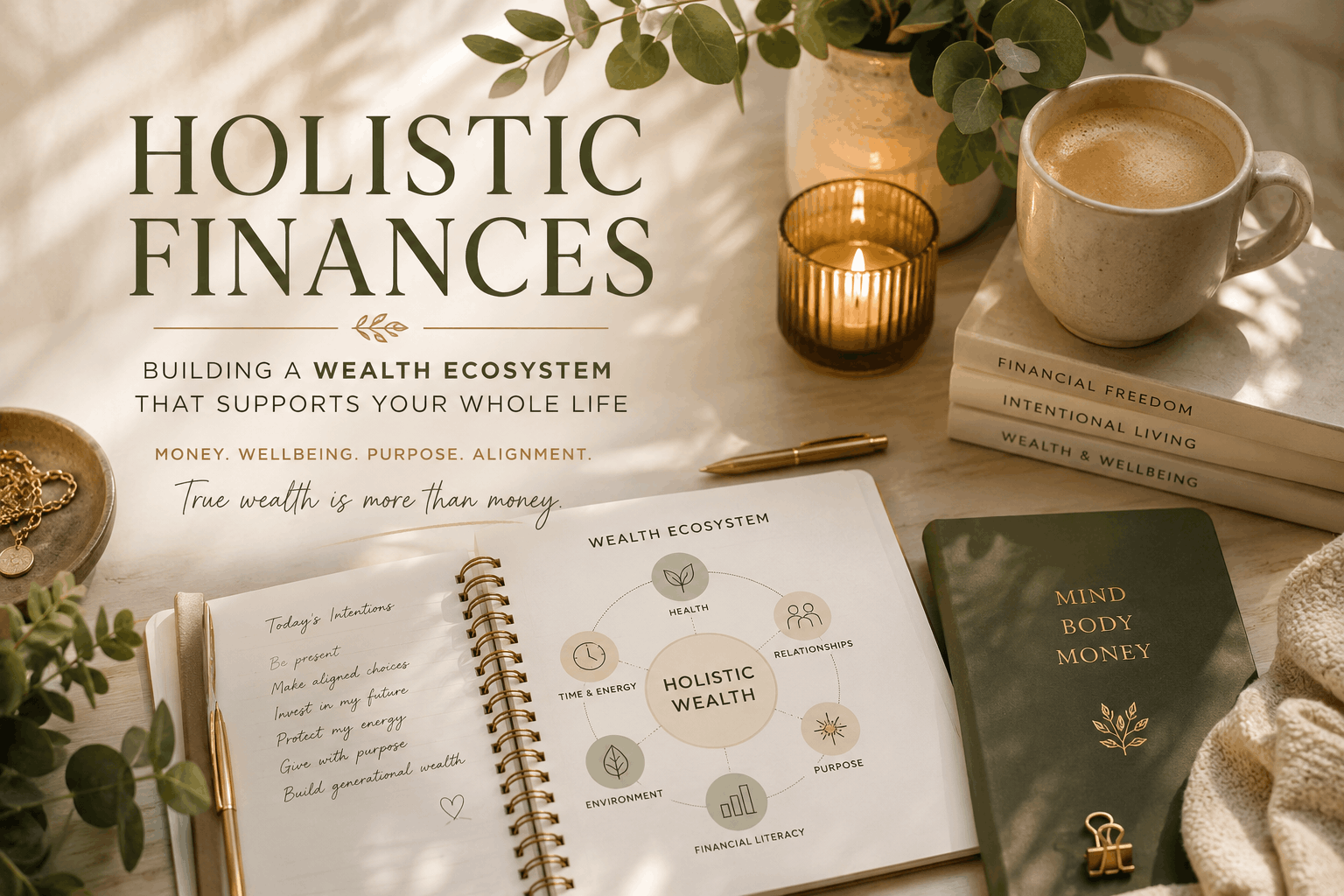
I don’t think anyone’s ever heard this term before, and honestly, I’d like to claim it.
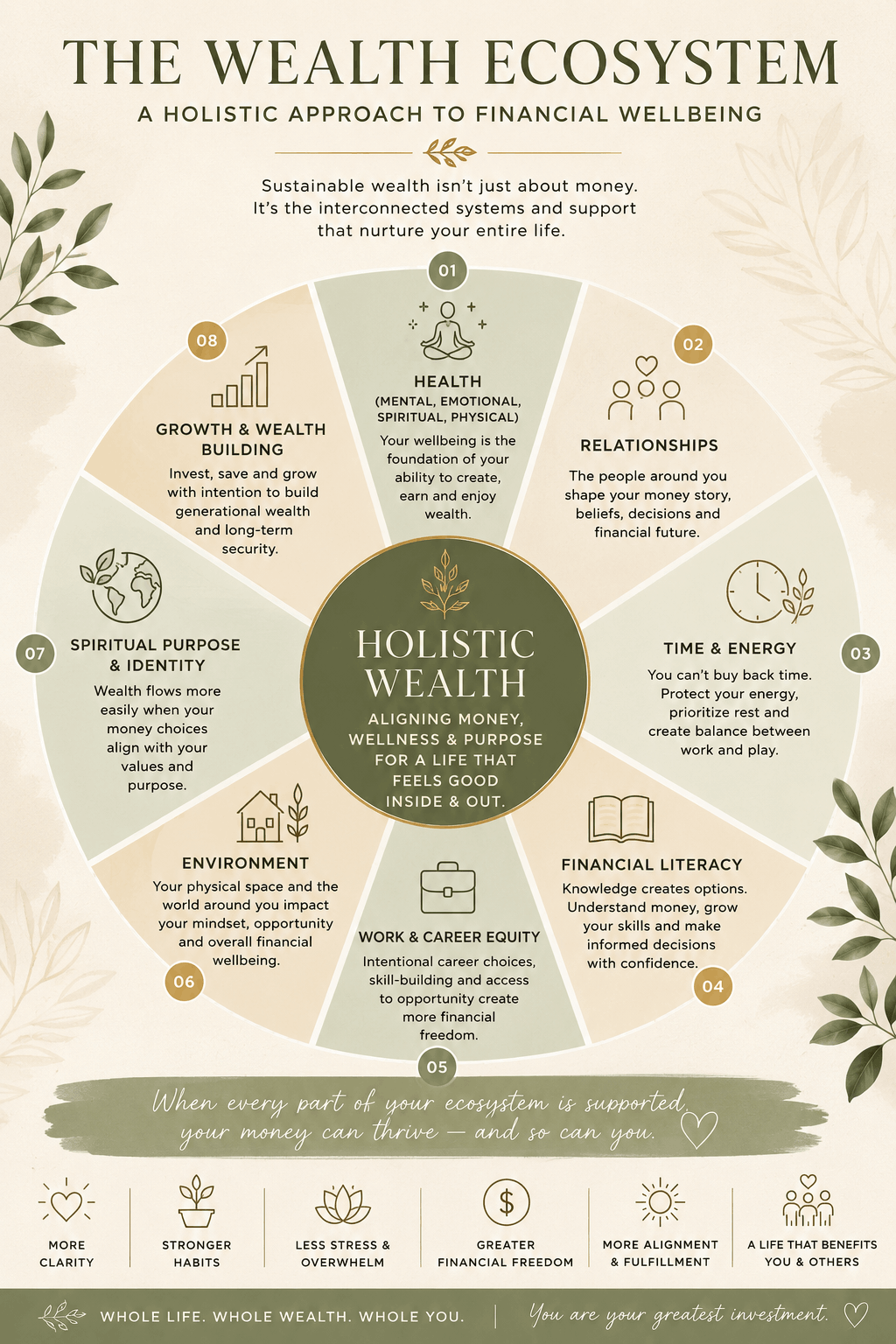
A wealth ecosystem, to me, is the interconnected network of internal and external systems that shape your ability to build and sustain wealth over time. It’s not just your income. It’s not just your savings account. It’s not just whether you invested in the “right” stock or followed the perfect budget.
It’s everything.
Your mindset. Your emotional health. Your environment. Your relationships. Your education. Your career opportunities. Your stress levels. Your values. Your sense of purpose. Your energy.
All of it affects your money.
That’s why I’ve never resonated with the hyper-rigid version of personal finance that tells people to optimize every dollar while completely ignoring burnout, trauma, inequality, exhaustion, grief, or emotional wellbeing. Holistic wealth asks a bigger question:
What does financial wellbeing actually look like when your whole life is taken into account?
Because the truth is, someone can have a six-figure salary and still feel financially unsafe. Someone can have money saved and still feel emotionally depleted. Someone can understand investing but constantly overspend because shopping became their coping mechanism during stressful seasons of life.
Money never exists in isolation.
And the more I’ve worked with people over the years, the more I’ve realized that sustainable wealth comes from creating support systems around your finances — not just financial strategies alone.
That’s the heart of holistic finances.
What Are Holistic Finances?
Holistic finances are an approach to money that looks beyond income, budgeting, and investing alone. It recognizes that wealth is deeply connected to emotional wellbeing, physical health, relationships, time, identity, spirituality, and the environments we live within.
Instead of asking:
“How do I make more money?”
Holistic wealth asks:
“How do I build a life that supports me emotionally, mentally, physically, spiritually, and financially?”
Those are two very different questions.
One is focused only on accumulation.
The other is focused on sustainability.
Research in behavioral psychology has repeatedly shown that emotions heavily influence financial decisions. Studies from the American Psychological Association have found that chronic stress affects decision-making, impulse control, and long-term planning. That means your nervous system and emotional health genuinely impact your ability to manage money well.
And honestly, I think a lot of us already know this intuitively.
When we’re exhausted, overwhelmed, emotionally unsupported, or disconnected from ourselves, money often becomes reactive. We overspend. We avoid our finances. We procrastinate. We numb ourselves through shopping, food, scrolling, or overworking.
That’s why building holistic wealth requires both internal and external work.
The external work is things like:
budgeting
saving
investing
career growth
financial literacy
debt repayment
But the internal work matters too:
healing scarcity mindset
emotional regulation
self-worth
boundaries
rest
purpose
nervous system support
A healthy wealth ecosystem needs both.

Health Is the Foundation of Holistic Wealth
When I talk about health, I mean all of it:
mental health
emotional health
physical health
spiritual health
Because if one area is deeply struggling, it eventually affects your finances too.
You’ve probably heard the phrase “health is wealth,” but I don’t think people fully understand how literal that can become.
If your mental health is deteriorating from chronic stress or burnout, it becomes harder to focus, work, create, plan, or make intentional financial decisions. If your physical health is constantly neglected, eventually your body forces you to slow down. If you’re emotionally overwhelmed, money management can start feeling impossible instead of empowering.
And spiritually — whatever spirituality means to you personally — disconnection from purpose can leave people chasing financial goals that don’t even fulfill them.
I’ve gone through seasons where I thought making more money would automatically make me feel secure or happy. But if I was anxious, exhausted, emotionally dysregulated, or disconnected from myself, the money alone didn’t solve the deeper issue.
A 2023 Deloitte workplace wellbeing report found that burnout significantly impacts productivity, financial stress, and long-term wellbeing. And honestly, I think many people are quietly experiencing this right now.
We’ve normalized overworking to the point where people are sacrificing their health to build wealth, then eventually spending money trying to recover from the damage burnout caused in the first place.
That cycle isn’t sustainable.
Holistic finances ask us to build wealth in ways that also protect our humanity.
Relationships Shape Our Money Stories
This is one of the most overlooked parts of financial wellbeing.
Most of us learned about money long before we ever opened our first bank account.
We learned by watching our parents stress over bills. We learned through arguments about money. Through scarcity. Through survival. Through witnessing overspending, avoidance, guilt, shame, fear, or financial instability.
Then society layered even more messaging on top of that.
Consume more.
Own more.
Upgrade more.
Look successful.
Perform success.
Our relationships — romantic, familial, social, and cultural — all shape how we experience money.
Some people learned that money disappears quickly, so they spend it immediately. Others learned that money equals safety, so they cling tightly to it. Some learned they had to overwork to deserve rest. Others learned to associate wealth with greed or guilt.
None of these beliefs appear out of nowhere.
That’s why part of building a healthy wealth ecosystem involves examining your financial conditioning with compassion instead of shame.
Ask yourself:
What did I learn about money growing up?
What emotional patterns show up around spending or saving?
Who influences my financial decisions?
Do my relationships support the life I’m trying to build?
This is also why boundaries matter financially.
Sometimes holistic wealth means distancing yourself from environments that constantly pressure you into overspending, overgiving, or abandoning your goals to fit in socially.
And sometimes it means allowing yourself to build new relationships with people who normalize financial wellness, emotional growth, and intentional living.

Time and Energy Are Forms of Wealth Too
One thing I think capitalism has conditioned many of us to believe is that productivity determines our worth.
But holistic finances challenge that.
Because time is wealth too.
Energy is wealth too.
Rest is wealth too.
If you’re constantly depleted, overworked, and emotionally drained, eventually your ability to create sustainably suffers. And while hustle culture often glorifies burnout, I think many people are beginning to realize that constantly being exhausted isn’t actually success.
You cannot buy back lost time.
You cannot endlessly override your body without consequences.
One of the biggest shifts in my own financial journey was realizing that protecting my energy was just as important as growing my income.
That meant:
learning boundaries
saying no more often
creating slower mornings
spending less time performing productivity
prioritizing work that felt aligned
building systems that supported my nervous system instead of constantly overwhelming it
Ironically, that often made me more financially effective — not less.
Studies in occupational psychology have shown that chronic overwork reduces cognitive performance, creativity, and decision-making quality over time. Rest isn’t laziness. It’s maintenance.
A strong wealth ecosystem includes both ambition and recovery.
Financial Literacy Creates More Freedom
This pillar matters deeply because money impacts almost every part of our lives, yet many people were never properly taught how finances actually work.
Not because they’re unintelligent.
Not because they’re irresponsible.
But because financial education is often inaccessible, class-based, or intentionally complicated.
Holistic money management isn’t about perfection. It’s about awareness.
Understanding:
budgeting
debt
credit
investing
taxes
saving
assets vs liabilities
compound growth
financial systems
creates more options and autonomy over time.
I think financial literacy becomes especially powerful when it’s paired with emotional awareness. Because information alone doesn’t always create change.
A lot of people know what they “should” do financially already.
But emotional patterns, fear, trauma, shame, survival mode, or burnout can make it difficult to consistently act on that knowledge.
That’s why holistic finances combine education with self-compassion instead of punishment.
If this is something you’re currently working through, I talk more about the emotional side of financial growth in How to Stop Feeling Behind Financially in Your 20s and 3 Money Blocks That Stop You From Building Wealth.

Work, Career Equity, and Access to Opportunity
I think conversations about wealth also need to acknowledge something uncomfortable:
Not everyone starts from the same place.
The reality is that systemic barriers absolutely impact financial outcomes. Gender, race, disability, sexuality, immigration status, class, geography, and generational wealth all influence access to opportunity.
That doesn’t mean personal responsibility disappears.
But it does mean context matters.
Holistic wealth recognizes both personal agency and systemic reality.
Career choices matter financially, yes. Skill development matters. Networking matters. Negotiation matters.
But so does access.
So does discrimination.
So does burnout.
So does unpaid labor.
So does caregiving.
So does economic inequality.
I think holistic finances allow us to hold compassion for ourselves while still working toward growth. It’s possible to acknowledge barriers without giving away your power completely.
And sometimes holistic wealth means redefining success entirely.
Maybe success for you isn’t climbing the highest corporate ladder possible. Maybe it’s flexibility. Maybe it’s peace. Maybe it’s creative freedom. Maybe it’s raising children while still building financial stability. Maybe it’s ethical entrepreneurship. Maybe it’s slower living.
There isn’t one correct blueprint for wealth.

Your Environment Impacts Your Financial Wellbeing
Your environment affects your nervous system more than you probably realize.
Your home.
Your city.
Your workplace.
Your online spaces.
The people around you.
Even the content you consume daily.
If your environment constantly triggers stress, chaos, insecurity, comparison, or emotional exhaustion, it becomes harder to make grounded financial decisions.
For me personally, home has always been sacred.
Not because it has to be expensive or perfect, but because I need spaces that help me feel emotionally safe, calm, and connected to myself.
Sometimes improving your financial wellbeing starts with surprisingly small environmental shifts:
organizing your space
reducing overstimulation
spending more time in nature
limiting comparison-heavy social media
creating routines that support your nervous system
making your environment feel more supportive instead of draining
There’s also the broader environment we all exist within.
Technology is changing rapidly. AI is reshaping industries. Climate instability affects economies and housing. Inflation affects mental health. Economic uncertainty affects decision-making.
Holistic finances acknowledge that wealth doesn’t exist separately from the world around us.
Spirituality, Purpose, and Alignment
I know spirituality isn’t a comfortable conversation for everyone, but I genuinely believe purpose matters financially too.
Because money earned completely out of alignment can eventually create emotional exhaustion.
I’ve seen people chase careers purely for status or income while quietly feeling disconnected from themselves the entire time. And while survival absolutely requires practicality sometimes, I also think long-term fulfillment requires alignment.
For me, holistic wealth means asking:
Does this lifestyle actually support my wellbeing?
Does my work align with my values?
Do my investments reflect what I believe in?
Am I building a life that feels meaningful to me personally?
That’s why ethical investing matters to me.
That’s why intentional spending matters to me.
That’s why rest matters to me.
That’s why emotional wellbeing matters to me.
Because holistic money isn’t just about accumulation.
It’s about congruence.
And sometimes the wealthiest thing you can do is stop abandoning yourself for external validation.
Bringing Your Wealth Ecosystem Together
At the end of the day, holistic finances are about integration.
The external:
work
income
investing
budgeting
education
saving
And the internal:
emotional wellbeing
health
relationships
self-worth
purpose
nervous system regulation
Both matter.
Because real wealth isn’t just about looking financially successful from the outside while quietly falling apart internally.
A healthy wealth ecosystem supports your entire life.
Not perfectly.
Not all at once.
Not without setbacks.
But sustainably.
So maybe the question isn’t just:
“How can I make more money?”
Maybe the deeper question is:
“What kind of life am I actually trying to build?”
And once you know that, your financial decisions start becoming a little clearer, a little more intentional, and a lot more aligned.
Further Reading
Continue Exploring Holistic Finances & Wealth Building
If you're working toward building a healthier relationship with money, emotional wellbeing, and long-term holistic wealth, these articles may support you further.
Free Resource To Share
If you’re realizing that wealth is about so much more than numbers alone, you might really enjoy my Intuitive Wealth Blueprint. It’s designed to help you explore the deeper emotional, energetic, and personal layers of wealth building in a way that feels supportive instead of overwhelming.
Product Recommendation
One thing that’s helped me tremendously in my own holistic wealth journey has been regulating my nervous system and creating more intentional moments of rest. The Othership App combines breathwork, mindfulness, and emotional regulation practices in a way that feels grounding and accessible — especially if financial stress tends to live in your body as anxiety or overwhelm.
FAQs
What are holistic finances?
Holistic finances are an approach to money that considers emotional wellbeing, physical health, relationships, purpose, and lifestyle alongside traditional financial strategies like budgeting, saving, and investing.
What is a wealth ecosystem?
A wealth ecosystem is the interconnected system of internal and external factors that influence your ability to build sustainable wealth, including mindset, health, education, career, relationships, and environment.
Why is emotional wellbeing important for financial health?
Emotional wellbeing impacts spending habits, decision-making, stress levels, and long-term financial consistency. Financial habits are often deeply connected to emotional patterns and nervous system regulation.
How can I start building holistic wealth?
Start by looking at both your financial habits and your overall wellbeing. Improving sleep, boundaries, emotional awareness, financial literacy, and intentional spending can all support holistic wealth building.
Is holistic wealth only about mindset?
No. Holistic wealth includes practical financial strategies like saving, investing, and budgeting alongside mindset, emotional health, purpose, and lifestyle alignment.
How do relationships affect finances?
Relationships influence money beliefs, spending habits, emotional safety, and financial decision-making. Many money patterns begin through childhood experiences and social conditioning.
Can you build wealth without burnout?
Yes. Sustainable wealth often requires balancing ambition with rest, boundaries, emotional wellbeing, and aligned decision-making instead of constant overworking.
〰️ LISTEN TO THE PODCAST OR WATCH THE VIDEO
↳ Listen to the full podcast version
↳ Watch the YouTube Video
〰️ WORK WITH ME
↳ my coaching services https://bit.ly/3ZAs0NZ
↴ additional resources and perks:
→ Watch my FREE Webinar 'From Financial Confusion to Clarity' - https://bit.ly/4h7dXqq 📺
→ Download my free ebook on mastering your money mindset https://bit.ly/3fAfj33 💵
→ Download my free Wealth Tracker - https://bit.ly/48H8Rxj 🧮
→ Invest in stocks with Wealthsimple https://bit.ly/3PJYscp 📈
→ Invest in crypto and receive $25 USD https://bit.ly/3TxD4dr 🪙
→ Invest like the rich in art and receive a $200 bonus (USD only) https://bit.ly/3Popuqh 🖼️
→ Sign up for my bi-weekly newsletters https://bit.ly/466g09H 📨
〰️ CONTACT ME
✉️ hello@morganblackman.com
