
Thinking About Quitting Your Job? Read This First
I think a lot more people are quietly thinking about quitting their jobs than we openly talk about. Not always because they’re lazy or ungrateful, but because many people feel emotionally exhausted, disconnected from purpose, or stuck in careers that no longer align with the life they truly want. I remember reaching that point myself — where the stress, misalignment, and emotional heaviness became impossible to ignore. At the same time, I could feel something else growing too: possibility. The more I poured energy into my side business, the more I realized I wanted a different kind of life entirely. But honestly, quitting your job is rarely just a financial decision. It’s emotional too. It requires courage, preparation, self-trust, and a willingness to navigate uncertainty while building something more aligned.
There’s this strange moment that happens before many major life changes.
A quiet knowing.
Not always dramatic.
Not loud.
Not perfectly clear.
Just this growing feeling that something no longer fits anymore.
I think that’s often how quitting your job begins emotionally. Not necessarily with anger or impulsiveness, but with a slow awareness that the life you’re living no longer aligns with who you’re becoming.
Maybe you start waking up already exhausted before the workday even begins. Maybe your creativity disappears. Maybe your body feels heavy every Sunday night because you know Monday is coming again. Or maybe you’ve built a version of success that looks stable on paper but feels emotionally empty in real life.
And honestly, I think many people stay in jobs far longer than they truly want to because uncertainty feels terrifying. Especially in a world where stability is so deeply tied to survival. Bills exist. Responsibilities exist. Families exist. Debt exists. So even when people deeply crave change, they often stay frozen between the discomfort they already know and the uncertainty they fear.
I understand that deeply because quitting your job is rarely just about work. It’s often an identity shift too.
Recognizing the Signs It May Be Time to Leave
I think one of the hardest parts about quitting your job is trusting yourself enough to admit when something no longer aligns.
Especially because hustle culture teaches people to push through everything. We’re taught to be grateful no matter how exhausted we feel. To stop complaining. To just survive. To keep going even when our mental health is deteriorating.
And while perseverance absolutely matters, I also think ignoring chronic emotional exhaustion comes at a cost.
For me personally, one of the clearest signs was how much my mental health started declining. I felt emotionally disconnected from my work, uninspired, constantly stressed, and honestly, I could feel my nervous system staying activated all the time.
At the same time, something else was happening too.
My side business was steadily growing. I was helping clients. Earning additional income. Feeling creatively energized again. And eventually I had to ask myself a question I could no longer ignore:
“If this is already working part-time, what could happen if I fully committed?”
That question changed everything for me.
But I also think the signs can look different for everyone. Maybe your job is affecting your physical health. Maybe you feel emotionally numb all the time. Maybe your values no longer align with your workplace culture. Maybe you feel like you’ve outgrown the version of yourself that once accepted this environment.
And honestly, I think your body often tells the truth before your mind fully accepts it.

Quitting Your Job Without Romanticizing Entrepreneurship
I also want to say this gently because social media sometimes oversimplifies career transitions in ways that can feel really unrealistic.
Quitting your job is not automatically freedom overnight.
And entrepreneurship is not automatically easier.
In many ways, building your own path can initially feel more emotionally vulnerable because there’s no guaranteed paycheck, no clear roadmap, and no certainty about how everything will unfold.
Especially in the beginning.
I think one of the biggest mistakes people make is quitting impulsively without building any form of foundation first. And honestly, that can create enormous stress because financial pressure can quickly turn passion into survival mode.
That’s why I believe intentional preparation matters so much.
Not fear-based paralysis.
Preparation.
Because there’s a huge difference between making a courageous decision and making a reckless one. I think people deserve to pursue more aligned lives while also protecting their wellbeing as much as possible throughout the process.
Financial Preparation Before Quitting Your Job
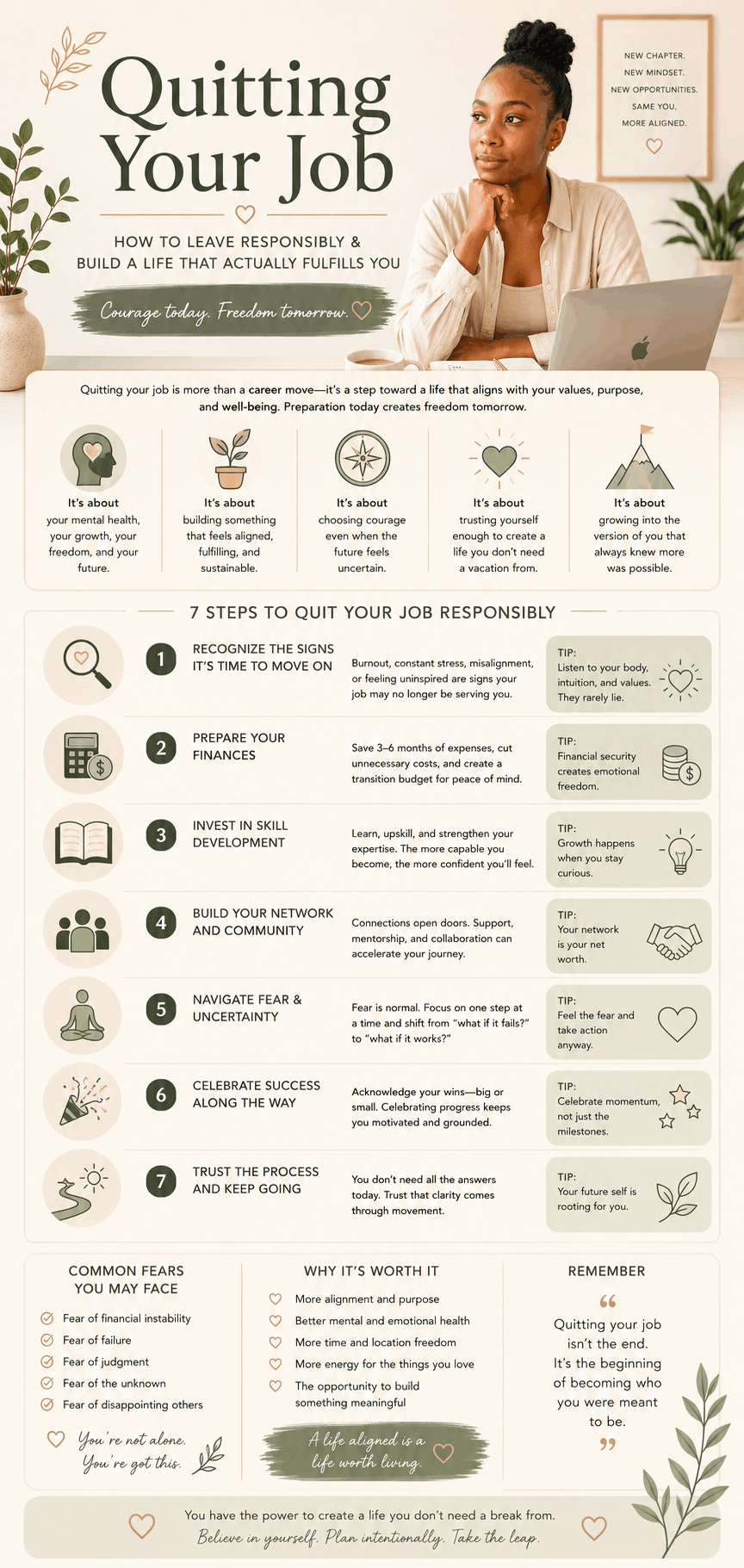
One of the healthiest things I did before quitting my job was building savings first.
When I officially left my job in January 2021, I had about three months of living expenses saved, and honestly, that emotional breathing room mattered tremendously.
Because transitions are already emotionally overwhelming enough.
Financial preparation helps reduce unnecessary panic.
I genuinely believe emergency savings create more than financial security. They create nervous system safety too. Knowing you have some form of cushion can make uncertainty feel less emotionally consuming.
Before quitting your job, it can help to spend time understanding your actual financial reality. That may look like reducing unnecessary expenses, paying down high-interest debt, building emergency savings, testing side income streams, or creating a transition budget that reflects your real needs instead of idealized expectations.
And honestly, I think preparation creates confidence. Not because uncertainty disappears completely, but because you begin trusting your ability to navigate it more responsibly.
Research consistently shows that financial stress significantly impacts mental health and emotional wellbeing, which honestly makes sense because survival anxiety affects nearly every area of life. That’s why financial planning matters emotionally too, not just practically.
Why Skill Development Matters So Much
I honestly think one of the biggest misconceptions about career transitions is believing passion alone is enough.
Passion matters deeply.
But sustainable change usually also requires skill development.
Before quitting my job, I spent a lot of time learning. I researched constantly, expanded my financial literacy, improved my communication skills, built systems, strengthened my business knowledge, and intentionally invested in personal growth.
Because the more capable you become, the more possibilities begin opening up.
And honestly, skill development doesn’t always require another expensive degree either.
Some of the most valuable growth can come through online courses, books, mentorship, podcasts, networking, practice, and simply staying curious enough to keep evolving.
I think many people underestimate how much confidence grows through competence. The more skills you develop, the less powerless uncertainty begins to feel.
And that matters deeply when you’re stepping into a new chapter of your life.

The Power of Networking & Community
I know networking can feel intimidating for a lot of people.
Especially introverts.
Especially people dealing with imposter syndrome.
Especially people who are used to hyper independence.
But honestly, community changes everything.
When I started expanding my network, I gained support, encouragement, opportunities, mentorship, collaborations, and perspective shifts that genuinely helped me grow.
And sometimes one aligned conversation can completely shift the direction of your life.
I think people often underestimate how life-changing supportive community can be because isolation magnifies fear. When you’re trying to navigate major transitions completely alone, everything feels heavier emotionally.
But connection reminds you that other people are figuring things out too.
Other people are pivoting.
Other people are scared.
Other people are learning as they go.
And honestly, I think success becomes much more sustainable when people stop trying to carry every single part of the journey entirely by themselves.
Navigating Fear & Uncertainty
Fear is such a normal part of major transitions.
I think many people expect themselves to feel fully confident before making a big decision like quitting their job, but honestly, most people don’t.
Even when I knew leaving was right for me, I still felt afraid sometimes. I worried about stability, money, uncertainty, judgment, and whether I was making the “right” choice.
And honestly, those fears were valid.
But eventually I realized something important:
Staying somewhere deeply misaligned also carried risks.
Emotional risks.
Mental health risks.
Burnout risks.
Creative risks.
Spiritual risks.
I think sometimes people become so afraid of uncertain futures that they ignore the damage of remaining stuck in environments already hurting them.
One thing that helped me tremendously was focusing less on controlling the entire future and more on taking one step at a time.
Because clarity often grows through movement.
Not endless overthinking.

Celebrating Success Along the Way
I think ambitious people often forget how important it is to celebrate progress.
So many people achieve something meaningful and immediately move the goalpost again. They barely pause long enough to acknowledge how far they’ve already come.
But honestly, celebrating success matters emotionally.
When I landed one of my first major clients after leaving my job, I remember allowing myself to genuinely pause and recognize the growth that had happened.
Not because everything was suddenly perfect.
But because progress deserves acknowledgment too.
And honestly, small wins matter:
sending the application,
building savings,
learning the skill,
having the difficult conversation,
taking the first risk,
showing up consistently,
trying again after fear.
Every step counts.
I think celebrating success helps retrain the nervous system to associate growth with possibility instead of fear and punishment.
You Do Not Need Your Entire Life Figured Out
I honestly think many people delay change because they feel pressure to have a perfect long-term plan before making any decisions.
But life rarely unfolds that neatly.
Sometimes clarity comes gradually through experimenting, trying, failing, adjusting, pivoting, learning, and evolving over time.
And honestly, I think many successful people changed directions multiple times before finding alignment.
You do not need every answer immediately.
You just need enough courage to take the next aligned step.
Quitting Your Job Is About More Than Work
At its core, I think quitting your job is rarely only about employment.
It’s often about reclaiming your energy, creativity, wellbeing, freedom, purpose, and self-trust.
And honestly, I think many people are craving more intentional lives now. Not just more money, but more meaning. More flexibility. More alignment between who they are and how they spend their days.
That doesn’t mean every transition will feel easy.
Or that fear disappears entirely.
But I do think people deserve lives that feel emotionally sustainable.
And sometimes the first step toward that life begins with finally admitting:
“This version of my life no longer fits who I’m becoming.”
Further Reading
Continue Exploring Career Transitions, Purpose & Financial Wellness
If you're navigating burnout, career changes, entrepreneurship, or building a more aligned life, these articles may support you further.
Free Resource To Share
If you’re currently thinking about quitting your job, building a new path, or trying to create more financial freedom, my Financial Clarity Webinar may help you feel more grounded and supported during the transition.
I created it to help people build healthier relationships with money, financial planning, and long-term wealth without shame, panic, or overwhelm.
Product Recommendation
Career transitions can feel emotionally overwhelming sometimes, and honestly, learning from other people’s stories, experiences, and perspectives can make uncertainty feel much less isolating. Spotify has been one of my favorite tools for listening to books about entrepreneurship, personal growth, financial wellness, mindset, and purpose-driven living.
Sometimes hearing someone else articulate what you’ve been feeling internally can completely shift your confidence and direction.
FAQs
How do I know when it’s time to quit my job?
Common signs include chronic burnout, emotional exhaustion, declining mental health, lack of alignment with your values, feeling constantly uninspired, or feeling physically affected by work-related stress.
Should I quit my job without another job lined up?
That depends on your financial situation, support systems, savings, and overall stability. Building an emergency fund and creating a transition plan can help reduce unnecessary stress during career changes.
How much money should I save before quitting my job?
Many financial experts recommend saving at least 3–6 months of living expenses before leaving a stable job, especially if transitioning into entrepreneurship or freelance work.
What skills should I develop before changing careers?
Skill development may include communication, leadership, financial literacy, networking, marketing, business strategy, technical skills, or industry-specific certifications depending on your goals.
Is quitting your job to pursue your passion risky?
Any major life transition involves risk, but intentional planning, financial preparation, skill development, and support systems can help create a smoother and more sustainable transition.
How do I overcome fear when quitting my job?
Fear is a natural part of major transitions. Building savings, developing skills, leaning on supportive community, and taking gradual steps can help reduce overwhelm and build confidence.
Why is celebrating success important during career transitions?
Celebrating success helps reinforce progress, boosts confidence, supports emotional resilience, and reminds you that growth happens through small consistent steps over time.
