
The 3 Common Fears That Hold People Back From Success
Fear is such a universal human experience, yet it can feel deeply isolating when you’re in the middle of it. Whether it’s fear of failure, fear of rejection, or even fear of success, these emotions have a way of quietly shaping our choices, relationships, confidence, and ability to move toward the life we genuinely want. Recently, I woke up from a vivid dream that brought some of my own underlying fears to the surface, and honestly, it reminded me how much fear can still exist even when we’re growing, healing, or evolving. That experience inspired me to reflect more deeply on the common fears so many of us carry — and how we can begin moving through them with more compassion and self-awareness.
Fear is one of those things every human being experiences, yet we rarely talk about how deeply it shapes our lives.
Not just in dramatic moments.
But quietly.
In the opportunities we avoid.
The risks we postpone.
The conversations we never have.
The dreams we convince ourselves are unrealistic.
The versions of ourselves we are too afraid to fully become.
And honestly, I think fear can be incredibly sneaky because it often disguises itself as logic, perfectionism, procrastination, overthinking, or “being realistic.”
But underneath many of those patterns is usually fear.
Fear of failing.
Fear of rejection.
Fear of judgment.
Fear of not being enough.
Fear of success.
Fear of change.
Fear of losing control.
Recently, I had a vivid dream that brought a lot of my own fears and insecurities to the surface unexpectedly. It reminded me that even when we are growing emotionally or building confidence, fear does not necessarily disappear completely. Sometimes it simply changes form.
And I think part of healing is learning that courage is not the absence of fear.
It is moving forward while fear still exists.

Why Fear Feels So Powerful
Fear is deeply connected to survival.
Our brains are naturally wired to protect us from danger, uncertainty, discomfort, and potential rejection. From a nervous system perspective, fear often activates protective responses designed to keep us emotionally and physically safe.
And honestly, that makes sense.
Because historically, belonging and survival were connected. Rejection could mean danger. Failure could mean instability. Uncertainty could mean risk.
The problem is that modern fears are often emotional rather than life-threatening — yet our nervous systems can respond to them as though they are emergencies anyway.
This is why:
applying for opportunities can feel terrifying
visibility can feel unsafe
vulnerability can feel overwhelming
taking risks can trigger anxiety
success can feel emotionally uncomfortable
Research in psychology has shown that fear and avoidance behaviors are closely tied to emotional regulation, stress responses, and learned experiences. Which means many fears are not signs that you are incapable — they are often protective patterns your brain learned over time.
And honestly, I think understanding that creates more compassion for ourselves.
Because fear is not weakness.
It is part of being human.

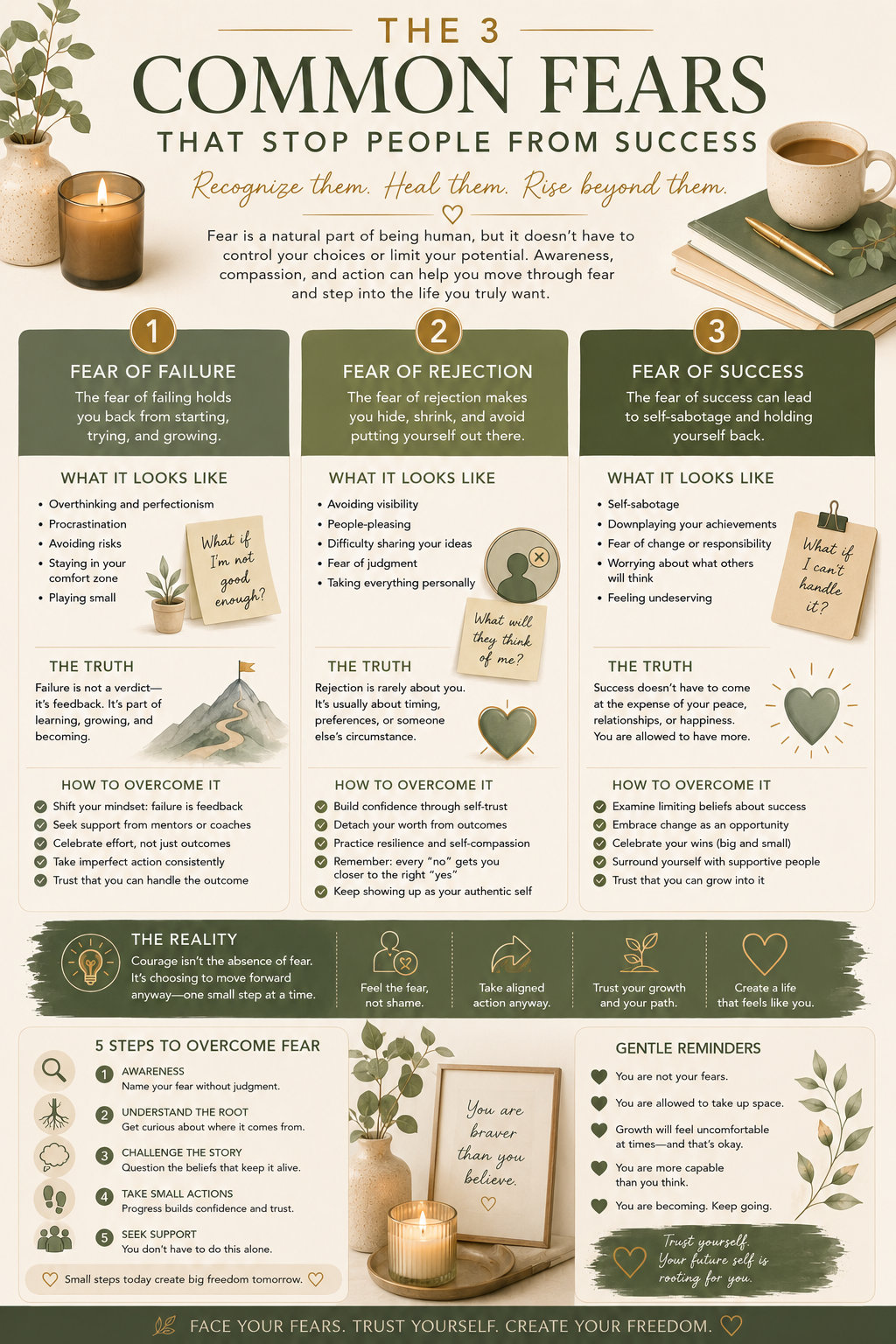
The Fear of Failure
The fear of failure is probably one of the most common fears people experience.
And honestly, it can become paralyzing.
For many people, fear of failure is not really about the event itself. It is about what failure feels like it means about them personally.
If I fail:
maybe I’m not good enough
maybe people will judge me
maybe I’ll embarrass myself
maybe I’ll prove my insecurities right
maybe I’ll disappoint others
maybe I’ll lose stability or security
So instead of risking failure, many people stay in situations that feel emotionally safer:
unfulfilling jobs
stagnant routines
unhealthy relationships
hidden dreams
procrastination
perfectionism
Because avoiding failure can temporarily feel safer than risking disappointment.
But honestly, one of the biggest mindset shifts I’ve experienced is realizing that failure is not a verdict on your worth.
It’s information.
It’s feedback.
It’s redirection.
It’s part of growth.
Every person you admire has failed at something.
Businesses fail.
Relationships fail.
Ideas fail.
Plans fail.
People pivot constantly.
And yet social media often presents success as linear, effortless, and perfectly curated.
But real growth is usually messy.
How to Overcome Fear of Failure
I honestly think overcoming fear of failure starts with changing the meaning you assign to failure itself.
Because if failure means “I am unworthy,” then of course your nervous system will avoid risk.
But if failure becomes:
learning
experimentation
growth
refinement
resilience
redirection
Then it becomes emotionally easier to keep moving.
One thing that has helped me personally is focusing less on perfection and more on self-trust.
Can I trust myself to handle discomfort?
Can I trust myself to recover if things do not go as planned?
Can I trust myself to adapt?
Because confidence is not believing everything will always work out perfectly.
Confidence is believing you can navigate challenges even when things feel uncertain.
And honestly, I think that shift changes everything.

The Fear of Rejection
The fear of rejection can affect nearly every area of life:
relationships
friendships
business
social media
dating
visibility
creativity
career opportunities
And I think rejection hurts so deeply because humans naturally want belonging and connection.
We want to feel accepted.
Wanted.
Chosen.
Valued.
So when rejection happens, it can easily trigger deeper wounds around worthiness or abandonment.
But one thing I’ve realized over time is that rejection is often far less personal than we think it is.
Sometimes people reject things because:
timing is wrong
needs are different
priorities do not align
capacity is limited
perspectives differ
they are projecting their own fears
And honestly, not every rejection is meant to be interpreted as evidence that you are inadequate.
Sometimes rejection is simply redirection.
There were opportunities I desperately wanted years ago that did not work out — jobs, collaborations, relationships, experiences. At the time, those rejections felt painful and deeply personal.
But looking back now, many of those situations would not have aligned with the life I eventually grew into.
And honestly?
That perspective softened rejection for me tremendously.
How to Get Over My Fears of Rejection
One of the gentlest ways to start healing fear of rejection is by separating your worth from other people’s responses.
Because your value cannot be determined by:
one person’s opinion
one missed opportunity
one failed launch
one awkward interaction
one rejection email
one “no”
I also think resilience grows through exposure.
The more you allow yourself to be seen authentically, the more your nervous system slowly learns that rejection, while uncomfortable, is survivable.
That may look like:
sharing your ideas online
applying for opportunities
setting boundaries
expressing your feelings honestly
creating something imperfectly
asking for support
trying again after disappointment
Every time you survive rejection, your confidence expands a little more.
Not because rejection stops hurting entirely.
But because you realize it does not destroy you.
The Fear of Success
Honestly, I think fear of success is one of the least talked about common fears.
And yet it affects so many people.
Because success often brings:
visibility
responsibility
change
pressure
expectations
growth
discomfort
new identities
Sometimes people unconsciously fear success because they worry:
success will isolate them
people will resent them
they will outgrow relationships
they will not be able to maintain it
they will lose balance
they will become overwhelmed
And honestly, this fear can create self-sabotage patterns.
You procrastinate.
Undercharge.
Play small.
Delay opportunities.
Avoid visibility.
Second-guess yourself.
Stay hidden.
Not because you do not want success.
But because some part of you associates success with emotional danger.
I think this is especially true for people who grew up around instability, criticism, or environments where standing out felt unsafe.
Because visibility can feel emotionally threatening to the nervous system.
How to Overcome Fear of Success
One thing that helped me begin healing fear of success was realizing that success does not have to mean abandoning myself.
For a long time, I subconsciously associated success with:
exhaustion
burnout
pressure
losing freedom
constant stress
But eventually I started redefining success more intentionally.
What if success could also include:
peace
rest
alignment
emotional wellbeing
supportive relationships
flexibility
joy
sustainability
That question changed a lot for me.
Because if your nervous system only associates success with pressure and overwhelm, then of course part of you will resist it.
I also think celebrating small wins matters deeply.
Many people move through life minimizing their accomplishments constantly. They achieve something meaningful and immediately shift the goalpost again.
But acknowledging growth helps your nervous system begin associating success with safety instead of fear.

Fear, Healing & Self-Compassion
I honestly do not think healing fear is about becoming fearless.
I think it is about becoming more compassionate toward the parts of yourself that learned fear for very real reasons.
Fear often develops through:
childhood experiences
rejection
criticism
instability
trauma
disappointment
perfectionism
shame
societal pressure
And healing usually happens gradually.
Through small moments of courage.
Through self-awareness.
Through emotional support.
Through nervous system regulation.
Through trying again.
Through allowing yourself to be imperfect.
Sometimes overcoming fear means taking one small step instead of waiting to feel completely confident first.
And honestly, I think that matters because confidence is often built through action, not before it.
You Do Not Have to Let Fear Run Your Life
Fear may always exist in some form.
But it does not have to make your decisions for you.
You are allowed to pursue dreams even while feeling uncertain.
You are allowed to take risks even while feeling afraid.
You are allowed to be visible even if rejection feels uncomfortable.
You are allowed to succeed without abandoning yourself.
You are allowed to grow beyond the fears that once protected you.
And honestly, I think one of the most powerful things we can do is stop viewing fear as proof we should stay small.
Sometimes fear simply means we are standing at the edge of growth.
Further Reading
Continue Exploring Healing, Confidence & Personal Growth
If you're learning how to move through fear, build self-trust, and create a healthier relationship with success, these articles may support you further.
Free Resource To Share
Fear and scarcity often overlap more than we realize. Whether it’s fear of failure, fear of rejection, or fear of success, these emotional patterns can quietly shape the way we relate to money, confidence, opportunities, and self-worth.
My Money Mindset Ebook was created to help you gently explore those deeper beliefs around abundance, safety, and worthiness while building a healthier relationship with success and financial wellbeing.
Product Recommendation
Because fear often lives in the body, nervous system support can be incredibly healing when you’re learning how to move through anxiety, self-doubt, and emotional overwhelm. Othership offers guided breathwork and emotional regulation practices that can help create more calm, grounding, and self-awareness.
I genuinely think emotional healing becomes much more sustainable when we support both the mind and the nervous system together.
FAQs
What are the most common fears people experience?
Some of the most common fears include fear of failure, fear of rejection, fear of success, fear of judgment, fear of change, and fear of uncertainty.
Why do fears hold people back from success?
Fear often activates protective responses in the nervous system that encourage avoidance, procrastination, perfectionism, or self-sabotage in order to prevent emotional discomfort or perceived danger.
How can I overcome fear of failure?
Overcoming fear of failure starts with changing the meaning you assign to failure. Instead of viewing failure as proof of inadequacy, try seeing it as feedback, growth, learning, and part of the human experience.
What causes fear of success?
Fear of success can stem from concerns around visibility, pressure, responsibility, burnout, change, or fear of outgrowing relationships and identities tied to your current life.
How do I get over my fears?
Healing fear often involves self-awareness, nervous system regulation, emotional support, gradual exposure, mindset shifts, and building self-trust through small acts of courage over time.
Why does rejection feel so painful?
Humans are naturally wired for belonging and connection, so rejection can activate emotional wounds tied to worthiness, abandonment, or social safety.
Can fear ever completely disappear?
Fear may never disappear entirely, but it can become more manageable. Healing often involves learning how to move forward with fear instead of allowing it to control your life decisions.
