
How to Recession Proof Your Finances and Build Security
I think one of the biggest lessons the past few years have taught many of us is how quickly life and the economy can change. Layoffs happen unexpectedly. Inflation rises. Costs increase. Entire industries shift almost overnight. And honestly, that kind of uncertainty can feel deeply unsettling, especially when so many people are already carrying financial stress. But over time, I’ve realized that becoming recession proof is not about controlling the economy perfectly or never experiencing difficulty. It’s about creating more resilience, flexibility, and stability so you can navigate uncertainty without completely falling apart financially or emotionally. Recessions are challenging, but they can also become periods of transformation, reinvention, and opportunity when you prepare intentionally.
Recessions can feel scary.
I think for many people, economic downturns trigger very real fears around survival, stability, and security. When headlines constantly talk about inflation, layoffs, rising costs, or economic uncertainty, it’s understandable why so many people begin feeling anxious about money.
And honestly, those fears are valid.
Because financial stress impacts far more than bank accounts. It affects mental health, relationships, nervous systems, decision-making, sleep, and overall wellbeing too.
But over time, I’ve also realized something important:
Being recession proof is not about avoiding uncertainty completely.
It’s about becoming more prepared for it.
It’s about building financial habits, emotional resilience, skills, and systems that help you navigate difficult seasons with more confidence and stability.
And honestly, I think that mindset shift changes everything.
Because when people hear the word “recession,” they often immediately think:
fear,
scarcity,
loss,
panic.
But historically, recessions have also created opportunities for people who were prepared, adaptable, educated, and willing to pivot.
That doesn’t mean recessions are easy.
But it does mean they do not automatically have to destroy your future either.
What Does It Mean To Be Recession Proof?
I think many people misunderstand what becoming recession proof actually means.
It does not mean becoming immune to economic hardship.
It does not mean never struggling.
It does not mean becoming rich overnight.
To me, recession-proof finances mean creating enough flexibility, preparedness, and financial resilience that economic shifts do not completely destabilize your life.
That can look like:
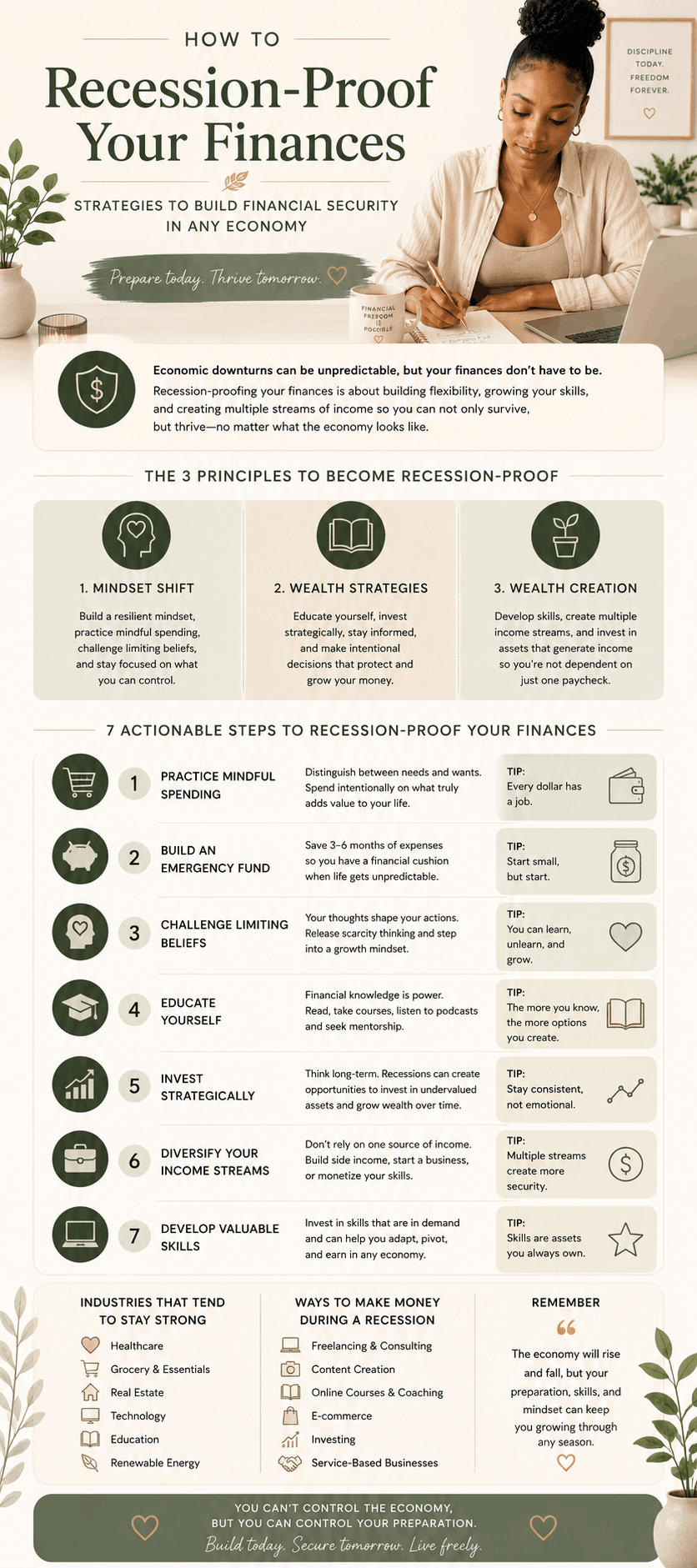
building emergency savings
reducing financial dependence on one income source
increasing financial literacy
developing valuable skills
creating multiple income streams
learning how to adapt during uncertainty
strengthening long-term wealth strategies
And honestly, I think emotional resilience matters here too.
Because people often focus only on money during recessions while ignoring the emotional impact financial stress creates.
Fear can lead people to:
panic spend
panic sell investments
avoid financial planning
shut down emotionally
procrastinate
stay frozen in scarcity mode
That’s why mindset matters so much.

Why Mindset Is So Important During a Recession
One of the biggest shifts that helped me approach money differently was learning to move from a reactive mindset into a proactive one.
When people operate from fear constantly, financial decisions often become emotionally driven instead of intentional.
People panic.
Avoid looking at their finances.
Assume hopelessness.
Stop planning entirely.
Or convince themselves there’s nothing they can do.
But honestly, becoming recession proof starts with believing you are capable of learning, adapting, and improving your financial situation over time.
I also think recessions reveal people’s existing financial habits more clearly.
If someone already struggles with overspending, avoidance, or financial instability, economic downturns tend to magnify those patterns.
That’s why I believe recessions can also become wake-up calls.
Not from shame.
From awareness.
And honestly, one of the most powerful things people can do during uncertain times is focus on what they actually can control.
You may not control inflation.
Interest rates.
Corporate layoffs.
Or the stock market.
But you can influence:
your spending habits
your financial literacy
your savings
your skills
your adaptability
your mindset
your income potential
And those things matter tremendously long term.
Mindful Spending During Economic Uncertainty
I honestly think one of the healthiest financial habits during a recession is mindful spending.
Not fear-based deprivation.
Mindful awareness.
One of the questions I constantly return to is:
“Is this a need or a want?”
Because when economic uncertainty increases, intentional spending becomes even more important.
That doesn’t mean never enjoying your life.
Or eliminating every source of joy.
But it does mean becoming more conscious about whether your spending aligns with your actual priorities and long-term wellbeing.
Mindful spending can help people:
reduce unnecessary expenses
strengthen savings
lower financial stress
avoid emotional spending
create more stability during uncertainty
And honestly, I think mindful spending creates emotional clarity too.
Because when people become intentional with money, they often feel more empowered instead of constantly overwhelmed.

Building Emergency Savings Creates Nervous System Safety
I genuinely believe emergency funds create more than financial protection.
They create emotional safety too.
One of the most important parts of recession-proof finances is building savings before emergencies happen whenever possible.
Even small savings can make a huge emotional difference during uncertain times.
Because financial emergencies feel much less destabilizing when you know you have some type of cushion available.
Traditionally, many financial experts recommend saving three to six months of living expenses, but honestly, I think people should focus less on perfection and more on progress.
Because even:
$500
$1,000
one extra month of expenses
can significantly reduce panic during difficult situations.
And honestly, I think people underestimate how much nervous system regulation is connected to financial stability.
When people constantly feel one emergency away from collapse, it affects nearly every area of life emotionally.
How To Make Money During The Recession
I think one of the biggest myths about recessions is the belief that nobody can grow financially during difficult economic periods.
Historically, that simply isn’t true.
Some people absolutely struggle deeply during recessions.
And others pivot, adapt, build businesses, invest strategically, or create entirely new opportunities.
Many successful businesses were actually built during recessions.
And honestly, I think adaptability becomes one of the most valuable skills during uncertain times.
If you’re wondering how to make money during the recession, one of the most important things you can do is stop relying entirely on one source of income whenever possible.
Because relying on a single paycheck can become incredibly risky during economic instability.
That’s why alternative income streams matter so much.

Creating Multiple Income Streams
I honestly think multiple income streams are one of the strongest forms of financial protection people can build.
Not necessarily because every stream will become massive immediately, but because diversification creates flexibility.
And flexibility matters during uncertainty.
Some ways people make money during recession periods include:
freelancing
consulting
coaching
content creation
digital products
investing
teaching online
remote work
service-based businesses
monetizing specialized skills
The goal is not perfection overnight.
It’s creating options.
And honestly, I think many people already have skills they underestimate tremendously.
Writing.
Design.
Organization.
Marketing.
Communication.
Editing.
Teaching.
Photography.
Research.
Social media.
Budgeting.
Project management.
There are so many ways skills can eventually become income-producing assets.
Skill Development Is One Of The Best Investments
I genuinely believe your skills are one of your greatest forms of security.
Especially during economic uncertainty.
Industries change constantly.
Technology evolves.
Jobs disappear.
Markets shift.
But adaptable people remain valuable.
That’s why I think recession-proof finances are not only about saving money.
They’re also about increasing your earning potential.
Learning in-demand skills can:
increase job security
improve income opportunities
create business potential
strengthen confidence
open career flexibility
And honestly, some of the most valuable education available now is incredibly accessible through:
books
podcasts
YouTube
online courses
mentorship
networking
community learning
I think people sometimes wait for perfect timing to start growing, but difficult seasons can actually become incredible periods for learning and reinvention.

Investing During A Recession
I know investing during recessions can feel emotionally intimidating.
Especially when markets feel unstable.
But historically, recessions have often created opportunities for long-term investors because many assets become undervalued during economic downturns.
That doesn’t mean investing recklessly.
Or ignoring risk.
But it does mean understanding that wealth building is usually a long-term process rather than an emotional reaction to short-term fear.
One thing I think is incredibly important is avoiding panic-based decisions.
Fear often causes people to:
sell investments emotionally
stop investing entirely
abandon long-term strategies
react impulsively
And honestly, emotional reactions often create worse outcomes financially over time.
Financial education matters tremendously here.
Because the more informed people become, the less powerless uncertainty tends to feel.
Recession Proof Finances Require Emotional Resilience Too
I honestly think people underestimate how emotional money can become during difficult economic seasons.
Financial stress affects:
relationships
confidence
sleep
emotional regulation
self-worth
mental health
nervous system functioning
That’s why becoming recession proof is not only about spreadsheets and savings accounts.
It’s also about emotional resilience.
Can you stay grounded during uncertainty?
Can you adapt instead of shutting down?
Can you continue learning instead of spiraling into hopelessness?
Can you ask for support when needed?
Can you remain intentional instead of reactive?
Those things matter deeply too.
Becoming Recession Proof Is Really About Flexibility
At the end of the day, I don’t think becoming recession proof means creating a perfectly protected life.
I think it means becoming more adaptable, intentional, educated, and resilient.
Because uncertainty is part of life.
Economic cycles happen.
Industries evolve.
Unexpected challenges appear.
But people who continuously:
learn
prepare
adapt
diversify
invest in themselves
build emotional resilience
often navigate difficult seasons differently.
And honestly, I think that’s empowering.
Because while you may not control the economy entirely, you can absolutely strengthen your ability to move through uncertainty with more confidence, stability, and long-term vision.
That’s what recession-proof finances really mean to me.
Further Reading
Continue Exploring Financial Security & Wealth Building
If you're working toward financial stability, intentional wealth building, and long-term security, these articles may support you further.
Free Resource To Share
If you’re currently feeling anxious about the economy, uncertain about your finances, or trying to create more financial stability, my Financial Clarity Webinar was created to help you feel more grounded and empowered around money.
It’s designed to help you build healthier financial habits, increase financial awareness, and create a stronger long-term foundation without shame or overwhelm.
Product Recommendation
During uncertain economic seasons, I think it becomes even more important to invest intentionally in tools, resources, and systems that genuinely support your wellbeing, finances, productivity, and long-term growth. The Well(th) List includes many of my favorite resources for intentional living, wealth building, and personal growth.
Because becoming recession proof is not just about surviving financially. It’s about building a life that remains sustainable emotionally too.
FAQs
What does recession-proof mean?
Being recession-proof means building financial resilience, flexibility, and preparedness so economic downturns have less impact on your overall financial stability and well-being.
How can I recession-proof my finances?
You can recession-proof your finances by building emergency savings, reducing unnecessary debt, increasing financial literacy, creating multiple income streams, developing valuable skills, and practicing intentional spending.
How do people make money during a recession?
People often make money during recessions through freelancing, entrepreneurship, consulting, investing strategically, teaching online, creating digital products, remote work, and monetizing valuable skills.
Is investing during a recession a good idea?
Historically, recessions have created long-term investing opportunities because many assets become undervalued. However, investing decisions should always align with your risk tolerance, financial goals, and long-term strategy.
Why is mindset important during economic downturns?
Mindset affects financial decision-making. Fear-based thinking can lead to panic spending, avoidance, or emotional decisions, while proactive thinking encourages planning, adaptability, and long-term strategy.
What skills are valuable during a recession?
Adaptable and in-demand skills such as communication, digital marketing, financial literacy, project management, technology skills, writing, design, and consulting can create additional income opportunities during recessions.
How much emergency savings should I have during a recession?
Many financial experts recommend saving three to six months of living expenses, but even smaller emergency funds can provide important financial and emotional stability during uncertain times.
