
Understanding Wealth Inequality: Why One Person Shouldn’t Control the World’s Wealth
The wealth inequality gap continues widening across the globe, leaving many people questioning capitalism, corporate power, and the future of economic opportunity. While personal wealth building remains important, we cannot separate individual success from collective wellbeing forever. In this post, I’m sharing my honest thoughts on wealth inequality, the flaws of unchecked capitalism, oligarchic power structures, and why redefining success may be one of the most important conversations of our generation.
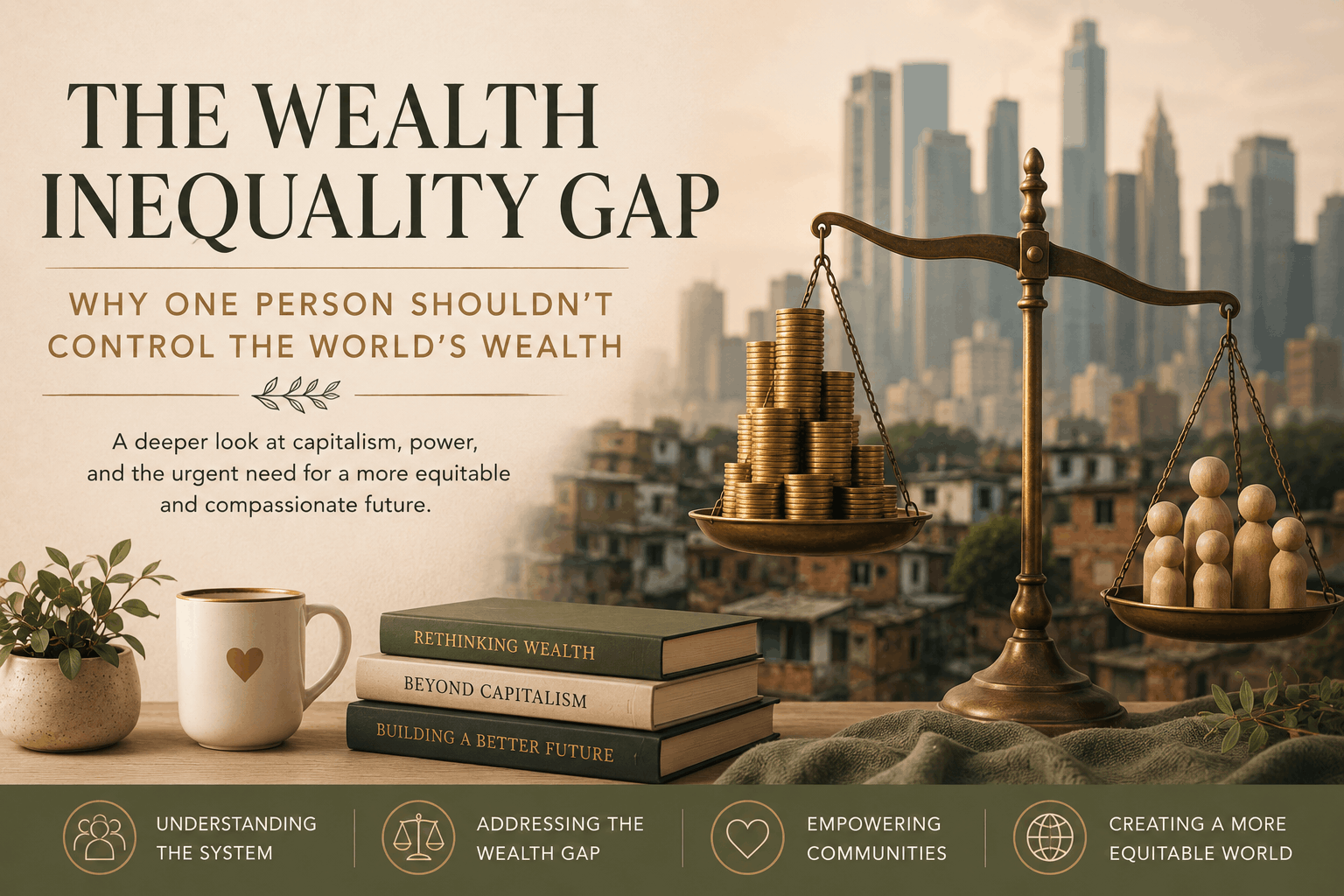
For years, much of my work focused heavily on individual wealth.
Financial freedom.
Building assets.
Investing.
Entrepreneurship.
Creating abundance.
Healing money mindset patterns.
And honestly, I still believe those conversations matter deeply.
I believe people deserve financial security.
I believe people deserve opportunities.
I believe people deserve to build wealth and create lives that feel expansive and aligned.
But over time, I’ve realized something important:
We cannot continue talking about personal wealth without also talking about collective wellbeing.
The two are deeply interconnected.
Because what happens when wealth becomes concentrated in the hands of fewer and fewer people? What happens when corporations and billionaires gain more influence than governments themselves? What happens when economic systems prioritize endless profit while millions of people struggle to afford housing, healthcare, education, or even basic stability?
Those are not abstract political questions anymore.
They’re real-life questions affecting millions of people every single day.
And honestly, I think many people can feel that something about the current system feels unsustainable.
(Check out my other blog post to accompany this post and a video I made (see above) on Capitalism).
The Wealth Inequality Gap Is Becoming Impossible to Ignore
Lately, conversations around wealth inequality feel unavoidable.
Everywhere you look, the gap between the ultra-wealthy and the average person continues widening.
Housing costs continue rising.
Wages stagnate.
Burnout increases.
People work multiple jobs and still struggle financially.
Meanwhile, billionaire wealth continues growing at extraordinary levels.
Research consistently shows that wealth concentration has accelerated globally over the last several decades, with the richest individuals holding increasingly larger percentages of total wealth.
And honestly, people feel this emotionally too.
Financial stress impacts:
mental health,
relationships,
physical wellbeing,
family dynamics,
hope for the future,
and overall quality of life.
This is why I think the wealth inequality gap is not just an economic conversation.
It’s a deeply human one.
Because when large portions of society are constantly operating in survival mode financially, collective wellbeing deteriorates too.
Capitalism Isn’t Entirely Evil — But It Has Serious Flaws
I want to approach this conversation with nuance because I don’t believe capitalism is entirely evil.
Capitalism has absolutely contributed to innovation, entrepreneurship, creativity, technology, medical advancement, and economic growth. As a business owner myself, I value aspects of entrepreneurship and economic freedom deeply.
But I also think capitalism becomes dangerous when profit is prioritized above humanity.
And honestly, that’s where much of my discomfort comes from now.
One of the biggest flaws of capitalism is that it often disconnects people from one another.
Productivity becomes more important than wellbeing.
Growth becomes more important than sustainability.
Profit becomes more important than community.
And over time, this creates a culture where people are valued primarily for what they produce rather than who they are.
Burnout becomes normalized.
Rest becomes associated with laziness.
Worth becomes tied to income and achievement.
Consumerism becomes mistaken for fulfillment.
And honestly, I think many people are emotionally exhausted from trying to survive inside systems that constantly demand more from them while giving very little back emotionally.

Politics and Wealth Are Deeply Connected
I think many people try separating politics from money, but honestly, that’s impossible.
Politics affects:
housing,
healthcare,
wages,
education,
worker protections,
tax structures,
and economic opportunity overall.
The systems governments create directly shape who has access to stability and who doesn’t.
And lately, I think more people are beginning to question whether we’re truly living in democracies when billionaires and corporations hold so much influence over public policy.
Because when ultra-wealthy individuals and corporations can heavily influence political systems through lobbying, campaign financing, media ownership, and economic pressure, power naturally becomes concentrated at the top.
And honestly, that concentration of power is what worries me most.
Not wealth itself.
But unchecked power without accountability.
My Thoughts on Elon Musk, Billionaires & Corporate Power
I think conversations around billionaires are often reduced into extremes.
Either:
“They’re evil.”
Or:
“They’re geniuses saving humanity.”
But honestly, reality is more complicated than that too.
For example, I don’t hate Elon Musk.
In fact, there was a period where I genuinely admired aspects of his innovation and vision. I invested in Tesla stock myself because I believed in parts of what the company represented environmentally and technologically.
But my concerns have never really been about ambition itself.
My concerns are about concentrated power.
Because no single person should hold enough influence to shape economies, political systems, media narratives, AI development, and global conversations without meaningful accountability.
And honestly, history has repeatedly shown us that when too much power becomes concentrated among a small group of people, marginalized communities are often the ones most affected.
This is why emotional intelligence, cultural awareness, and community-centered leadership matter so much.
Leadership should not only be about intelligence, innovation, or profit.
It should also involve listening.
Empathy.
Collaboration.
Accountability.
Understanding how policies and decisions impact real people’s lives.
The Wealth Inequality Gap Did Not Happen Accidentally
One thing I think we need to acknowledge more honestly is that modern wealth inequality did not appear overnight.
It is deeply tied to history.
Colonialism.
Slavery.
Racism.
Discriminatory housing policies.
Unequal education access.
Wage gaps.
Generational wealth disparities.
Historically marginalized communities — especially Black and Indigenous communities — continue facing systemic barriers connected to wealth accumulation and economic mobility because of historical and ongoing structural inequalities.
And honestly, I think conversations around wealth become incomplete when we ignore those realities.
Because not everyone begins from the same starting line financially.
Access matters.
Safety matters.
Education matters.
Networks matter.
Generational wealth matters.
That doesn’t mean individual responsibility disappears.
But it does mean systems matter too.
AI, Automation & The Future of Work
Another reason this conversation feels especially urgent right now is because artificial intelligence and automation are rapidly changing the future of work itself.
And honestly, I think many people feel both excited and terrified simultaneously.
Technology has the potential to improve quality of life dramatically.
But it also has the potential to deepen inequality if wealth and power remain concentrated among a handful of corporations controlling AI systems, automation, and data ownership.
That’s why I think we need to start asking bigger questions now:
Who benefits from technological advancement?
Who gets left behind?
How do we protect workers during economic transitions?
How do we ensure innovation benefits society collectively instead of only enriching a small percentage of people?
Because honestly, these are not futuristic questions anymore.
They’re happening now.

Redefining Success Altogether
I honestly think part of the problem is that society has defined success far too narrowly for far too long.
We praise:
wealth,
status,
power,
productivity,
and accumulation.
But we rarely prioritize:
empathy,
community,
emotional intelligence,
collective wellbeing,
rest,
or sustainability.
And honestly, I think many people are waking up to the reality that endless growth without emotional wellbeing eventually feels empty.
This is one of the reasons I care so deeply about wealth wellness now.
Because true abundance should include:
mental health,
community care,
emotional wellbeing,
financial stability,
purpose,
health,
and sustainability too.
Not just money alone.
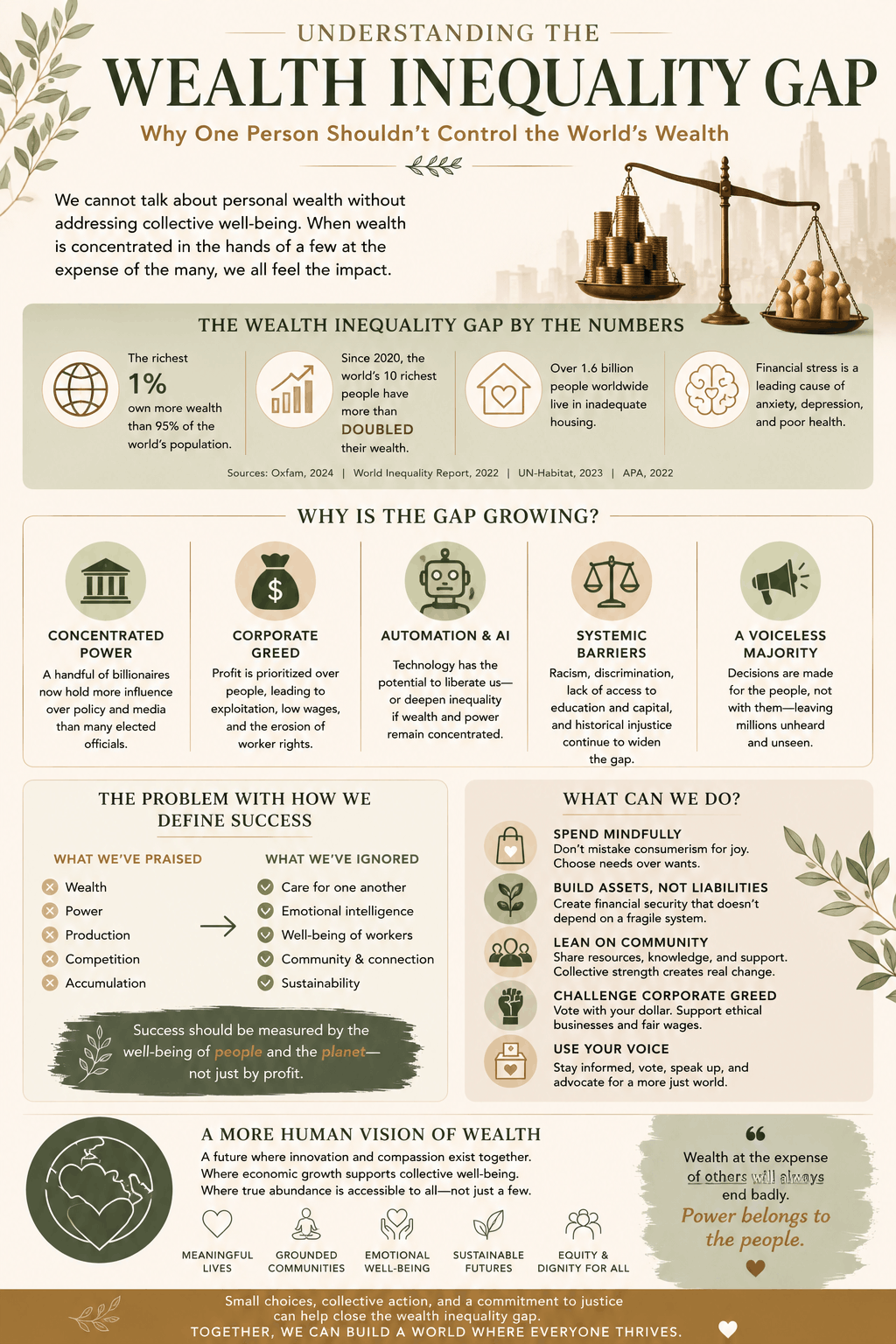
A More Human Vision of Wealth
At the end of the day, I don’t think wealth itself is the problem.
And honestly, I don’t think humans are inherently evil either.
I think the real issue is disconnection.
Disconnection from community. Disconnection from empathy. Disconnection from balance. Disconnection from the understanding that our wellbeing is deeply interconnected whether we realize it or not.
For so long, society has conditioned us to define success through accumulation. More money. More productivity. More status. More power. More consumption. But I think many people are starting to realize that endless achievement without emotional wellbeing eventually feels empty.
You can have money and still feel disconnected from yourself.
You can have success and still feel exhausted.
You can build an impressive life externally while quietly feeling emotionally unfulfilled internally.
And honestly, I think that’s why so many people are craving a more humane version of wealth now.
Not just financial abundance, but emotional abundance too.
People want lives that feel meaningful. Lives that feel grounded. Lives where success does not come at the expense of mental health, relationships, community, or personal wellbeing. I think people are beginning to crave slower living, deeper connection, purposeful work, and a healthier relationship with both money and themselves.
Because true abundance should not only exist for a tiny percentage of people while everyone else struggles to survive.
And maybe the future of wealth is not about choosing between capitalism or socialism entirely. Maybe it’s about creating systems rooted in both innovation and compassion. Systems where entrepreneurship and creativity can still thrive, while collective wellbeing is also protected and prioritized.
Because economic growth means very little if people are emotionally burnt out, financially unstable, disconnected from community, and unable to meet their basic needs.
I think real progress requires us to start asking different questions altogether.
Not just:
“How do we create more wealth?”
But also:
“How do we create healthier societies?”
“How do we create more balance?”
“How do we create systems that value people as much as profit?”
And honestly, I think that’s the conversation we need to keep having.
Further Reading
Continue Exploring Wealth & Society
If you’re reflecting on wealth inequality, capitalism, money mindset, and creating a more intentional relationship with abundance, these posts may support you further.
Resource to Start With
If this conversation around wealth inequality, capitalism, and financial wellbeing resonated with you, I’d recommend starting with the Intuitive Wealth Blueprint.
A huge part of navigating modern wealth conversations is learning how to build financial stability without disconnecting from your wellbeing, values, or sense of purpose. This resource helps you create a more grounded, intentional relationship with abundance while reconnecting with your intuition and long-term vision for your life.
Download Your Intuitive Wealth Blueprint GPT
Product Recommendation
One book I genuinely think everyone should read when reflecting on wealth inequality and modern economic systems is The Psychology of Money by Morgan Housel.
What I appreciate most about this book is that it approaches money through human behavior, emotions, psychology, privilege, decision-making, and lived experience rather than purely financial theory. It helps explain why wealth, success, scarcity, and financial choices are often much more emotional and systemic than people realize.
And honestly, I think books like this help people develop more nuance around conversations about money and society overall.
FAQs
What is the wealth inequality gap?
The wealth inequality gap refers to the unequal distribution of wealth within society, where a small percentage of people hold a large portion of total wealth while many others struggle financially.
Why is the wealth inequality gap growing?
The wealth inequality gap continues growing due to factors like wage stagnation, rising living costs, corporate consolidation, unequal access to education and investments, generational wealth disparities, and systemic barriers.
What are the flaws of capitalism?
Some of the biggest flaws of capitalism include wealth concentration, corporate greed, burnout culture, income inequality, environmental exploitation, and prioritizing profit over collective wellbeing when left unchecked.
Does capitalism make the rich richer?
Capitalism can allow wealth to compound significantly through investments, ownership, and assets, which often benefits those who already have financial advantages and access to wealth-building opportunities.
How does wealth inequality affect society?
Wealth inequality impacts housing access, healthcare, mental health, education, economic opportunity, social mobility, and overall collective wellbeing.
Can wealth inequality impact mental health?
Yes. Research consistently shows that financial insecurity and economic stress can contribute to anxiety, depression, chronic stress, burnout, and emotional exhaustion.
Is wealth inequality only about personal responsibility?
No. While personal financial habits matter, systemic barriers like discrimination, unequal education access, wage inequality, historical injustices, and generational wealth disparities also play major roles in wealth inequality.
〰️ LISTEN TO THE PODCAST OR WATCH THE VIDEO
↳ Listen to the full and unedited version of this blog post on The Greenest Tea Podcast
〰️ WORK WITH ME
↳ my coaching services https://bit.ly/3ZAs0NZ
↴ additional resources and perks:
→ Watch my FREE Webinar 'From Financial Confusion to Clarity' - https://bit.ly/4h7dXqq 📺
→ Download my free ebook on mastering your money mindset https://bit.ly/3fAfj33 💵
→ Download my free Wealth Tracker - https://bit.ly/48H8Rxj 🧮
→ Invest in stocks with Wealthsimple https://bit.ly/3PJYscp 📈
→ Invest in crypto and receive $25 USD https://bit.ly/3TxD4dr 🪙
→ Invest like the rich in art and receive a $200 bonus (USD only) https://bit.ly/3Popuqh 🖼️
→ Sign up for my bi-weekly newsletters https://bit.ly/466g09H 📨
〰️ CONTACT ME
✉️ hello@morganblackman.com
