
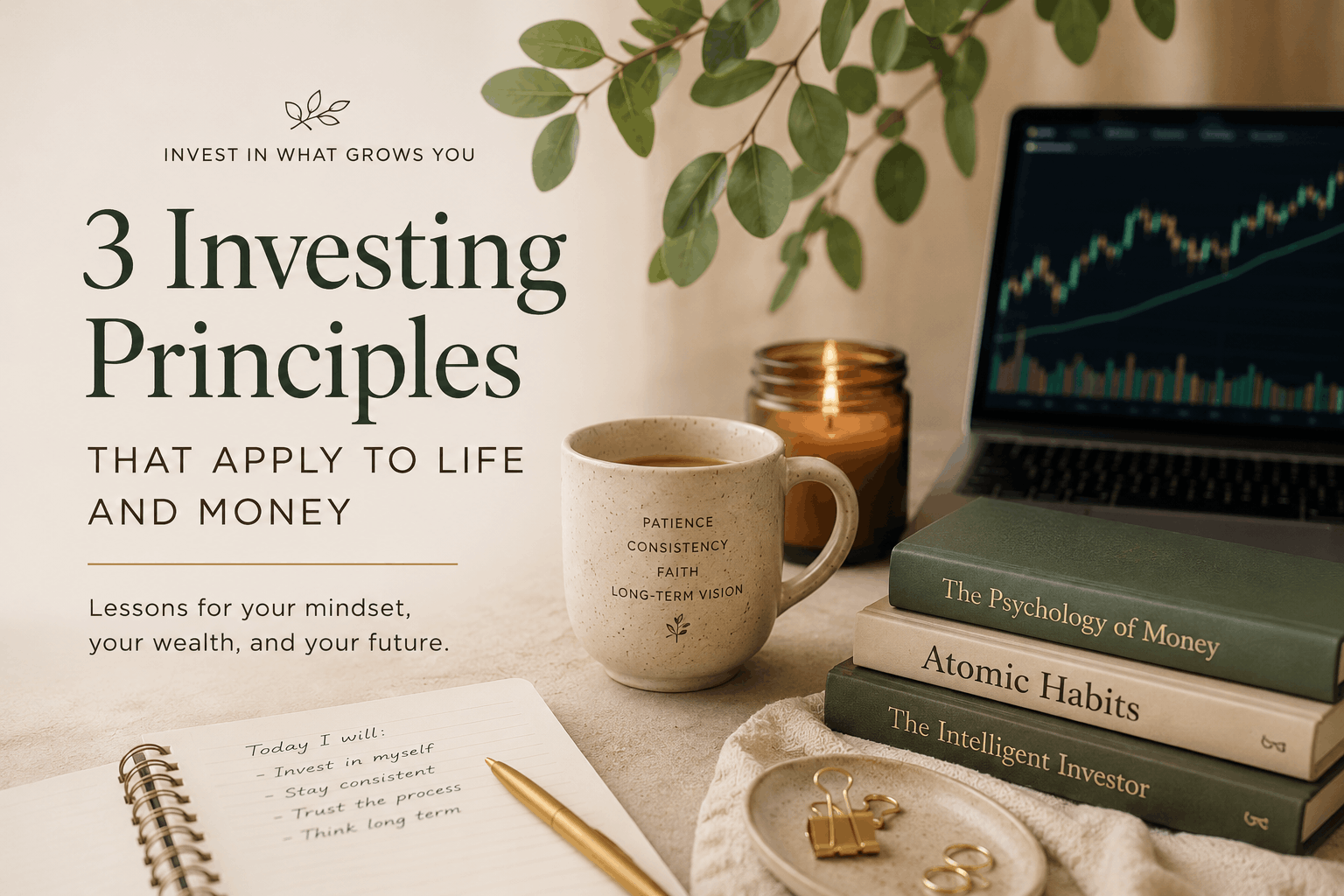
3 Investing Principles That Apply to Life and Money
The biggest thing I’ve learned about investing principles is that they apply to so much more than money. A healthy investing mindset teaches you patience, emotional resilience, consistency, and trust in long-term growth — not just in your portfolio, but in your healing, relationships, career, and personal evolution too. The more I’ve learned about investing, the more I’ve realized that building wealth and building yourself often require the exact same skills.
When people hear the word “investing,” they usually think about stocks, retirement accounts, or building wealth. But over the years, I’ve realized that investing principles apply to so much more than money.
The stock market has honestly become one of my greatest teachers for life itself.
It’s taught me about patience. Emotional regulation. Trust. Delayed gratification. Faith during uncertainty. And maybe most importantly — the importance of staying committed to long-term growth even when things don’t look perfect in the moment.
A healthy investing mindset isn’t just about making more money. It’s about learning how to stay grounded while building a life that actually feels aligned and sustainable.
Because the truth is, the way you approach money often mirrors the way you approach yourself.
If you panic every time the market dips, chances are you also panic when life feels uncertain. If you constantly chase “quick wins” financially, you might also struggle to trust slow growth in your healing, relationships, or career.
And I say that with love because I’ve lived it too.
The more I’ve learned about investing principles, the more I’ve realized they’re really lessons in emotional resilience, self-trust, and long-term vision.
So today, I want to share the three biggest investing principles that completely changed how I approach both money and life — and how they can support your investing mindset too.
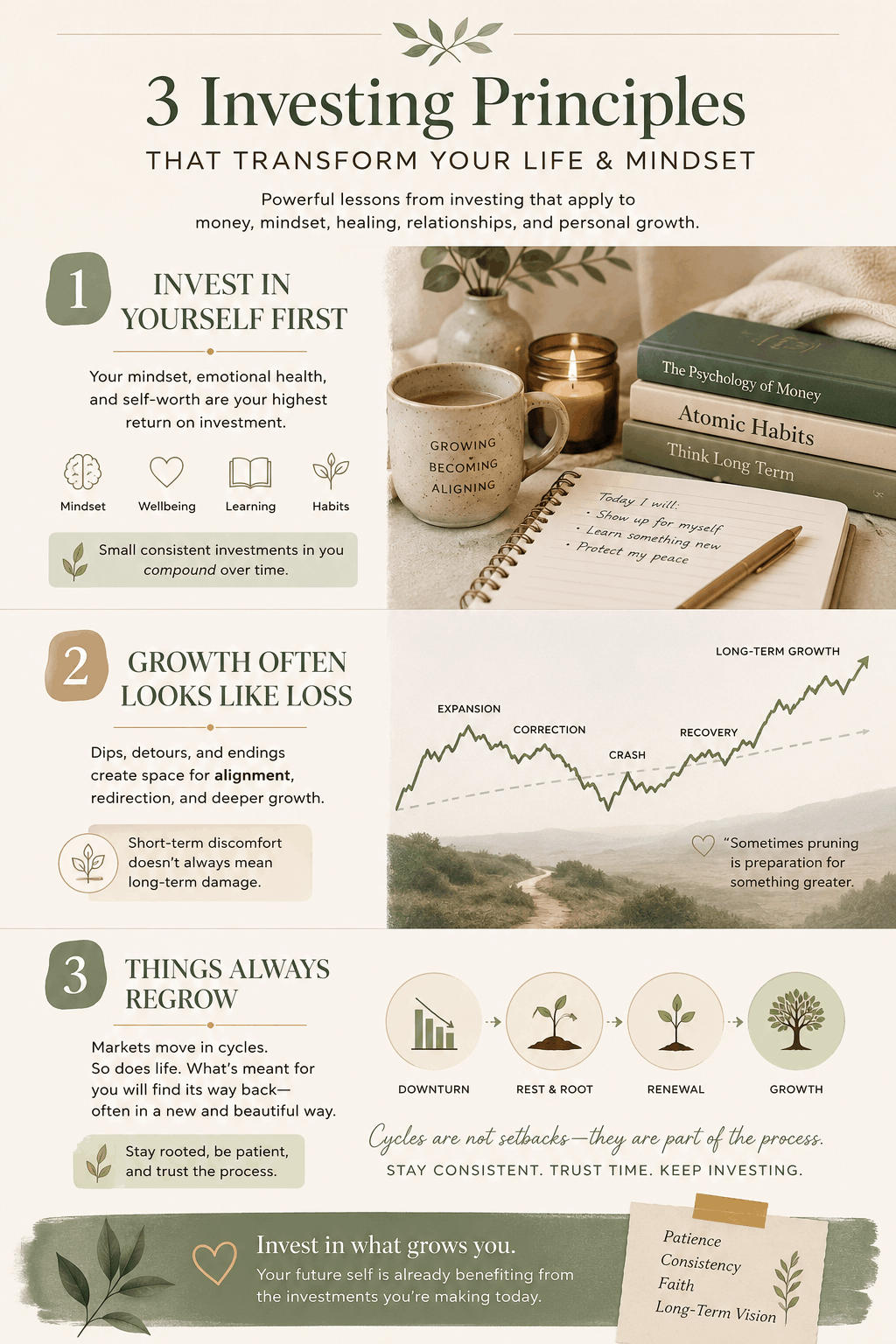
Investing Principles That Can Transform Your Life and Money Mindset
If there’s one thing investing has taught me, it’s that the stock market is one of the greatest metaphors for life. The ups, the downs, the uncertainty, the patience, the long-term growth — it’s all there. It’s so interesting to see the parallels between investing in money and investing in yourself, your health, your relationships, and your purpose.
Most people think investing is only about money. But when you really sit with it, investing is simply planting seeds today so you can experience growth tomorrow. It’s choosing to nurture something consistently, even before you see visible results.
And honestly? That’s what healing is too.
That’s what building confidence is.
That’s what creating financial security is.
That’s what becoming the version of yourself you dream about is.
None of it happens overnight.
One of the biggest mindset shifts I had to learn in my own financial journey was understanding that sustainable wealth is usually built slowly, quietly, and consistently — not through constant urgency or chasing fast results.
Behavioral finance research actually supports this. Studies have shown that emotional decision-making is one of the biggest reasons investors underperform over time. People often panic during uncertainty, abandon long-term strategies too early, or make impulsive decisions based on fear instead of vision.
And honestly, life works the same way.
The moments where we want to quit are often the moments where growth is happening underneath the surface.

1. Invest in Yourself First
If you want the highest return on investment, start with yourself.
Most people think investing principles are only about external assets — stocks, ETFs, crypto, real estate. But the strongest foundation for long-term wealth is actually internal.
Your mindset.
Your nervous system.
Your emotional health.
Your self-worth.
Because without those things, even the best financial strategy can feel impossible to sustain.
When I look at where I am now — building a purpose-driven business, creating financial freedom, feeling more grounded in myself — it all started with inner work first.
Not perfection.
Not having everything figured out.
Not becoming some hyper-productive version of myself.
Just slowly learning how to feel safe enough to grow.
That meant rewiring old beliefs around scarcity, healing my relationship with money, learning emotional regulation, and creating habits that supported the future I wanted instead of the fears I was carrying.
Because here’s the thing nobody talks about enough: your investing mindset impacts your financial decisions more than almost anything else.
If you deeply believe you’ll always struggle financially, you’ll unconsciously make choices that reinforce that belief.
If you believe wealth is unsafe, you may sabotage opportunities without realizing it.
If you’re constantly operating from fear, urgency, or comparison, it becomes incredibly difficult to build wealth sustainably.
Research from the American Psychological Association has shown that chronic financial stress can significantly impact decision-making, emotional regulation, and long-term planning. Which honestly makes so much sense. When your nervous system is overwhelmed, it’s hard to think long-term.
That’s why investing in yourself matters so deeply.
And when I say “invest in yourself,” I don’t mean buying expensive courses or constantly trying to optimize yourself into exhaustion.
I mean the small things that reconnect you to yourself again:
journaling
therapy
meditation
movement
rest
community
setting boundaries
spending time offline
learning financial literacy
creating routines that support your peace
Those things compound over time too.
That’s one of the most powerful investing principles I’ve learned: consistency matters more than intensity.
In investing, wealth grows through compounding. Small contributions made consistently over time eventually create exponential growth.
Your healing works the same way.
Every small decision to choose yourself becomes emotional compound interest.
Every boundary.
Every difficult conversation.
Every time you rest instead of abandoning yourself for productivity.
Every time you choose long-term peace over short-term validation.
It all adds up.
And eventually, one day, you look around and realize your life feels completely different because of the tiny investments you kept making along the way.
If this is something you’re currently working through, I dive deeper into this idea in How to Heal Your Relationship With Money and Financial Anxiety: How to Stop Money Stress From Controlling Your Life.
✨ Gentle Reminder
Growth doesn’t always look productive while it’s happening.
Sometimes the most important investments you’ll ever make are the quiet ones — resting, healing, setting boundaries, learning patience, or simply continuing to show up for yourself during uncertain seasons. Not all growth is visible immediately, but that doesn’t mean nothing is changing beneath the surface.
2. Growth Often Looks Like Loss
If you’ve ever looked at a long-term stock market chart, you know growth is never linear.
There are dips.
Corrections.
Crashes.
Periods where nothing seems to move.
And somehow, despite all of that, the market historically continues trending upward over time.
Life feels exactly the same sometimes.
There are seasons where everything feels expansive and aligned — and then there are seasons where things seem to fall apart all at once.
You lose relationships.
Outgrow friendships.
Leave jobs.
Move cities.
Release identities.
Question everything.
And in those moments, it’s incredibly easy to interpret loss as failure.
I’ve had seasons in my own life where letting go felt unbearable at first. There were moments where I clung tightly to people, opportunities, or old versions of myself simply because they felt familiar. Even when I knew deep down they no longer aligned.
But one thing investing principles have taught me is this:
Short-term discomfort doesn’t always mean long-term damage.
Sometimes the “dip” is actually redirection.
Sometimes growth requires pruning first.
Psychologists often talk about something called “loss aversion,” which is our tendency to fear losing something more than we value gaining something new. It’s one of the reasons investing emotionally can become so difficult during market volatility.
But this also explains why we stay attached to things that no longer serve us.
We stay because uncertainty feels scarier than familiarity.
And yet, almost every major period of growth in my life required me to release something first.
A version of myself.
A relationship.
A belief.
A coping mechanism.
A comfort zone.
When you zoom out, you eventually realize that many of the things you mourned were actually creating space for what was meant for you next.
That’s why cultivating a healthy investing mindset matters so much in life too.
You cannot abandon your vision every time things feel uncertain.
The same way long-term investors don’t panic sell during every market dip, you can’t give up on your healing, your goals, or your future self every time discomfort shows up.
Sometimes resilience looks like staying committed to yourself through uncertainty.
Sometimes faith looks like continuing anyway.
And honestly, some of the most beautiful chapters of my life came after periods that initially felt like loss.

3. Things Always Regrow
One of the most comforting investing principles is understanding that markets move in cycles.
Crashes happen.
Recoveries happen.
Expansion happens.
Correction happens.
Nothing stays stagnant forever.
And honestly, this perspective has helped me emotionally survive some really difficult seasons of life.
There have absolutely been moments where I wanted to give up on things I cared deeply about. Times where fear completely consumed me. Times where uncertainty felt louder than hope.
But every single time I stayed rooted long enough, something eventually regrew.
Not always in the same form.
Not always in the timeline I expected.
But growth always returned.
That’s the thing about healing and wealth-building that people don’t talk about enough: sometimes growth is incredibly quiet.
Sometimes it looks like resting.
Sometimes it looks like grieving.
Sometimes it looks like slowing down long enough to reconnect with yourself.
We live in a culture that glorifies constant hustle and immediate results, which is probably one of the reasons so many people struggle emotionally with investing. Long-term investing requires patience in a world addicted to immediacy.
But sustainable wealth rarely comes from urgency.
And sustainable healing doesn’t either.
One of the biggest shifts in my investing mindset happened when I stopped needing immediate proof that everything was working.
I started trusting the process more.
Trusting consistency more.
Trusting timing more.
And honestly, that trust changed everything.
Because if you quit every time things feel uncertain, you never stay long enough to experience the rebound.
Of course, discernment matters too.
In investing, there are absolutely times to walk away from something that no longer aligns with your long-term goals. And life is no different.
Some relationships are lessons.
Some jobs are temporary chapters.
Some identities are meant to evolve.
But there’s a difference between leaving from fear and leaving from alignment.
Fear says:
“I’m uncomfortable, so I should run.”
Alignment says:
“This no longer supports who I’m becoming.”
That distinction matters deeply.
And when you do outgrow something, I think it’s important to leave with peace instead of resentment. Because resentment keeps you emotionally tethered to the past, while peace creates room for new growth.
Invest in What Grows You
The more I learn about investing principles, the more I realize investing isn’t really just about money.
It’s about alignment.
It’s about learning where your energy belongs.
What deserves your time.
What deserves your attention.
What deserves your faith.
Because you can technically invest in a thousand different things — financially and emotionally — but if those things don’t align with your values, they eventually drain you instead of nourish you.
That’s why I believe so deeply in intentional wealth-building.
Not performative hustle.
Not burnout culture.
Not chasing status.
But building wealth in a way that actually supports your wellbeing, relationships, peace, and future.
Because true wealth isn’t just about having more money.
It’s about having more freedom.
More peace.
More capacity.
More alignment.
More time for the life you actually want to live.
And honestly, cultivating a healthy investing mindset changes everything because it teaches you patience with yourself too.
It reminds you that growth takes time.
That setbacks aren’t failure.
That consistency matters.
That fear doesn’t always mean stop.
And that long-term vision matters more than temporary emotion.
So if you’re in a season where things feel uncertain right now, I hope this reminds you that not all growth is visible immediately.
Some investments take time before they bloom.
But that doesn’t mean nothing is happening.
Keep planting seeds anyway.
Your future self is already benefiting from the investments you’re making today.
Further Reading
Continue Exploring Investing Principles & Mindset
If you're working on building wealth, healing your relationship with money, or developing a healthier investing mindset, these posts may support you further.
Free Resource To Share
If you’re currently working on building a healthier investing mindset and creating long-term wealth in a more aligned way, I’d really recommend starting with the Ethical Investor Starter Kit.
It’s a gentle beginner-friendly resource designed to help you build confidence with investing while staying connected to your values and long-term vision.
Product Recommendation
One book I genuinely think supports both emotional growth and financial mindset work is The Psychology of Money.
It’s less about technical investing strategies and more about the emotional side of wealth-building — patience, behavior, decision-making, and long-term thinking. It honestly changed the way I view investing principles and helped me approach money with a lot more calm and perspective.
FAQs
What are investing principles?
Investing principles are the foundational beliefs and strategies that guide long-term investing decisions. They often include consistency, patience, diversification, emotional discipline, and long-term thinking.
Why is investing mindset important?
Your investing mindset affects how you respond to uncertainty, risk, and financial growth. A healthy investing mindset helps you make grounded long-term decisions instead of reacting emotionally to short-term fear or pressure.
How do investing principles apply to life?
Many investing principles mirror personal growth. Patience, consistency, emotional resilience, and trusting long-term growth are just as important in healing, relationships, and career development as they are in investing.
What is the most important investing principle for beginners?
One of the most important investing principles for beginners is consistency. Small investments made regularly over time often outperform emotional or impulsive investing decisions.
Can mindset affect financial success?
Yes. Research in behavioral finance consistently shows that emotions and mindset significantly impact financial decisions. Fear, scarcity, and impulsive thinking can lead to poor money habits, while grounded decision-making supports long-term wealth-building.
How can I improve my investing mindset?
You can improve your investing mindset by learning financial literacy, regulating emotional spending habits, focusing on long-term goals, and building healthier beliefs around money and self-worth.
〰️ RESOURCES AND NEXT STEPS
1. Watch the full video in this post to deepen the practice or listen to the raw, unedited podcast.
2. Want support? Schedule a clarity call to map your next step. [Schedule Here]
〰️ WORK WITH ME
Check out my coaching services here.
〰️ CONTACT ME
✉️ hello@morganblackman.com
